

On This Day in Business: March 31, 1889
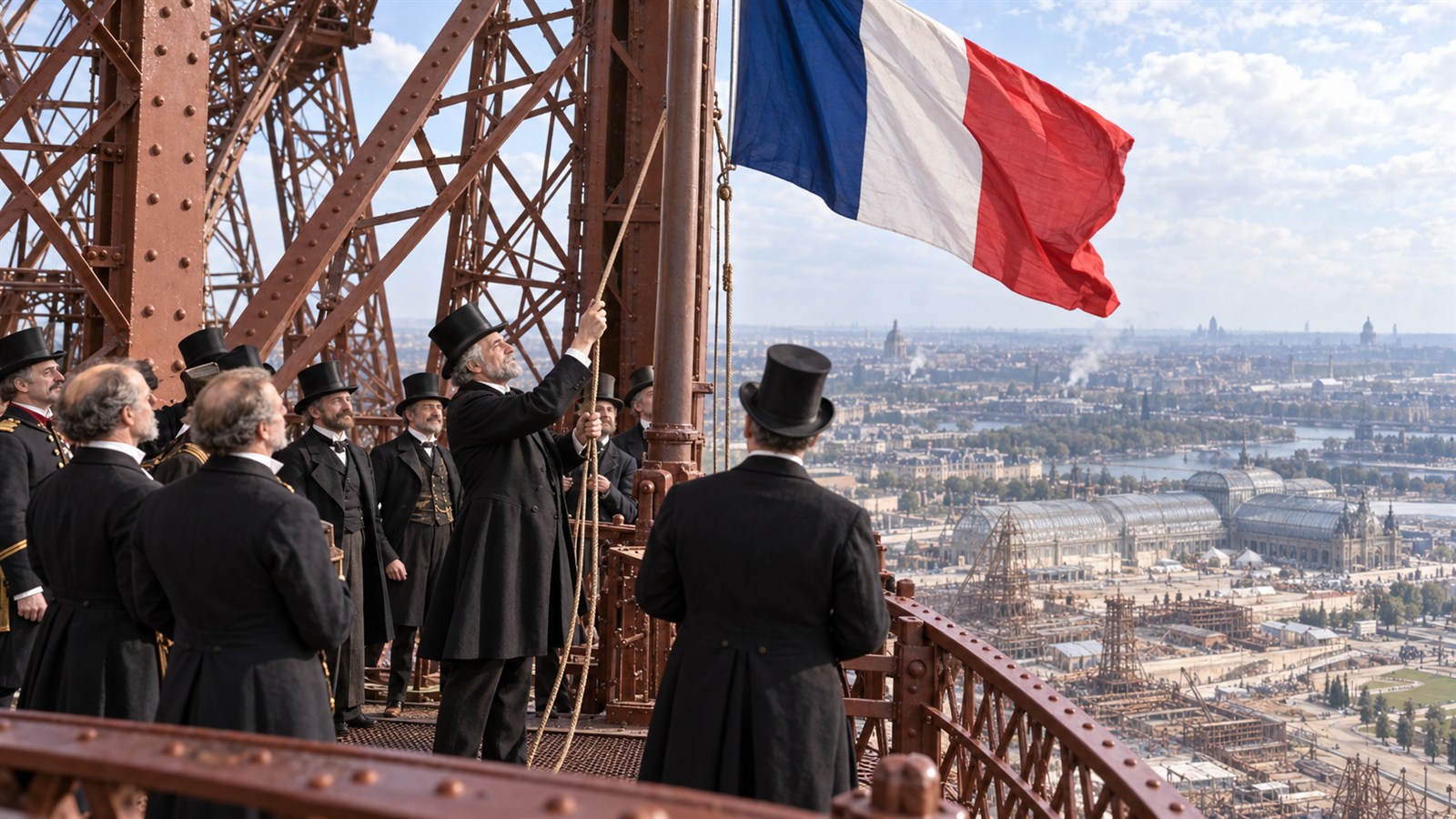
On March 31, 1889, Gustave Eiffel inaugurated the tower built by his company on the Champ de Mars in Paris. After climbing the structure with officials and guests, he raised the French flag at the summit. Construction had taken two years, two months, and five days, although interior work and elevators were not yet finished. Designed as the monumental entrance and star attraction for the coming Exposition Universelle, the 300-meter iron structure was then the tallest human-made building in the world.
The project was an extraordinary exercise in industrial coordination. Engineers produced thousands of detailed drawings, Eiffel's factory prefabricated more than eighteen thousand iron parts, and workers assembled them with roughly two and a half million rivets. Precise calculation allowed components made off-site to fit high above the ground. Financing combined public support with Eiffel's own investment and a concession to operate the attraction. Construction efficiency therefore supported a commercial model based on admission revenue and the fair's enormous audience.
The tower faced strong opposition before completion. Prominent artists and writers called it ugly and feared it would overwhelm historic Paris. Eiffel and his team had to manage technical risk, political scrutiny, labor, deadlines, and public reputation at once. When the fair opened, visitors climbed the structure in huge numbers, and nearly two million people came during the exposition. The tower's usefulness for scientific experiments and later radio communications helped it survive beyond the period originally expected for the concession.
The inauguration shows how ambitious infrastructure can become a brand, platform, and enduring asset. The tower advertised French engineering, drew paying visitors, supplied a site for experiments, and created an image reproduced across global media and merchandise. None of that value was guaranteed while riveters worked in wind above Paris. It emerged from technical credibility, distinctive design, visibility, and repeated adaptation after the fair. March 31, 1889, marks the completion of a risky temporary attraction that became permanent because its symbolic and practical uses kept generating reasons to preserve it. Eiffel's concession also aligned risk with potential reward. By investing personally in the structure in exchange for operating rights, he accepted exposure that a fee-only contractor would avoid, but retained upside if visitors came. The model rewarded completion and public appeal, not merely construction activity. At the same time, public authorities shaped the opportunity through land, permissions, and the exhibition. The tower's success emerged from this negotiated partnership between engineering enterprise and civic spectacle, with benefits neither side could have produced alone.
The 1889 Paris World's Fair called for a dramatic monument, and Eiffel's company proposed an unprecedented 300-meter iron tower.
Detailed engineering, factory prefabrication, careful foundations, cranes, and coordinated rivet teams made the rapid assembly possible.
Eiffel inaugurated the structure on March 31, 1889, raising a flag at the summit while interior fittings and elevators remained unfinished.
The project had faced artistic protest, financial exposure, political attention, safety challenges, and an immovable exposition deadline.
Mass visitation, scientific experiments, broadcasting uses, and a powerful visual identity helped the tower outlive its original concession period.
Its history shows how precise execution and adaptability can turn a controversial project into durable economic and cultural infrastructure.
Explore more of "On This Day ..."
Discover more events from the same date across news, politics, technology, sports, and other fields. Each link highlights significant moments that shaped history on different fronts.