

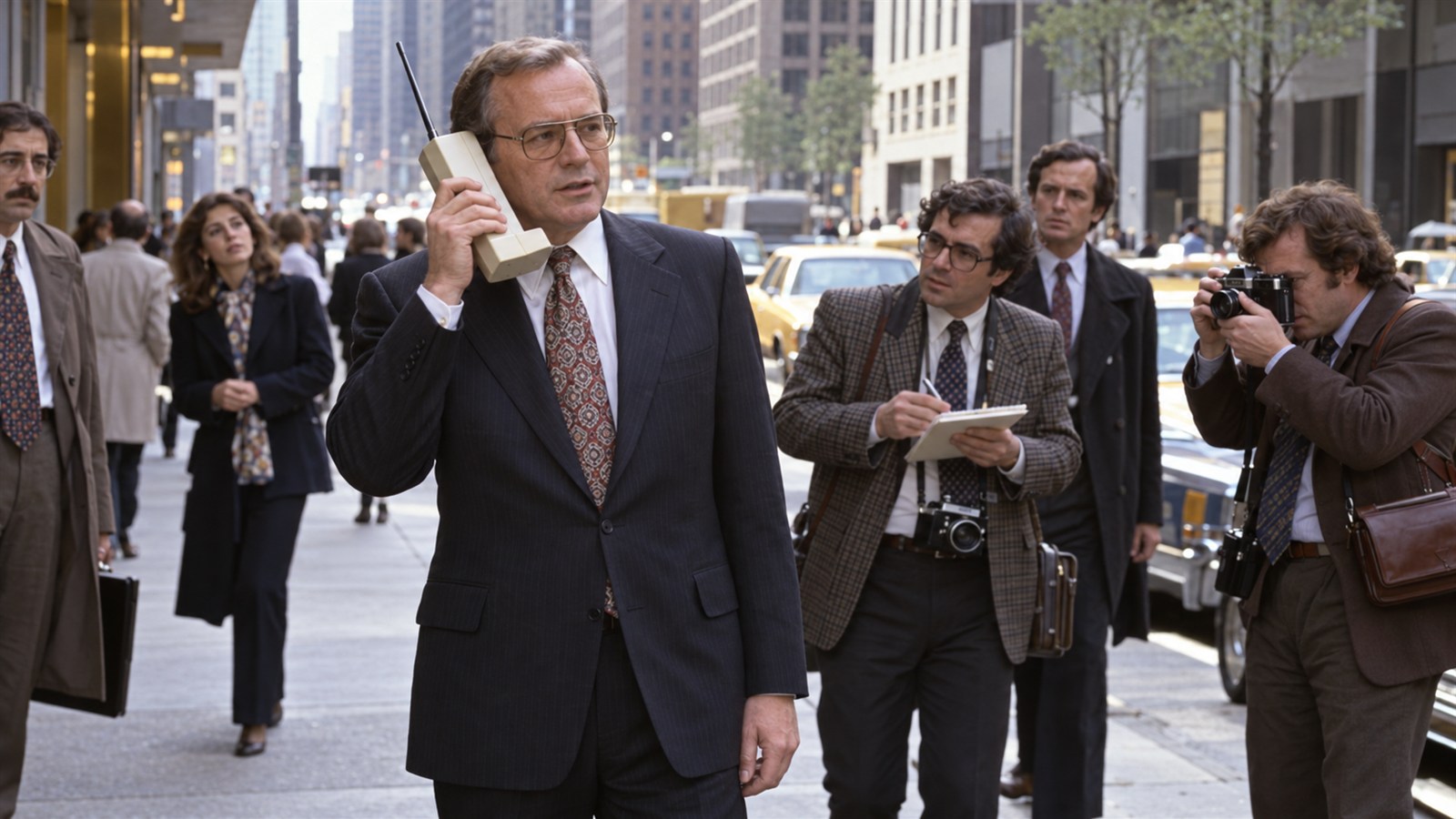
On This Day in Business: April 3, 1973
On April 3, 1973, Motorola engineer Martin Cooper stood on a Manhattan sidewalk and placed a public call from a handheld cellular telephone prototype. He called Joel Engel at Bell Labs, a rival in the race to shape mobile communications. The bulky device, an ancestor of the DynaTAC, weighed more than two pounds and offered only a short conversation before its battery needed hours of charging. Yet the demonstration made a strategic point: a cellular network could serve people carrying personal devices, not only telephones installed in automobiles. A working call transformed an engineering proposal into something journalists and policymakers could immediately understand.
Motorola and AT&T approached the emerging market from different positions. Bell Labs had developed important cellular concepts and AT&T operated the national telephone system, while Motorola was strong in two-way radios and portable equipment. Spectrum allocation and Federal Communications Commission decisions would influence who could compete and what kind of system would be built. Cooper's team accelerated its prototype so Motorola could argue that the future should include truly portable handsets. The call therefore functioned as both a technical milestone and corporate advocacy, placing a tangible product vision into a regulatory debate with enormous commercial consequences.
A decade passed before Motorola's first commercial handheld cellular phone reached consumers. The device was expensive, networks were limited, and manufacturing reliable radios, batteries, antennas, and switching systems at scale required sustained investment. Prices eventually fell as networks expanded, components improved, and competing manufacturers entered. Mobile telephony then separated communication from fixed places. Salespeople, emergency workers, executives, families, and small businesses could coordinate while moving. Later digital standards added text, data, cameras, and software, turning the handset into a platform for services that the 1973 prototype could not have supported.
The first handheld call illustrates the business value of a demonstration. Specifications may remain abstract, but a visible prototype can reshape expectations, attract partners, and influence rules before a market exists. It also shows that invention and adoption run on different clocks. Motorola proved a possibility in minutes, yet commercialization required years of infrastructure, approvals, capital, and operational learning. Today's mobile economy rests on that combination of device and network. Neither side creates much value alone; the handset becomes useful as coverage and services grow, while the network becomes valuable as more people carry compatible devices. The business model eventually shifted from selling voice minutes to supporting a portable computing platform. That evolution depended on standards allowing devices from many makers to reach the same network. Operators, manufacturers, and application developers sometimes competed and sometimes depended on one another. The 1973 prototype contained none of those later services, but it placed personal mobility at the center of the system, the decision that made them possible.
Cellular engineering promised more capacity than conventional mobile radio by reusing frequencies across a network of geographic cells.
Motorola wanted regulators and the public to see that cellular service could center on a person carrying a handset rather than a car.
Cooper's April 3 call from New York used a heavy prototype developed rapidly by a small Motorola engineering team.
The demonstration did not create an immediate consumer market because spectrum decisions, networks, battery limits, and cost still constrained adoption.
Commercial handheld phones arrived years later, then became cheaper and more useful as digital networks and component industries scaled.
The event shows how a prototype can influence standards and investment by making a future business model visible before it is economical.
Explore more of "On This Day ..."
Discover more events from the same date across news, politics, technology, sports, and other fields. Each link highlights significant moments that shaped history on different fronts.