

On This Day in Business: May 2, 1952
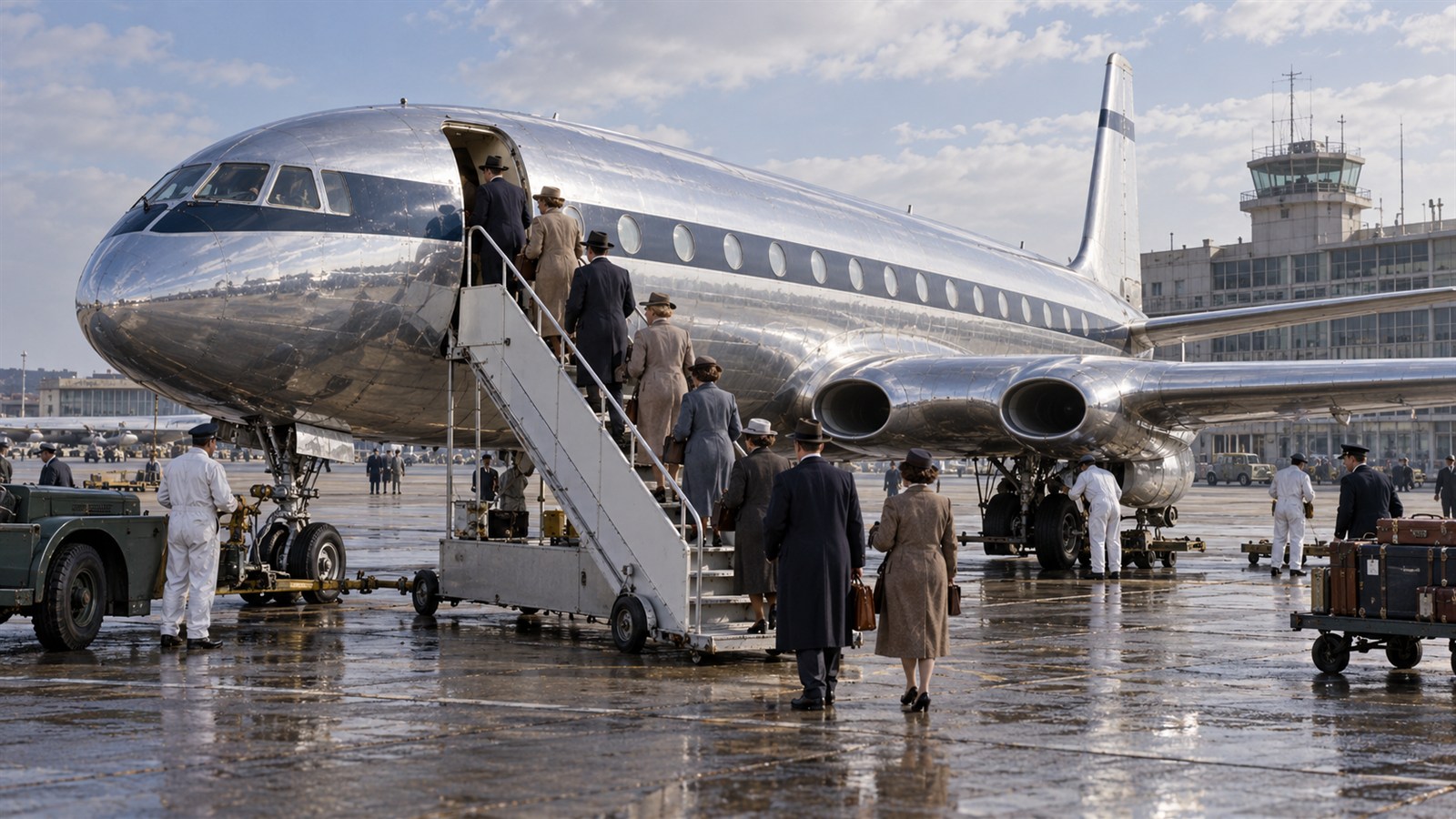
On May 2, 1952, a British Overseas Airways Corporation de Havilland Comet departed London for Johannesburg, inaugurating the world’s first scheduled commercial jet-airliner service. The sleek four-engine aircraft carried fare-paying passengers across several stops and dramatically shortened a route previously flown by propeller aircraft. Its pressurized cabin, high cruising altitude, and quiet ride presented jet travel as a premium modern experience. For BOAC and manufacturer de Havilland, the service was more than a technological demonstration: it was a bid to establish British leadership in a postwar market where speed, comfort, and national prestige were becoming decisive commercial advantages.
The Comet concentrated new technology in a product that airlines had to operate reliably every day. Its engines were embedded in the wings, its fuselage was pressurized for high-altitude flight, and its systems required unfamiliar maintenance and training. BOAC developed schedules, crew procedures, passenger service, and ground support around an aircraft unlike anything in its existing fleet. The London-to-Johannesburg route advertised the aircraft’s long-distance promise while giving the airline multiple stations at which to refuel and support operations. Early passengers bought time as much as transportation, and the jet’s ability to compress journeys created room for higher fares and strong publicity.
Commercial success was interrupted by catastrophic structural failures in 1953 and 1954. Investigators eventually connected repeated pressurization cycles and stress concentrations around openings in the fuselage to metal fatigue. The Comet fleet was grounded, aircraft were tested in a water tank, and the design was extensively revised. Those failures cost lives and destroyed the model’s first-mover advantage, while Boeing and Douglas developed larger jetliners for a rapidly expanding market. The investigations nevertheless improved understanding of fatigue, testing, and airworthiness, shaping the safety practices on which later jet transport depended.
The first service matters because innovation entered the market before every risk was fully understood. De Havilland and BOAC proved that passengers wanted jet speed and that airlines could reorganize routes around it, but they also demonstrated the financial and human consequences of hidden engineering weakness. A breakthrough product creates obligations extending far beyond launch day: manufacturers must study how repeated use changes materials, operators must report anomalies, and regulators must translate evidence into standards. The Comet’s early lead did not become lasting dominance, yet its May 1952 flight established the commercial proposition that defined modern aviation—higher speed and altitude delivered through a tightly integrated aircraft, airline, airport, and safety system. The episode also changed certification practice. Full-scale fatigue testing, incident reporting, and design review became essential commercial safeguards because airlines and passengers could not inspect hidden structural stress themselves. Safety evidence had to travel with the product. In aviation, confidence is a network asset shared by manufacturers, carriers, regulators, crews, and airports.
Britain backed the Comet to convert wartime aeronautical expertise into leadership in civilian air transport.
BOAC built crew, maintenance, and station procedures around the unfamiliar requirements of high-altitude jet operations.
The May 2 London-to-Johannesburg service proved passengers would pay for a faster and smoother long-distance journey.
Fatal structural failures exposed metal-fatigue risks created by repeated cabin pressurization and concentrated stress.
Grounding and full-scale testing produced hard lessons that influenced later aircraft design and certification.
The Comet lost its first-mover advantage, but it established the business case for scheduled passenger jet travel.
Explore more of "On This Day ..."
Discover more events from the same date across news, politics, technology, sports, and other fields. Each link highlights significant moments that shaped history on different fronts.