

On This Day in Business: May 11, 1997
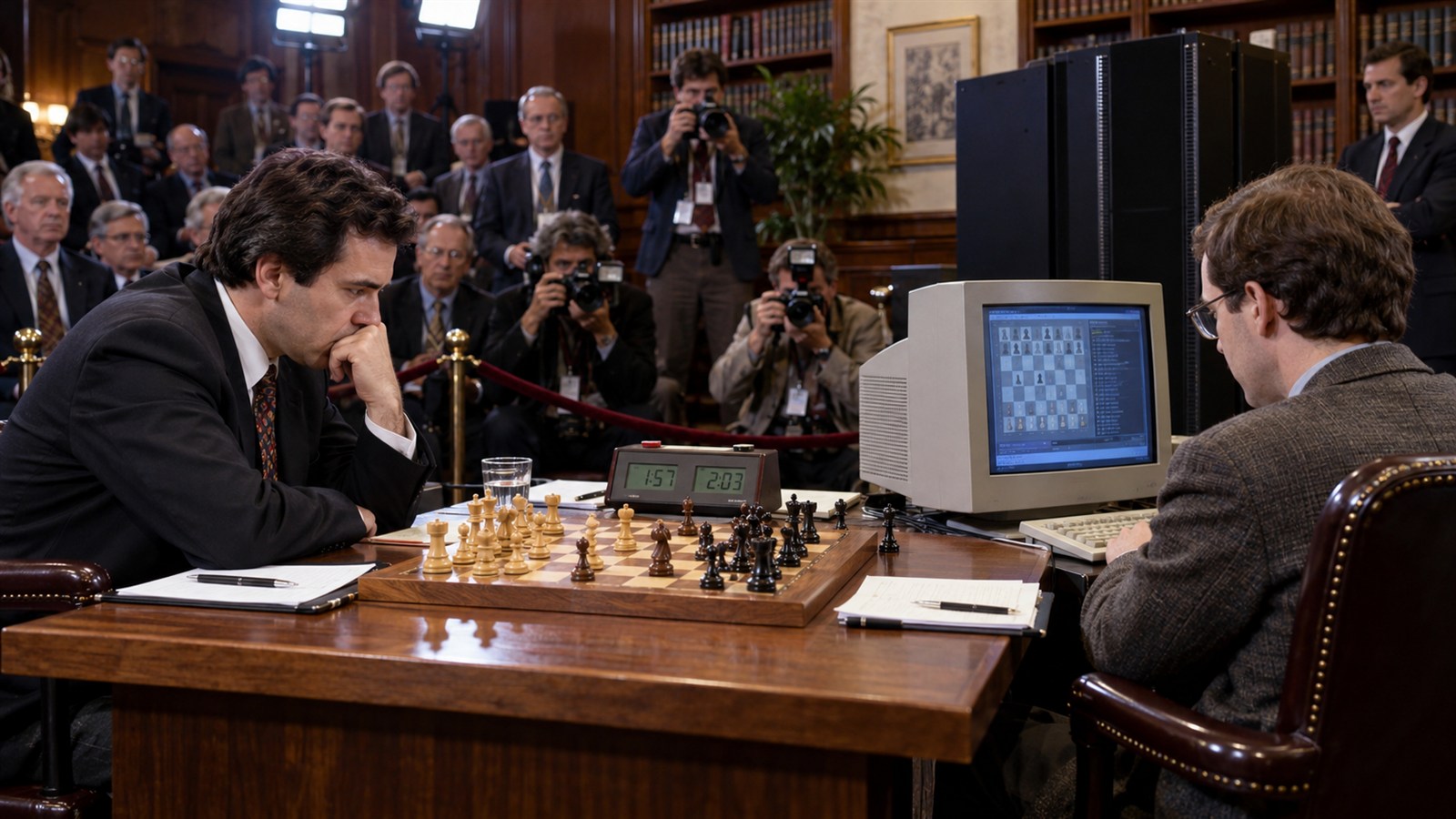
On May 11, 1997, IBM’s Deep Blue defeated world chess champion Garry Kasparov in the sixth and deciding game of their New York rematch. The victory gave the computer a 3½–2½ match win, the first time a reigning world champion had lost a match to a machine under standard tournament conditions. Deep Blue combined specialized chess hardware, powerful parallel computing, opening knowledge, and evaluation software developed by an IBM team. The match attracted global coverage because it turned an abstract question about machine intelligence into a visible contest with a clear scoreboard and one of the world’s most recognizable human champions.
IBM treated the event as both research and corporate theater. Deep Blue could examine roughly 200 million positions per second, but speed alone did not choose strong moves. Engineers and chess specialists refined evaluation rules, opening preparation, and methods for dividing work across processors. A human operator entered Kasparov’s moves and relayed the machine’s choices, while the system itself was housed away from the stage. The public match made otherwise inaccessible computing capability legible: viewers did not need to understand chip architecture to understand that the machine had won a chess game.
The result generated debate over what the victory meant. Deep Blue did not think like a human or possess general intelligence; it was an expensive system optimized for a narrow domain. Kasparov questioned aspects of the match and sought another contest, but IBM retired the machine. Even so, the event became a reference point for later advances in search, machine learning, and human-computer competition. It also supplied IBM with enormous publicity, associating the company with high-performance computing at a moment when the internet and data-intensive business were expanding.
The match matters because demonstrations can create commercial meaning around complex research. IBM selected a challenge with rules, drama, and an expert benchmark, then placed its technology in a public narrative about the future. That visibility brought reputational benefits beyond any direct sale of Deep Blue. The outcome also refined the business question. Machines need not reproduce every feature of human thought to create value; they can outperform people at defined tasks and become components in broader workflows. The durable opportunity lies in combining computation with human goals, judgment, and accountability. Deep Blue’s victory was less the end of human expertise than evidence that expertise would increasingly include knowing where powerful specialized systems belong. The event also exposed the marketing power of a benchmark. Chess supplied a respected expert, unambiguous rules, and millions of informed observers, so IBM could communicate progress without a technical lecture. Businesses launching complex systems still seek comparable demonstrations. The strongest ones measure a real capability while clearly acknowledging the boundaries beyond the test.
IBM assembled specialized hardware, parallel processing, chess software, and expert preparation into a system built for one domain.
A public rematch made enormous computing power understandable through the familiar rules and drama of chess.
Deep Blue won the deciding game on May 11, 1997, taking the six-game match from the reigning world champion.
The result delivered IBM worldwide publicity while prompting debate about the meaning and limits of machine intelligence.
Deep Blue was narrow and costly, but it showed that specialized computation could surpass elite human performance.
The broader market lesson was to match machines to well-defined tasks while retaining human responsibility for goals and use.
Explore more of "On This Day ..."
Discover more events from the same date across news, politics, technology, sports, and other fields. Each link highlights significant moments that shaped history on different fronts.