

On This Day in Business: June 1, 1980
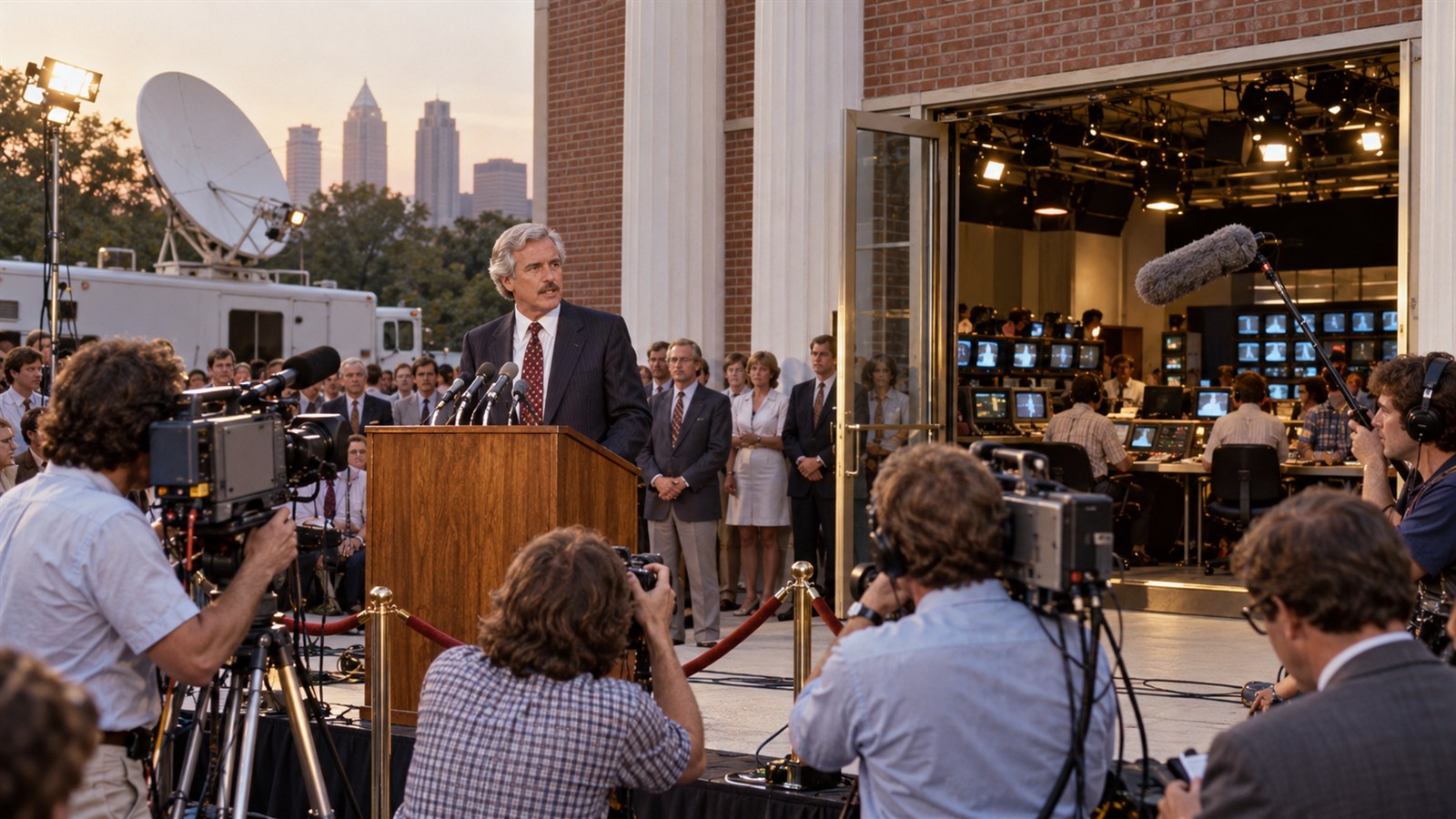
On June 1, 1980, the Cable News Network began broadcasting from Atlanta at 6 p.m. Eastern time. Ted Turner introduced the service as a permanent news operation rather than a program that appeared only in scheduled evening slots. CNN opened with an address from Turner and soon reported on the attempted assassination of civil rights leader Vernon Jordan. The audience was initially small, cable distribution remained incomplete, and the operation looked ambitious beside the established broadcast networks. Yet the launch created the first television network devoted to news around the clock and gave Turner Broadcasting a new national product built for the expanding cable system.
The commercial idea joined three assets that were becoming more valuable together: satellite distribution, local cable systems, and a continuously refreshed newsroom. ABC, CBS, and NBC could reach enormous audiences, but their flagship newscasts occupied limited time. CNN instead supplied affiliates and viewers with a live channel whenever events occurred. Maintaining that schedule required bureaus, producers, correspondents, anchors, technical crews, and a deep reserve of material during quiet hours. The model was expensive and lost money in its early years, but every additional cable household improved the potential return on the same national feed. Scale came from distribution rather than from adding a separate station in every city.
Continuous availability changed both the product and the competitive standard. Breaking events could be covered as they developed, while interviews, business updates, weather, and international reports filled a rolling schedule. CNN also needed agreements with cable operators, access to satellite capacity, and enough advertising demand to support a specialized audience. Turner kept investing in bureaus and in recognizable programming even when critics questioned whether viewers wanted so much news. The network's live coverage of major stories, especially the 1991 Gulf War, later demonstrated the value of an operation designed to remain on air when scheduled broadcasters had to rearrange their lineups.
CNN's launch matters because it turned time itself into a competitive advantage. A news organization no longer had to wait for an appointment with the audience; it could be present whenever attention surged. That promise also created a demanding cost structure, because a twenty-four-hour brand must be staffed, verified, and technically reliable at all times. Cable news eventually attracted rivals and fragmented into distinct editorial identities, but the underlying business lesson endured. New distribution technology can support a focused service that incumbents consider uneconomic, and persistence can convert an initially narrow audience into a category. CNN did not merely add another newscast. It reorganized television news around continuous access.
Ted Turner combined satellite distribution and the expanding cable system to offer television news at every hour of the day.
CNN signed on from Atlanta at 6 p.m. Eastern on June 1, 1980, with an address from Turner and a working newsroom.
A small initial audience and heavy staffing costs made the round-the-clock model financially difficult in its early years.
Cable carriage, advertising, recognizable programs, and a growing bureau network gradually strengthened the service's economics.
Live coverage of major breaking events proved that continuous availability could outperform fixed broadcast schedules.
The launch established a new media category in which speed, reach, and constant readiness became the product promise.
Explore more of "On This Day ..."
Discover more events from the same date across news, politics, technology, sports, and other fields. Each link highlights significant moments that shaped history on different fronts.