

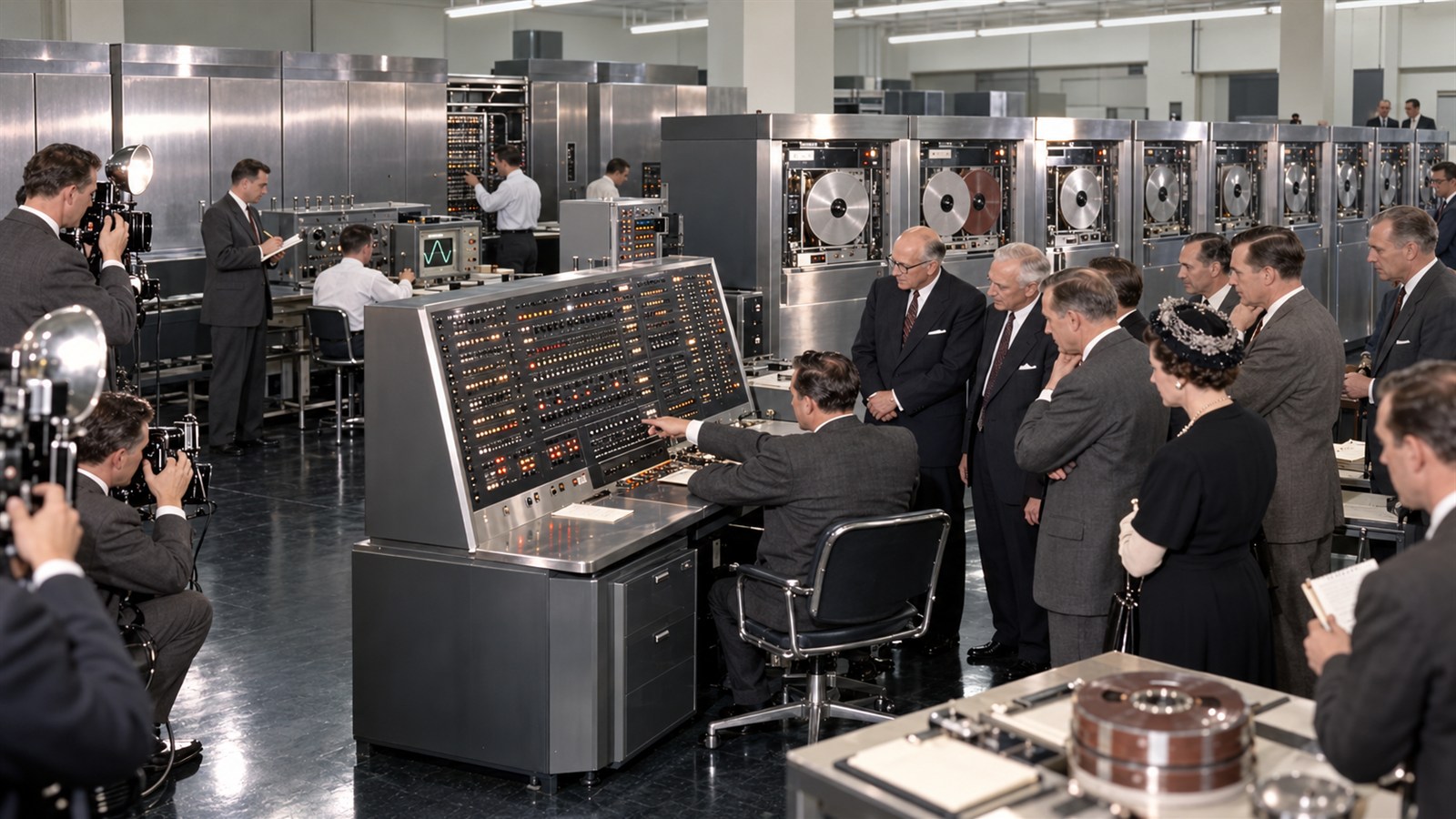
On This Day in Business: June 14, 1951
On June 14, 1951, officials formally dedicated UNIVAC I at the Eckert-Mauchly laboratory in Philadelphia. The U.S. Census Bureau had contracted for the system to handle large, repetitive calculations and data processing that mechanical tabulators performed slowly. Designed by J. Presper Eckert and John Mauchly and completed under Remington Rand, UNIVAC used thousands of vacuum tubes, mercury delay-line memory, and magnetic tape for input and storage. It occupied a room and demanded specialized operators, but it could process information at electronic speed. The ceremony introduced a machine intended not as a military experiment but as a practical tool for civilian administration.
The commercial breakthrough involved a complete operating system in the ordinary business sense. Customers needed tape preparation, procedures, trained staff, maintenance, reliable power, and methods for checking results. Magnetic tape could hold far more data than a deck of punched cards and move it quickly, but organizations had years of records and workflows built around older equipment. Adoption therefore required conversion as well as purchase. The Census Bureau used UNIVAC for population and economic work, while other government agencies and large companies began ordering systems for payroll, insurance, accounting, and scientific calculations.
Public attention grew when a UNIVAC system correctly projected the 1952 presidential election from a limited sample, although broadcasters initially hesitated to trust the unexpected result. The episode demonstrated the machine's analytical potential and the organizational difficulty of accepting computer output that challenged human expectations. Remington Rand sold dozens of UNIVAC I systems, creating a market for hardware, programmers, operators, service, and data media. The expense kept early computing concentrated in large institutions, yet the economic logic was clear: one programmable machine could handle many recurring information tasks by changing instructions and data rather than rebuilding mechanical equipment.
The dedication matters because computing entered business as a service system, not simply as an impressive box. Speed created value only when data was prepared accurately, employees understood the process, and managers were willing to act on results. Those implementation costs remain familiar in modern software and artificial intelligence projects. Organizations can acquire technology faster than they can redesign decisions around it. UNIVAC's success depended on combining engineering with training, maintenance, workflow conversion, and credible demonstrations. The machine helped establish information processing as a distinct organizational capability—one that could improve government administration and corporate operations long before computers became small enough to sit on every desk. Procurement changed as well. Buying a computer meant committing to a vendor relationship for media, repairs, upgrades, and operating knowledge. Early customers were not acquiring a replaceable office appliance; they were choosing a technical ecosystem. That dependence increased the importance of supplier credibility and long-term support.
UNIVAC I was dedicated in Philadelphia as a civilian data-processing system built for the U.S. Census Bureau.
Vacuum tubes, mercury memory, and magnetic tape delivered electronic speed but required a room of equipment and trained operators.
Customers had to convert records, design procedures, prepare tape, verify results, and maintain the system around the clock.
Government, insurance, payroll, accounting, and scientific applications showed the value of one programmable general-purpose machine.
The 1952 election projection gave the public a memorable demonstration while exposing hesitation to trust unexpected computer output.
UNIVAC established that digital investment succeeds when hardware is joined to data quality, workflow change, service, and managerial confidence.
Explore more of "On This Day ..."
Discover more events from the same date across news, politics, technology, sports, and other fields. Each link highlights significant moments that shaped history on different fronts.