

On This Day in Business: June 27, 1967
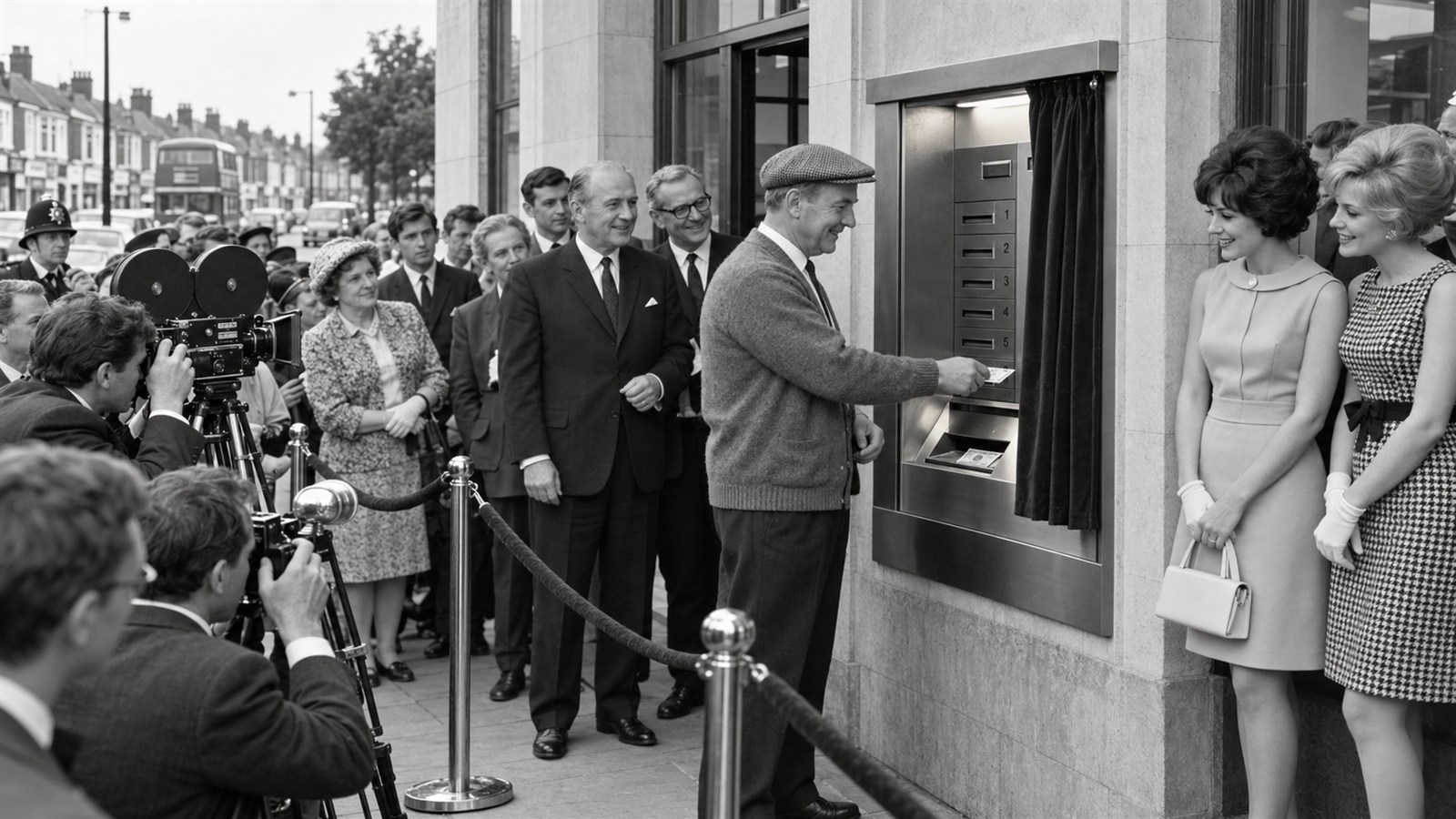
On June 27, 1967, Barclays unveiled a cash-dispensing machine at its Enfield branch in north London. Actor Reg Varney made the ceremonial first withdrawal, drawing public attention to a device designed by a team led by John Shepherd-Barron at De La Rue. The machine accepted special paper vouchers encoded for verification and dispensed a £10 note. It did not yet offer the full account access of a modern automated teller machine, but it solved a familiar problem: customers could obtain cash when the bank counter was closed. A service once limited by branch hours began moving into self-service operation.
The commercial innovation rearranged cost, convenience, and trust. Banks could extend availability without staffing a teller window around the clock, while customers gained control over the timing of a routine transaction. The first system still required customers to obtain vouchers in advance and relied on security methods different from later plastic cards and networked account databases. Placement in the exterior wall made reliability and physical protection essential. A malfunction did not merely interrupt machinery; it could trap money, expose security weaknesses, and damage confidence in the bank.
Competing inventors and banks developed card, personal identification number, online authorization, deposit, and multi-account capabilities. Networks eventually allowed customers to use machines far from their own branch, creating interchange fees and shared infrastructure. ATMs changed branch design and the role of staff by automating high-volume cash transactions. They also created new expenses in cash replenishment, maintenance, telecommunications, fraud prevention, accessibility, and site security. The machine lowered the cost of some service interactions while establishing an entirely new operating network that banks had to manage continuously.
The opening matters because self-service succeeds when a customer receives more control without feeling that responsibility has simply been abandoned. Barclays offered a clear benefit—cash after hours—and used a familiar public figure to make the machine less intimidating. Later adoption depended on standards, dependable networks, simple interfaces, and visible security. Digital banking follows the same pattern: automation can improve convenience and reduce routine work, but failures become more personal when no employee is present to intervene. The first cash dispenser turned a wall into a service channel and showed that trust could extend from a human teller to a carefully designed system. Location strategy became a new discipline. A machine had to be visible, accessible, supplied with cash, connected to the network, and protected from attack. Those requirements made physical deployment part of banking strategy, much as application availability and uptime later became part of digital-channel strategy.
Barclays installed the first public cash dispenser at its Enfield branch and invited actor Reg Varney to make the first withdrawal.
The machine accepted special encoded vouchers and dispensed a fixed £10 amount outside normal bank-counter hours.
Self-service extended availability and reduced the need to staff every routine transaction, but introduced new security and reliability risks.
Cards, personal identification numbers, online authorization, deposits, and shared networks later expanded the original concept.
Banks automated cash handling while assuming continuing costs for replenishment, maintenance, fraud control, telecommunications, and accessibility.
The cash machine shows that automation earns trust when it gives customers useful control through a dependable and understandable interface.
Explore more of "On This Day ..."
Discover more events from the same date across news, politics, technology, sports, and other fields. Each link highlights significant moments that shaped history on different fronts.