

On This Day in Business: July 3, 1886
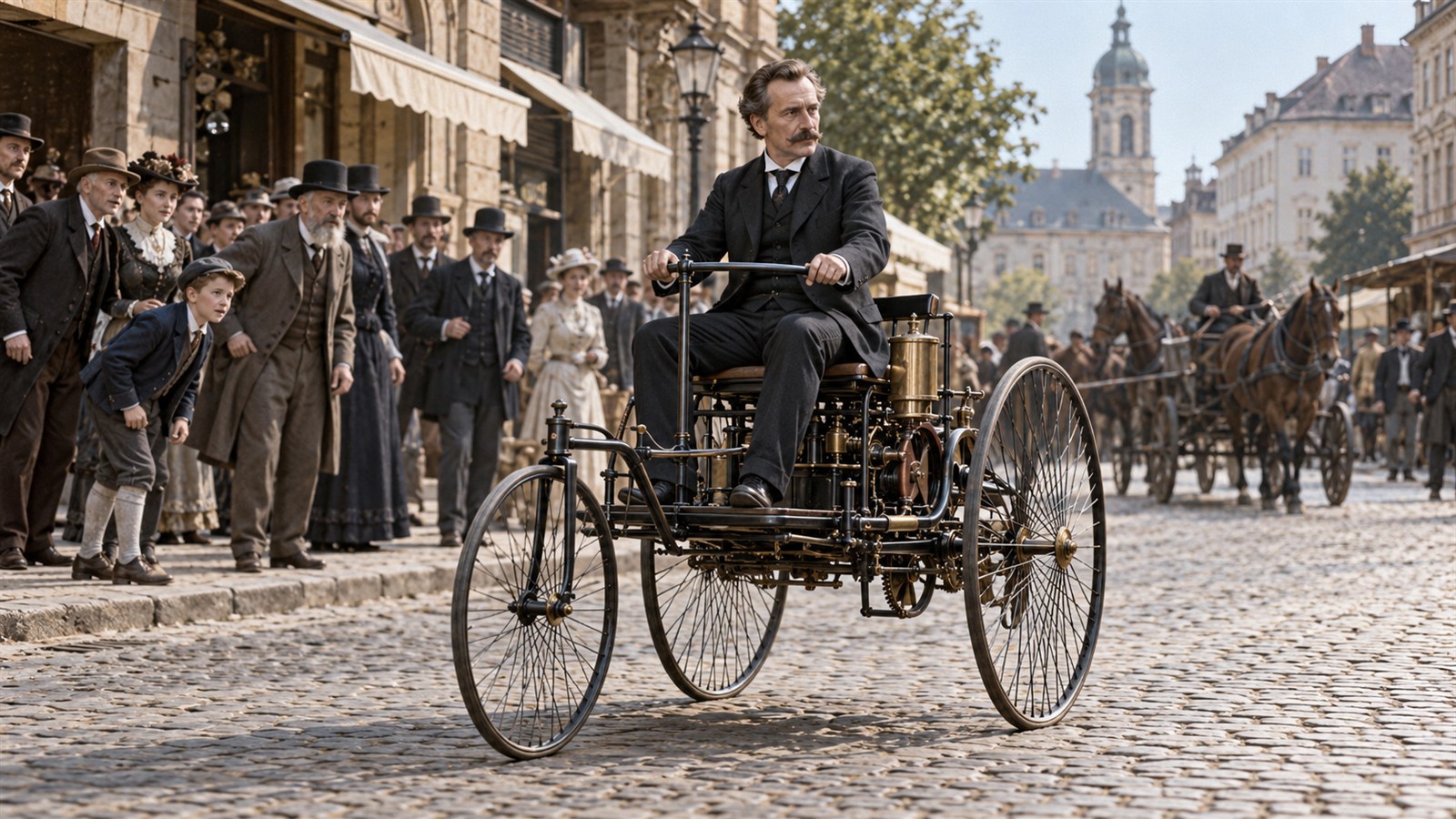
On July 3, 1886, Mannheim's newspaper reported a public outing by Karl Benz's newly patented motor vehicle, one of the earliest appearances of a purpose-built gasoline automobile before a general audience. Benz had filed for his German patent in January and constructed a three-wheeled carriage around a compact four-stroke engine. The machine used a tubular steel frame, wire-spoked wheels, a single front wheel for steering, and chain drive to the rear axle. Unlike experiments that installed engines in existing carriages, Benz designed the vehicle as a complete system in which engine, chassis, controls, and weight had to work together.
Public operation converted a patent drawing into evidence. The vehicle could move without rails, draft animals, or a fixed steam plant, yet it was noisy, unfamiliar, and mechanically delicate. Benz needed to improve ignition, cooling, gearing, and steering while persuading observers that the machine offered more than novelty. His wife, Bertha Benz, later demonstrated its practical potential on a long-distance journey in 1888, solving problems along the route and drawing enormous attention. Engineering progress and public confidence developed together because customers had to imagine roads, fuel, repair, and everyday uses that did not yet exist.
Benz & Cie. began selling improved versions and became an important early automobile producer. The market demanded specialized components, skilled assembly, dealerships, fuel availability, and rules for sharing streets with pedestrians and horses. Other inventors and firms pursued different layouts, and four-wheeled designs soon became standard. The motor vehicle therefore emerged from many experiments rather than from a single finished invention. Benz's contribution was to protect, demonstrate, refine, and commercialize an integrated gasoline-powered vehicle at a moment when each of those steps carried unusual uncertainty.
The July report matters because industries often begin when a working prototype enters public view. A technical achievement becomes a business opportunity only when people can observe its usefulness, discuss its limitations, and compare it with existing alternatives. Benz could patent mechanisms, but no patent could create roads, fuel stations, trained mechanics, or social acceptance. Those complementary systems grew after repeated demonstrations and investment by many participants. The Patent-Motorwagen illustrates the difference between inventing an object and building a market around it. Both were necessary before the automobile could reorganize manufacturing, retail, transportation, and the shape of modern cities. Early automobile firms also confronted a difficult pricing problem. Hand-built machines cost far more than ordinary transport, so the first buyers were enthusiasts, professionals, and institutions willing to tolerate inconvenience. Their purchases financed improvement and made vehicles visible. Mass demand arrived only after manufacturing scale, reliability, and supporting services reduced the total burden of ownership.
Karl Benz designed a gasoline vehicle as an integrated machine rather than adding an engine to a conventional carriage.
A Mannheim newspaper reported the motor car's public outing on July 3, 1886, after Benz secured his patent.
The three-wheeler combined a tubular frame, wire wheels, chain drive, steering, and a rear-mounted four-stroke engine.
Public demonstrations revealed technical weaknesses while helping potential customers imagine transportation without horses or rails.
Later journeys, improved models, suppliers, mechanics, fuel access, and road rules turned the experiment into an industry.
The episode shows that commercialization requires complementary infrastructure and confidence, not only a protected invention.
Explore more of "On This Day ..."
Discover more events from the same date across news, politics, technology, sports, and other fields. Each link highlights significant moments that shaped history on different fronts.