

On This Day in Business: July 15, 1954
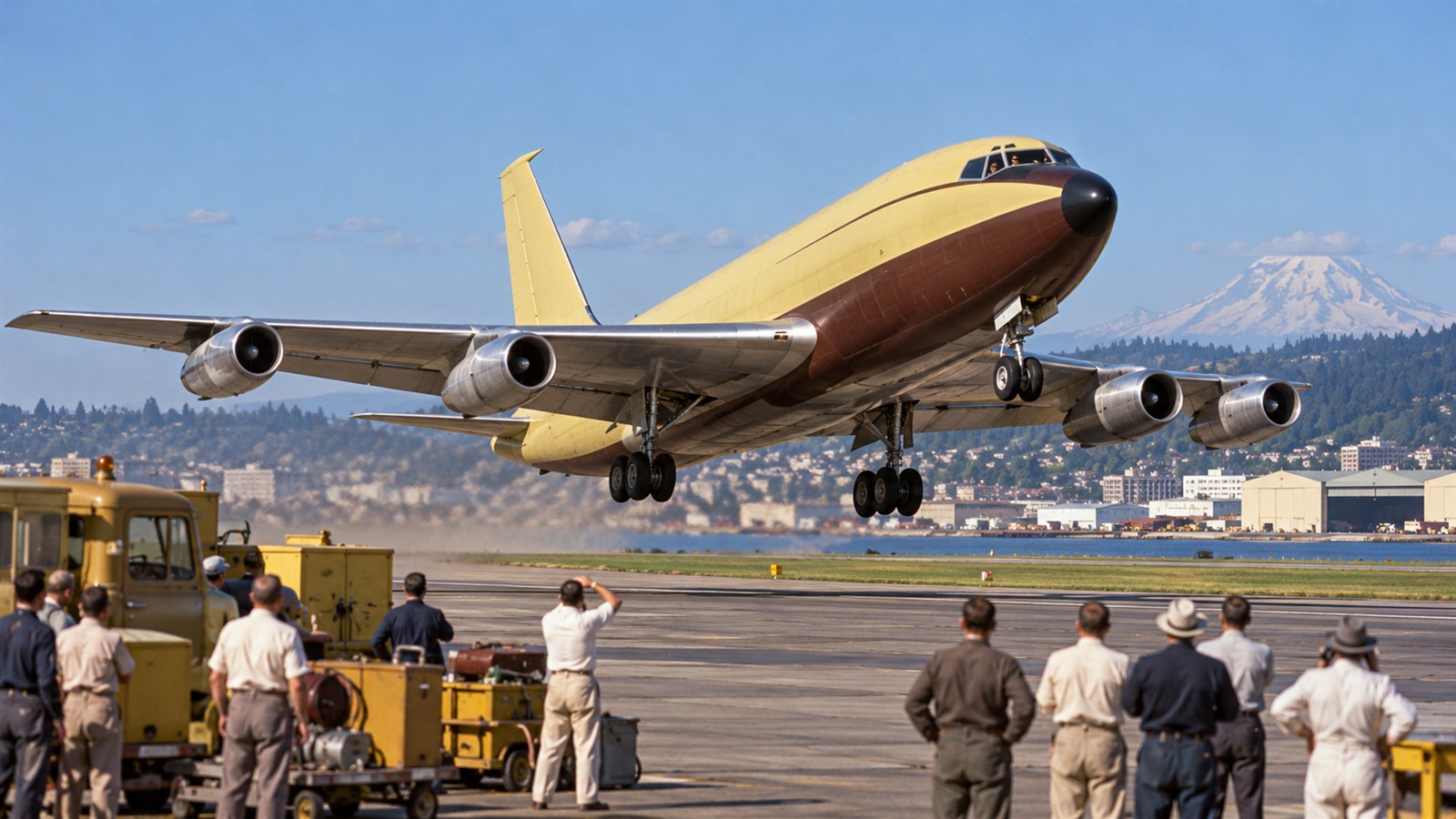
On July 15, 1954, Boeing's Model 367-80, known as the Dash 80, made its first flight from Renton, Washington. Boeing had financed the swept-wing, four-engine prototype with company money, betting that military and commercial customers would move from piston aircraft to jets. The airplane incorporated knowledge from wartime bombers but was designed to demonstrate tanker and passenger-transport possibilities. Test pilots Tex Johnston and Richard Dix Loesch took it aloft before engineers, employees, and prospective buyers. The flight converted a costly private gamble into an operating aircraft that customers could evaluate.
The market was uncertain because airlines had large investments in propeller fleets and airports built around them. Jets promised greater speed and altitude, but they required fuel, training, maintenance, runway, cabin, and safety decisions across the aviation system. Boeing used the Dash 80 to test structures, controls, engines, and handling while showing the concept to the Air Force and airlines. In a famous 1955 demonstration, Johnston rolled the prototype above Lake Washington, attracting attention while alarming executives. Performance had become a sales argument visible from the ground.
The Dash 80 led to two related but distinct products: the KC-135 military tanker and the 707 commercial airliner. Orders created production scale, supplier commitments, and confidence in jet operations. The 707 entered airline service in 1958 and helped make long-distance air travel faster and more accessible, although rival manufacturers also shaped the market. Boeing's choice to build a demonstrator before securing its full customer base placed substantial capital at risk, but it shortened learning and gave buyers something more persuasive than drawings.
The first flight matters because strategic prototypes can bridge markets. Boeing did not merely test an aircraft; it created a platform from which military and civilian variants could be developed. Shared knowledge and components improved the return on the original investment while each customer received a tailored product. The bet succeeded because the prototype addressed technical uncertainty and commercial imagination at once. Companies entering capital-intensive markets often face the same challenge: customers want proof before ordering, but proof requires spending before orders exist. The Dash 80 showed how a focused demonstrator can unlock a much larger production system. The prototype additionally created internal focus. Engineers, production planners, sales teams, and executives could organize decisions around the same flying machine instead of separate assumptions. Problems became measurable and tradeoffs became concrete. In complex development, that shared reference can be as important as the external demonstration because it allows a large organization to learn from one set of operating evidence.
Boeing invested its own money in the Dash 80 to demonstrate both aerial-refueling and passenger-jet possibilities.
The four-engine swept-wing prototype made its first flight from Renton on July 15, 1954.
Flight testing reduced uncertainty about structures, controls, engines, handling, and the operating demands of jet transport.
Airlines and the military could evaluate a real aircraft before committing to fleets and supporting infrastructure.
The prototype led to the KC-135 tanker and the 707 airliner, spreading its development value across two markets.
The program shows how a costly demonstrator can create the proof customers need to order a new technology.
Explore more of "On This Day ..."
Discover more events from the same date across news, politics, technology, sports, and other fields. Each link highlights significant moments that shaped history on different fronts.