

On This Day in Business: July 29, 1958
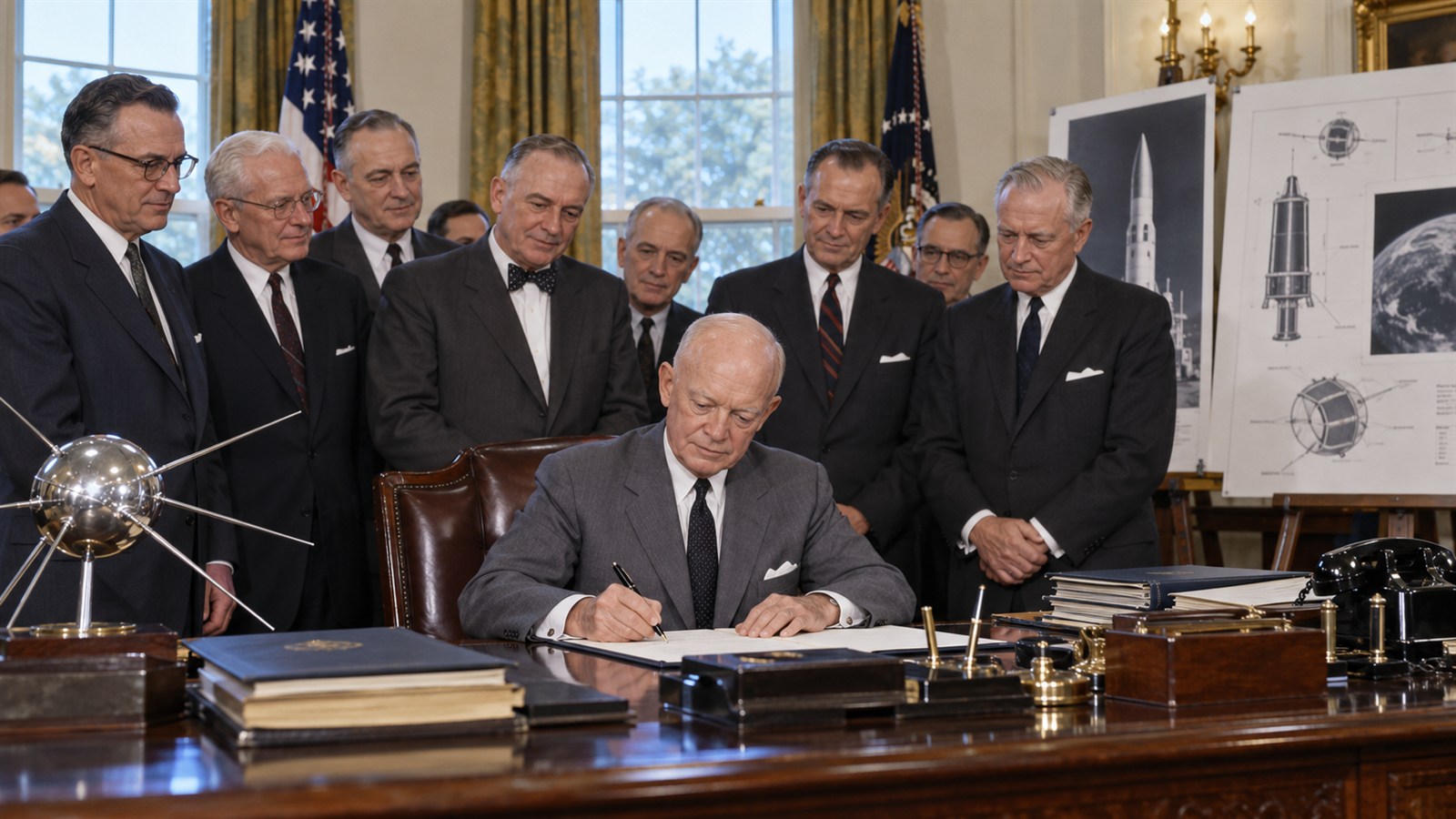
On July 29, 1958, President Dwight D. Eisenhower signed the National Aeronautics and Space Act. The law created the National Aeronautics and Space Administration as a civilian agency and gave it responsibility for peaceful space activities and aeronautical research. The Soviet launch of Sputnik in 1957 had intensified concern about American science, defense, education, and technological organization. Rather than begin entirely from nothing, NASA absorbed the National Advisory Committee for Aeronautics and drew on its laboratories, employees, and long history of flight research.
The agency became a customer, coordinator, and technical institution within a broad industrial network. Universities, aerospace manufacturers, electronics companies, construction firms, communications providers, and thousands of suppliers competed for and performed contracts. Government set missions and funded work whose cost, risk, or time horizon often exceeded what private markets would accept alone. Standards, testing, documentation, and systems engineering helped combine parts built by many organizations into launch vehicles, spacecraft, ground networks, and scientific instruments.
NASA began operations on October 1, 1958, and soon pursued human spaceflight, satellites, planetary exploration, Earth observation, and continued aeronautics. The Apollo program later demonstrated the scale of coordinated procurement and project management the agency could mobilize. Space investments produced specialized capabilities and commercial spillovers, while failures exposed the consequences of schedule pressure, communication breakdowns, and technical complexity. Public budgets made political support and transparent purpose central to the institution's durability.
The signing matters because markets sometimes need a mission-setting organization before a new industry can develop. NASA did not replace private enterprise; it created demanding goals, purchased capabilities, shared research, and sustained infrastructure that firms could build upon. The relationship also required oversight because contractors and government distributed risk, knowledge, and public money across a large system. The enduring lesson is that ambitious innovation depends on institutions as much as inventions. Clear objectives, patient funding, technical authority, competition, and learning from failure can turn scattered expertise into achievements no single participant could deliver alone. The act also required NASA to disseminate information about its activities, embedding public knowledge in the agency's mission. That choice helped research circulate beyond individual contractors and allowed citizens to evaluate accomplishments funded by taxes. Openness had limits where security or proprietary information applied, but publication expanded the spillover value of exploration and reinforced the civilian character of the organization. Contracts also transferred knowledge in both directions. Government laboratories defined requirements and reviewed results, while private firms developed manufacturing methods and specialized tools. Employees moved between organizations, and suppliers applied capabilities to later commercial markets. Measuring the return therefore requires looking beyond a single mission's direct revenue or hardware.
Sputnik increased pressure to organize American civil space activity, science, and aerospace capabilities.
Eisenhower signed the National Aeronautics and Space Act on July 29, 1958, creating a civilian agency.
NASA inherited people and laboratories from the National Advisory Committee for Aeronautics.
The agency coordinated universities, manufacturers, contractors, suppliers, launch sites, tracking networks, and researchers.
Government missions supported work whose risk, scale, and time horizon often exceeded ordinary private investment.
NASA's creation shows how a mission-setting institution can organize an industry while depending on accountability and public trust.
Explore more of "On This Day ..."
Discover more events from the same date across news, politics, technology, sports, and other fields. Each link highlights significant moments that shaped history on different fronts.