

On This Day in Business: July 31, 1790
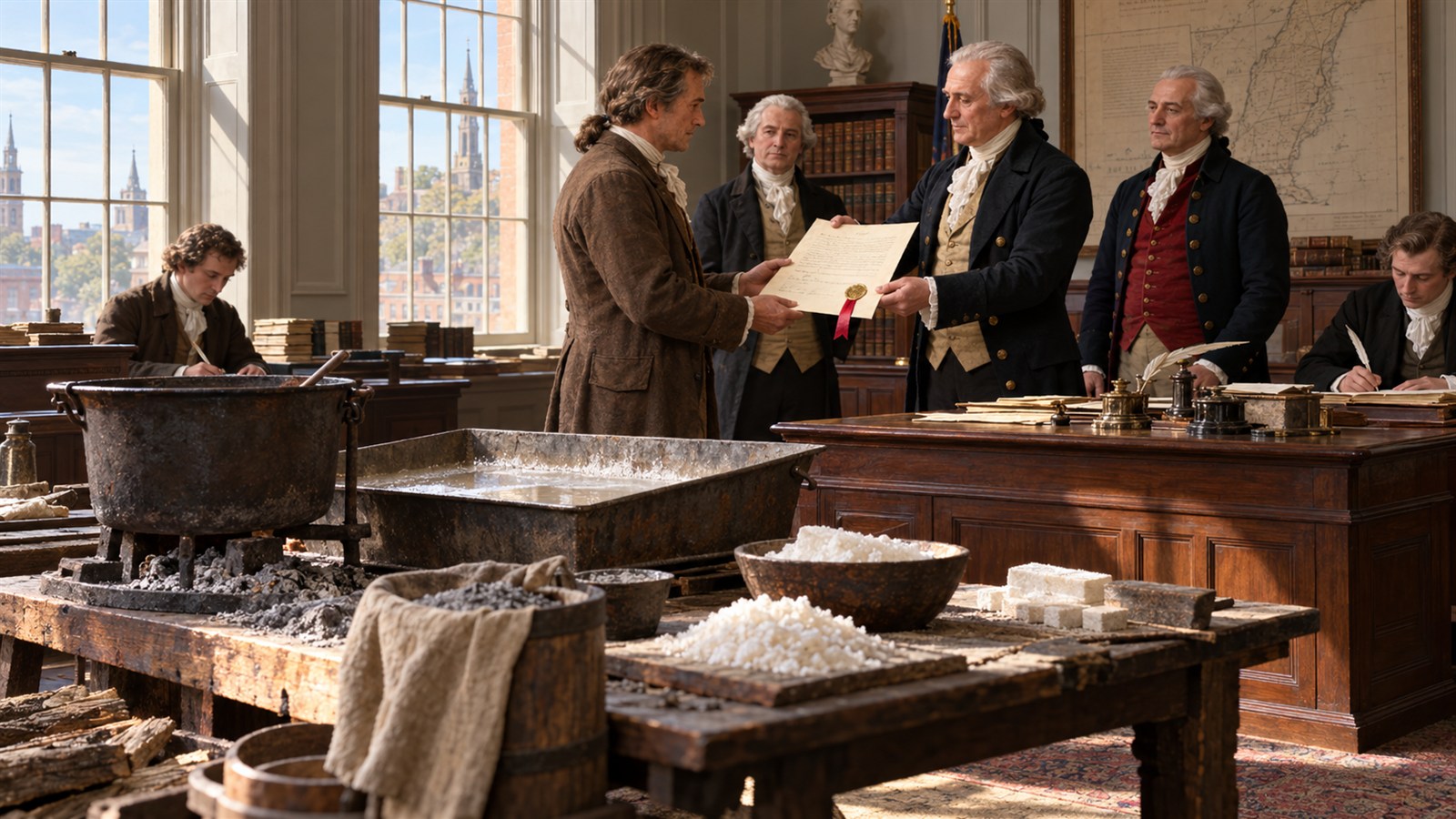
On July 31, 1790, Samuel Hopkins of Vermont received the first patent issued under the new United States patent law. His invention improved the making of potash and pearl ash, alkaline materials produced from wood ashes and used in soap, glass, textiles, and other goods. President George Washington signed the document, with review involving Secretary of State Thomas Jefferson and other senior officials under the early system. The patent granted Hopkins exclusive rights for a limited term in exchange for describing his process.
Potash was commercially important in a wooded country. Settlers clearing land could turn ashes into a transportable product for domestic use and export, but quality and fuel efficiency varied. Hopkins proposed improved furnace and processing methods. The patent did not guarantee that customers would adopt them or that enforcement would be easy. It created a legal asset that could support production, licensing, investment, or negotiation while eventually adding the disclosed knowledge to the public record.
The 1790 law required high-level examination, an arrangement that soon proved burdensome as applications increased. Congress revised the system, and the Patent Office evolved through new statutes, professional examiners, models, records, court decisions, and international agreements. Patents became central to industries ranging from machinery and chemicals to electronics and biotechnology. They also generated continuing debate about claim breadth, litigation, access, competition, and whether exclusive rights actually promote useful progress.
The first grant matters because it made innovation part of the federal economic framework. The system offered inventors time-limited exclusion rather than permanent secrecy, attempting to balance private incentive with public disclosure. Hopkins still needed materials, labor, markets, and execution; the document alone did not create a business. That distinction remains essential. Intellectual property can protect a position and make investment easier, but customers pay for useful outcomes. A patent is strongest when it supports a capable organization that can turn disclosed knowledge into reliable products or license it to someone who can. The Hopkins patent also linked an everyday frontier byproduct to international commerce. Wood ash from land clearing could enter a chain serving glassmakers, soap producers, dyers, and exporters. Improving the process therefore had value beyond one workshop. It illustrates why patent systems often protect methods as well as machines: a better sequence of operations can raise yield and quality without creating a wholly new object. Disclosure also helps later inventors distinguish what is genuinely new. A searchable record can prevent repeated effort, reveal technical paths, and define boundaries for competition. That public function works only when descriptions are meaningful and the examination record is accessible, making patent administration an information service as well as a grant of legal rights.
Samuel Hopkins developed an improved process for producing potash and pearl ash from wood ashes.
He received the first U.S. patent on July 31, 1790, under the new federal patent law.
The early document was reviewed by senior officials and signed by President George Washington.
Limited exclusivity could support production, licensing, and investment while disclosure eventually entered public knowledge.
The patent system later developed professional examination, records, courts, and rules for increasingly complex industries.
The first grant shows that legal protection can encourage invention, but commercial value still depends on execution and demand.
Explore more of "On This Day ..."
Discover more events from the same date across news, politics, technology, sports, and other fields. Each link highlights significant moments that shaped history on different fronts.