

On This Day in Business: August 2, 1870
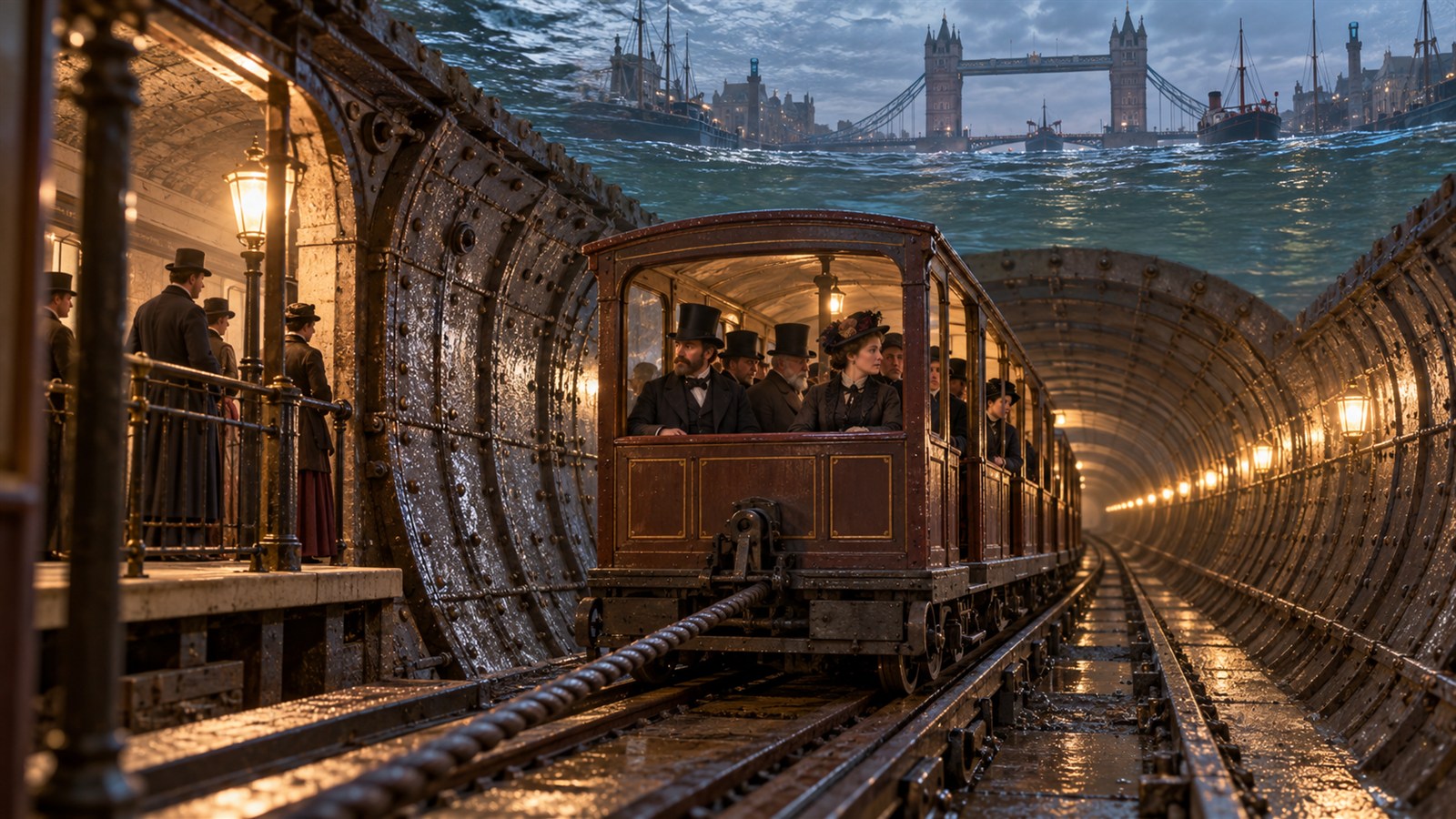
On August 2, 1870, London's Tower Subway opened beneath the River Thames between Tower Hill and Southwark. The narrow iron tunnel carried a small cable-hauled passenger car and offered a direct crossing without a bridge or ferry. It was an ambitious piece of urban engineering built with a cylindrical tunneling shield and lined with cast-iron segments. The railway was tiny by later underground standards, but it tested a crucial proposition: densely developed cities could add transport capacity below existing streets and waterways. That idea would become central to the economics of modern metropolitan growth.
The enterprise also revealed the difficulty of matching technical invention with a durable operating model. The cable car could carry only a small number of passengers, service was limited, and the system competed with well-established river crossings. Revenue could not support the railway for long. Within months, operators removed the machinery and converted the tunnel into a pedestrian toll passage. The physical asset survived because its use changed. Instead of insisting on the original concept, the owners found a simpler service that made use of the costly bore and continued to collect small payments from people crossing the Thames.
For business history, the Tower Subway is valuable precisely because it was not an uncomplicated commercial triumph. Infrastructure projects carry large upfront costs, uncertain demand, and technology risk. Their economics depend on capacity, reliability, pricing, and connections to a wider network. The subway's small diameter constrained all four. Yet its construction demonstrated that shield-driven tunneling could work through difficult ground under a major river. Engineers and investors learned from the project, and later tunnels applied improved methods at larger scale. A limited venture therefore produced knowledge that outlived its first balance sheet.
The pedestrian tunnel closed after Tower Bridge opened in 1894 and provided a free, more convenient crossing. The bore later found another use carrying utility pipes, another example of infrastructure being repurposed as a city changes. London's far larger deep-level railways would follow with better capacity and network effects. The Tower Subway's legacy lies in both engineering and adaptation: it showed what underground construction could accomplish, then demonstrated how an asset might be salvaged when the original service failed. Innovation advances through successful products, but it also advances through practical lessons purchased by early investors. In that sense, the tunnel became a prototype whose greatest return was not its first fare revenue, but the methods, confidence, and urban imagination it helped others build.
The Tower Subway opened beneath the Thames on August 2, 1870, linking the Tower Hill and Southwark sides.
A compact cable-hauled car operated through a narrow cast-iron tunnel.
Low capacity and weak economics ended the railway service after only a short period.
The tunnel was converted into a toll footway, preserving value from the original construction.
Its tunneling methods contributed practical knowledge to later underground projects.
After Tower Bridge made the footway obsolete, the bore continued in service as a utility route.
Explore more of "On This Day ..."
Discover more events from the same date across news, politics, technology, sports, and other fields. Each link highlights significant moments that shaped history on different fronts.