

On This Day in Business: August 17, 1807
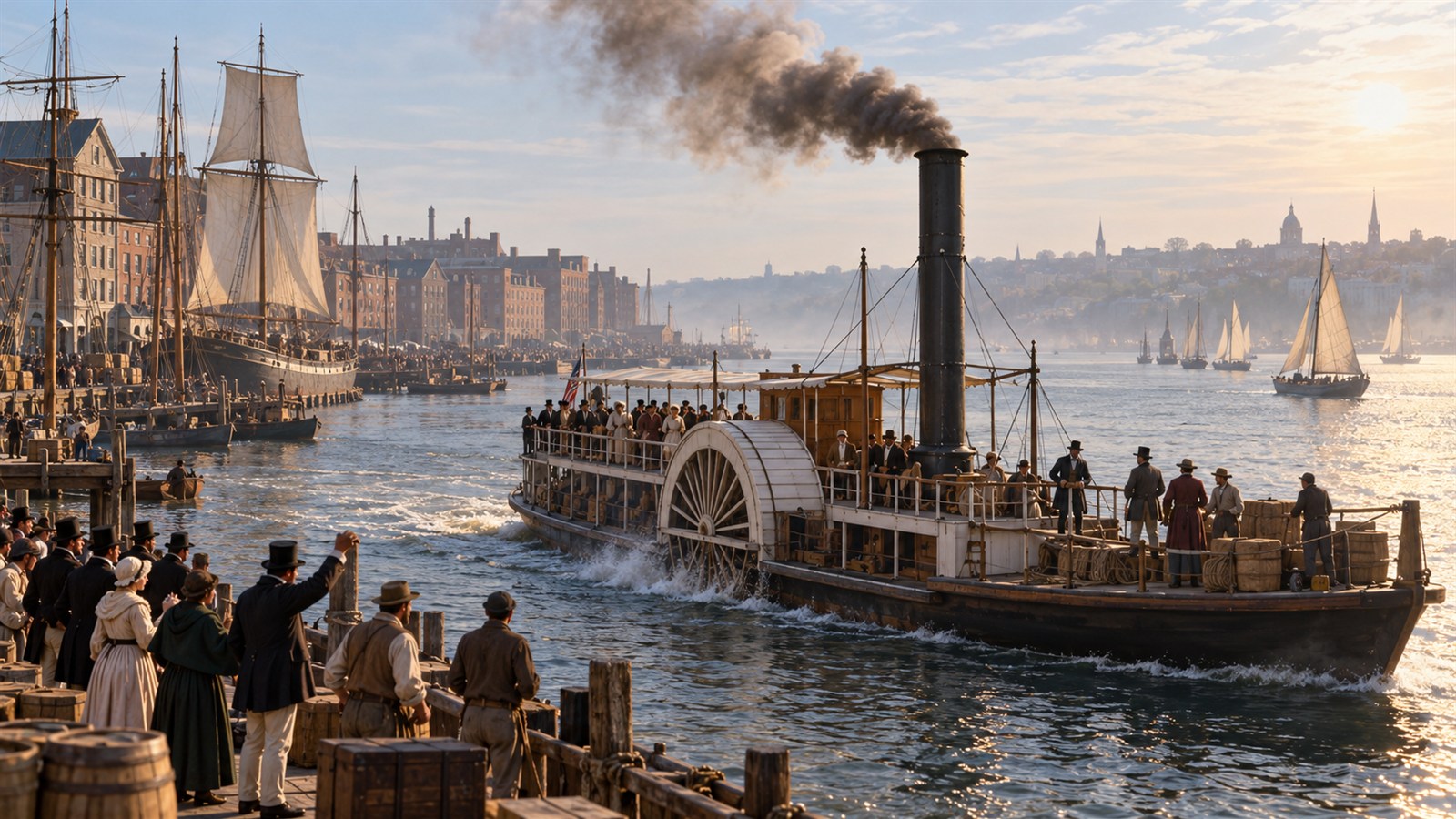
On August 17, 1807, Robert Fulton's steamboat left New York City for Albany on the Hudson River. Often remembered as the Clermont, the vessel demonstrated that steam propulsion could support reliable commercial passenger service on an inland waterway. Steam-powered boats had been attempted before, but Fulton's voyage combined workable engineering with an organized route and financial backing from Robert Livingston. The trip mattered because customers could imagine buying transportation on a schedule rather than depending entirely on wind, currents, or animal power. A machine became a service, and a demonstration became the basis of an operating business.
Reliability changed the economics of river travel. Merchants could plan shipments with greater confidence, travelers could estimate arrival times, and operators could make more intensive use of a vessel. Fulton and Livingston also benefited from exclusive rights granted by New York, which protected their early route but provoked later legal battles over monopoly and interstate commerce. The enterprise showed how innovation often depends on a mixture of private capital, government privileges, infrastructure, and regulation. It also showed why control of a route can be as valuable as ownership of a machine.
Successful steamboat service encouraged investment in vessels, docks, repair facilities, fuel supply, hotels, and river towns. Faster movement widened markets for farm products and manufactured goods and connected inland producers more closely with coastal trade. Competition drove technical improvement, while boiler explosions and other accidents revealed the costs of rapid expansion without adequate standards. The industry created opportunity and danger together. Its growth required insurance, inspection, navigation rules, and engineering knowledge to develop alongside the boats themselves.
Railroads later captured much long-distance traffic, but steamboats remained important on rivers, lakes, and coastal routes. The 1807 voyage endures because it marks the point at which steam navigation became commercially persuasive in the United States. Fulton did not simply prove that a vessel could move; he showed that propulsion, scheduling, financing, and route rights could be assembled into a repeatable service. That combination is the essence of transportation enterprise. New mobility technologies create their greatest economic effect when users can trust them enough to reorganize trade, travel, and investment around their regular operation. Regular service also changed expectations. Once customers experienced movement that did not depend on a favorable wind, slower uncertainty became a competitive disadvantage. That pressure encouraged rival operators to invest, experiment, and connect more communities to the emerging steam network. Dependability became a feature customers would pay to obtain.
Fulton's steamboat departed New York for Albany on August 17, 1807.
The vessel demonstrated practical, scheduled steam service on the Hudson River.
Financial backing and route privileges helped convert an engineering project into a business.
Reliable movement improved planning for passengers, merchants, and shippers.
Steamboat growth supported docks, fuel suppliers, repair shops, hotels, and river towns.
The voyage showed that transportation innovation succeeds when machinery becomes a dependable service.
Explore more of "On This Day ..."
Discover more events from the same date across news, politics, technology, sports, and other fields. Each link highlights significant moments that shaped history on different fronts.