

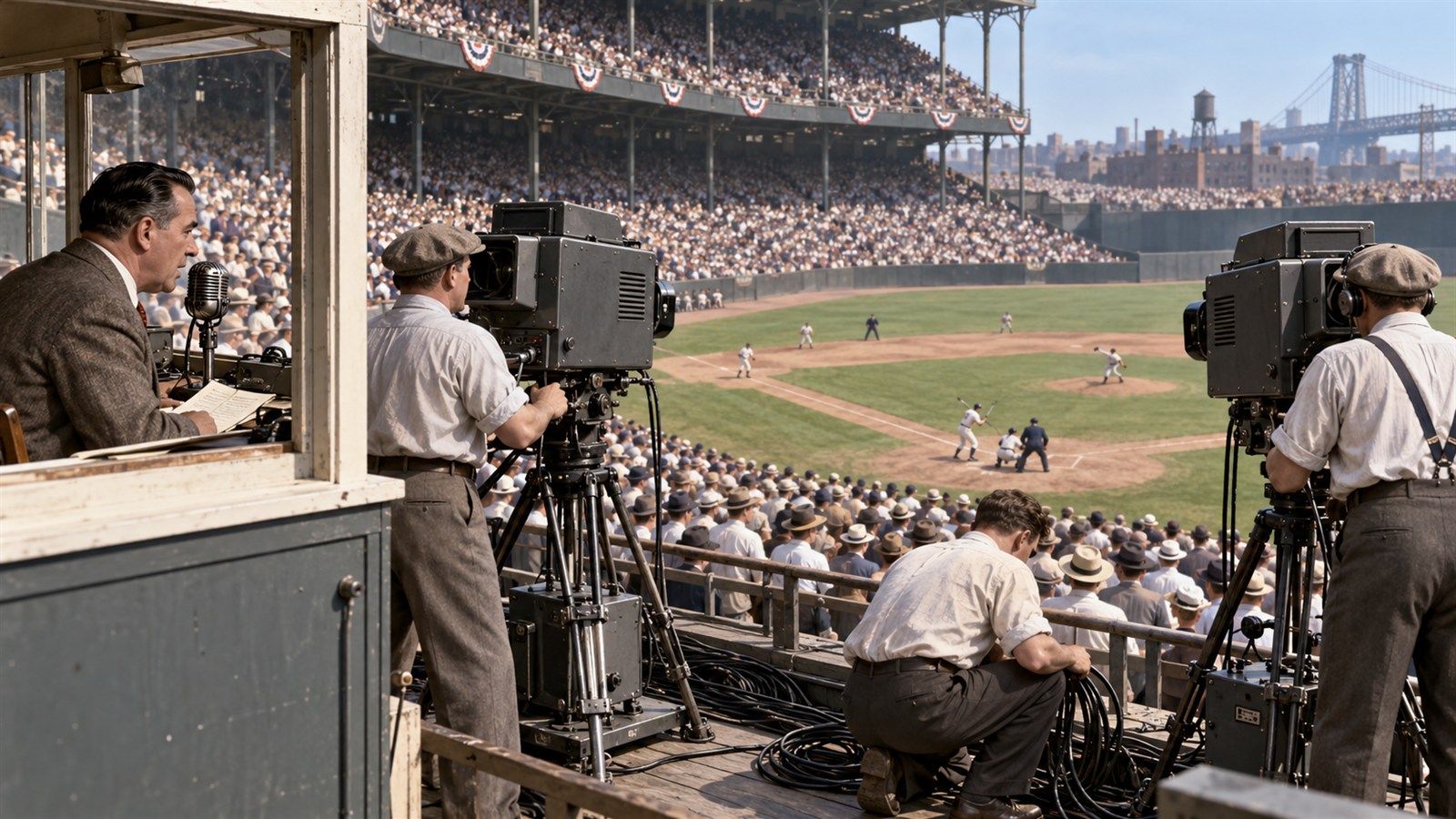
On This Day in Business: August 26, 1939
On August 26, 1939, experimental station W2XBS televised a Major League Baseball doubleheader between the Cincinnati Reds and Brooklyn Dodgers at Ebbets Field. Announcer Red Barber worked with only two cameras and had to adjust his description without always knowing which angle viewers were seeing. The potential audience was tiny—only a few thousand television sets were in the New York area—but the broadcast demonstrated that a live game could be turned into a remote visual experience. Baseball had entered a medium that would eventually reshape the economics of professional sports.
Radio had already shown that broadcasting could expand a team's following beyond the ballpark. Television added pictures, making players, uniforms, signs, and stadiums visible to people who had not bought a ticket. Owners initially worried that free broadcasts might reduce attendance, a concern that would recur with every new distribution technology. Over time, the larger audience proved commercially valuable. Broadcast rights, sponsorships, and advertising could generate revenue while televised exposure increased fan interest, merchandise demand, and the cultural importance of leagues.
Live sports became especially valuable programming because the outcome was uncertain and audiences preferred to watch in real time. That combination produced concentrated attention for advertisers and later for subscription networks and streaming platforms. Leagues organized schedules and rights packages around media markets, while broadcasters invested in cameras, replay, graphics, and production talent. The relationship changed the games themselves: start times, breaks, venue design, and league rules increasingly considered the needs of television. Distribution was no longer an afterthought; it became part of the product.
The 1939 telecast was technically modest, but its business model grew into one of the most valuable sectors in media. Rights fees now support teams and player salaries, while broadcasters use sports to attract subscribers and preserve live audiences in a fragmented market. The same growth has raised questions about access, blackouts, pricing, and public financing of stadiums. Baseball's first television appearance shows how a new medium can amplify an existing event and then acquire enough economic power to influence it. The camera did not merely record the game; it created a second marketplace around watching. Television also changed sponsorship inventory. Outfield walls, uniforms, commercials, and on-screen presentation became packages that could be valued according to audience size and frequency. The game supplied the attention, while media companies learned to divide, measure, and sell that attention in increasingly precise forms. Broadcast exposure became an asset teams could negotiate rather than incidental publicity.
W2XBS aired a Reds-Dodgers doubleheader from Ebbets Field on August 26, 1939.
Red Barber called the game while a two-camera crew supplied experimental pictures.
Only a small number of television households could receive the broadcast.
Visual coverage expanded sports beyond ticket buyers and increased the value of sponsorship exposure.
Live uncertainty made games unusually valuable programming for advertising and subscriptions.
Media rights eventually became central to league revenue, scheduling, and the design of the fan experience.
Explore more of "On This Day ..."
Discover more events from the same date across news, politics, technology, sports, and other fields. Each link highlights significant moments that shaped history on different fronts.