

On This Day in Business: September 1, 1897
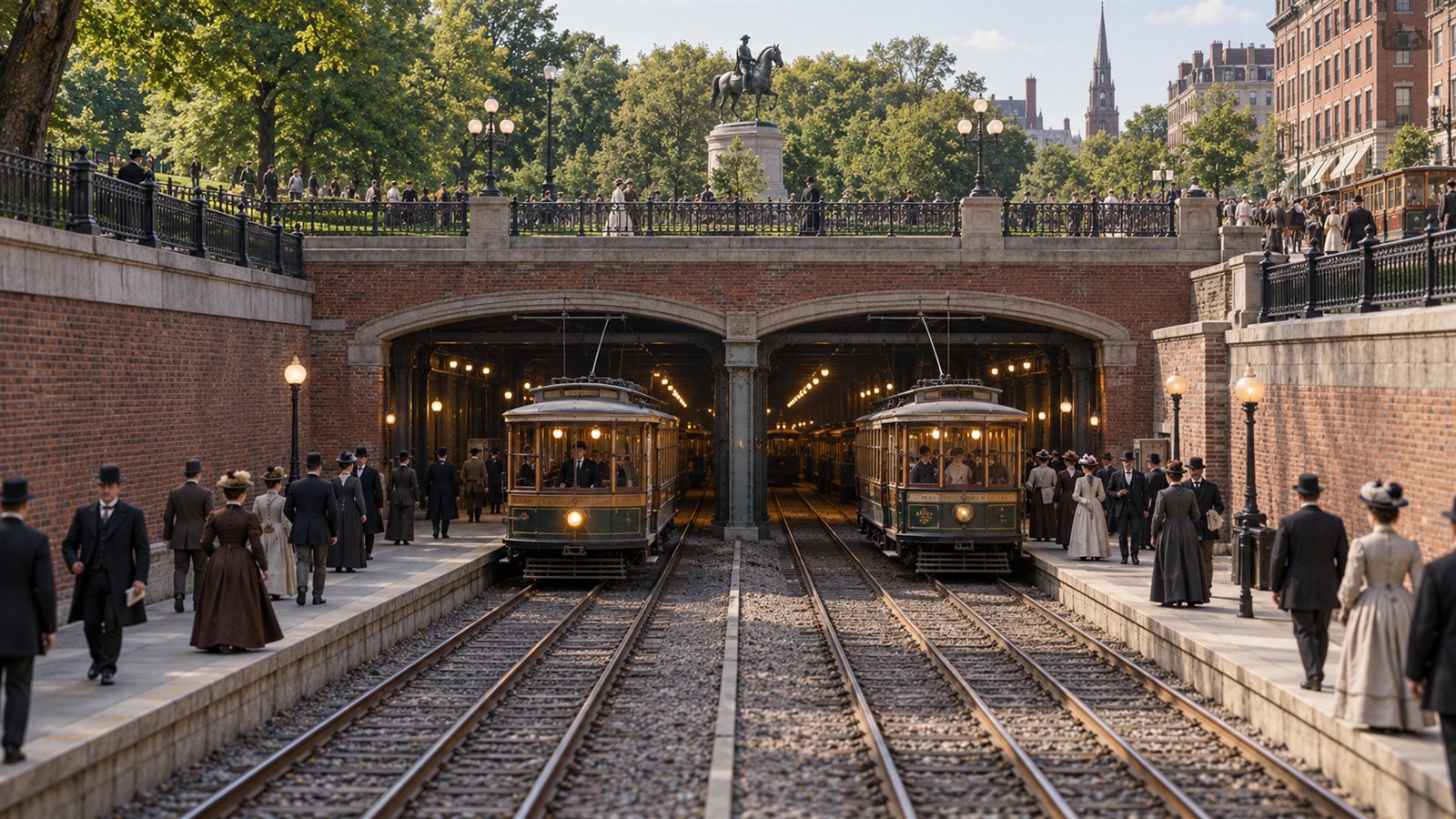
On September 1, 1897, the first section of Boston's Tremont Street Subway entered service beneath the crowded streets beside Boston Common. Electric streetcars ran through tunnels between the Public Garden area and downtown stations, making the project the first subway in the United States. Its purpose was practical rather than theatrical: downtown Boston was choking on street traffic, and the growing number of trolley lines could not all move efficiently through the same intersections. By placing the busiest part of the network underground, the city created new transport capacity without clearing a wide path through valuable commercial neighborhoods.
The subway emerged from a public-private transit economy. Private street railway companies operated the cars, while a public commission planned and built the tunnel. That division recognized that the bottleneck was larger than any single operator. An individual company could add vehicles or tracks, but only a coordinated infrastructure project could separate traffic at the center of the system. Construction used shallow excavation, steel columns, concrete, brick, and a four-track section under Boston Common. Crews had to preserve surface activity and protect nearby buildings while producing a route that could accept existing streetcars instead of requiring passengers to adopt an entirely new vehicle.
The opening immediately demonstrated the value of grade separation. Trolleys no longer competed with wagons, pedestrians, and other vehicles on the most congested blocks. Faster, more predictable movement improved the usefulness of the entire network, not just the tunnel itself. The business lesson was a network effect: removing one critical bottleneck can raise the value of many routes feeding into it. Fares remained accessible, and heavy ridership showed that urban travelers would use underground service when it saved time. Boston's experiment therefore gave other American cities a working model for financing, engineering, and operating rapid transit beneath established streets.
Parts of the original Tremont Street Subway remain in service as part of the Massachusetts Bay Transportation Authority's Green Line. Its survival reflects the durability of a sound transport corridor even as vehicles, signals, ownership, and passenger expectations change. Later subways would be deeper, longer, and designed for larger trains, but Boston established the essential commercial proposition: scarce surface space could be supplemented with valuable underground capacity. The 1897 opening was both an engineering milestone and an investment in metropolitan productivity. It shortened trips, supported denser development, and showed that public infrastructure could unlock growth for many private businesses at once. More than a century later, the same tunnel still carries passengers through the market it helped reshape. Its value also depends on continuous public stewardship. Signals, ventilation, stations, accessibility, and maintenance must evolve while trains keep moving, making the subway a living operating business rather than a completed nineteenth-century artifact. That continuing work converts an old tunnel into current economic capacity every day.
Boston opened the first operating section of the Tremont Street Subway on September 1, 1897.
Electric streetcars moved below congested downtown streets beside Boston Common.
A public transit commission built infrastructure used by private street railway operators.
The tunnel increased the capacity and reliability of routes feeding into central Boston.
Shallow construction and compatibility with existing trolleys limited disruption and operating change.
The surviving tunnel remains part of the MBTA Green Line and a model of durable urban infrastructure.
Explore more of "On This Day ..."
Discover more events from the same date across news, politics, technology, sports, and other fields. Each link highlights significant moments that shaped history on different fronts.