

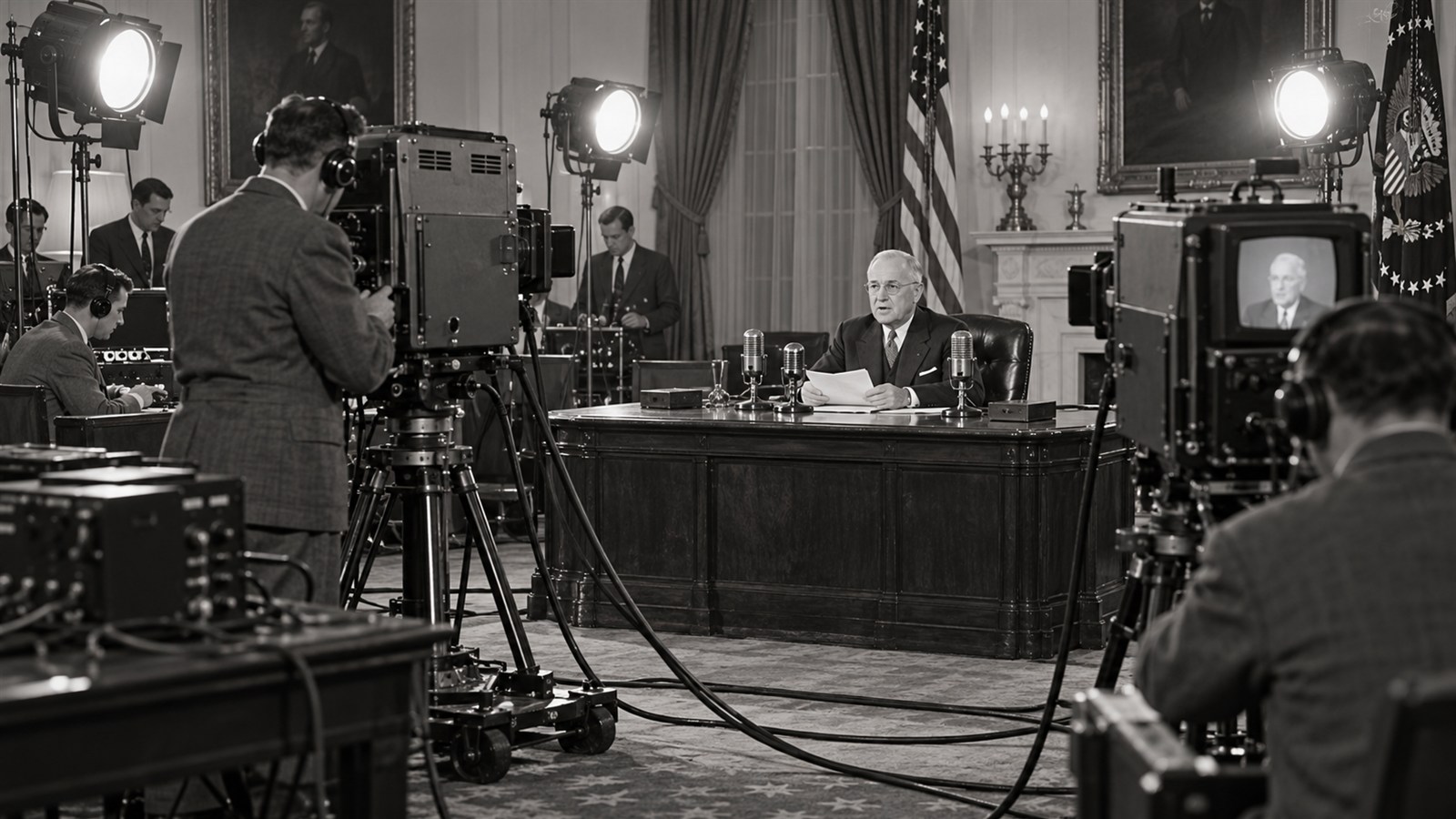
On This Day in Business: October 5, 1947
On October 5, 1947, President Harry S. Truman delivered the first televised presidential address from the White House. Speaking about food conservation, he asked Americans to reduce consumption of grain, meat, poultry, and eggs so that more supplies could be sent to Europe after the war. Radio still carried the address to the great majority of households, while the television audience was small and concentrated around a limited network of stations. Even so, placing a live presidential message on television demonstrated that the young medium could carry national public affairs rather than only experiments, sports, and local entertainment.
Television required a coordinated commercial system. Camera equipment, studio lighting, coaxial connections, transmitters, licensed stations, home receivers, program schedules, and advertising all had to expand together. A government address supplied prestigious programming that manufacturers and broadcasters could use to show potential buyers why a television set mattered. Viewers did not need to travel to a theater or wait for film; they could watch a national event as it happened. That sense of presence became television's strongest product advantage over print, recorded film, and ordinary radio.
The broadcast also illustrated the relationship between public policy and consumer communication. Truman's appeal sought voluntary changes in household purchasing to affect commodity demand and international relief. Images of the president gave the message a new kind of intimacy and allowed political presentation to become part of the content. Networks and advertisers soon learned that television could create shared attention around live events, while candidates and officeholders learned that posture, setting, and delivery reached voters alongside words. Campaign spending and public relations would increasingly follow audiences from radio into television.
Within a decade, television ownership spread rapidly and the industry reorganized American advertising, entertainment, retailing, sports, and politics. The October 5 address did not cause that expansion by itself, but it helped validate television as civic infrastructure and a mass-market appliance. Its business lesson is that networks grow when compelling uses arrive before universal ownership. Each important broadcast made a receiver more valuable; each new household made programming and advertising more valuable in return. The White House appearance therefore belonged to a feedback loop joining institutional content, consumer hardware, transmission investment, and sponsor demand—the same pattern later seen in many communications platforms. For broadcasters, the appearance also supplied a repeatable sales argument: a receiver was not merely furniture but a window onto events that neighbors might otherwise miss. That promise helped retailers, stations, and advertisers justify investment before the national audience was fully formed.
Harry Truman delivered the first televised presidential address from the White House on October 5, 1947.
The speech asked households to conserve food so that more supplies could support postwar Europe.
Radio reached most listeners, while television service and receiver ownership remained limited.
A live White House event gave broadcasters and manufacturers prestigious proof of television's value.
Political presentation, advertising, and shared national attention increasingly moved to the visual medium.
The event shows how important content can accelerate adoption across a communications network.
Explore more of "On This Day ..."
Discover more events from the same date across news, politics, technology, sports, and other fields. Each link highlights significant moments that shaped history on different fronts.