

On This Day in Business: October 8, 1871
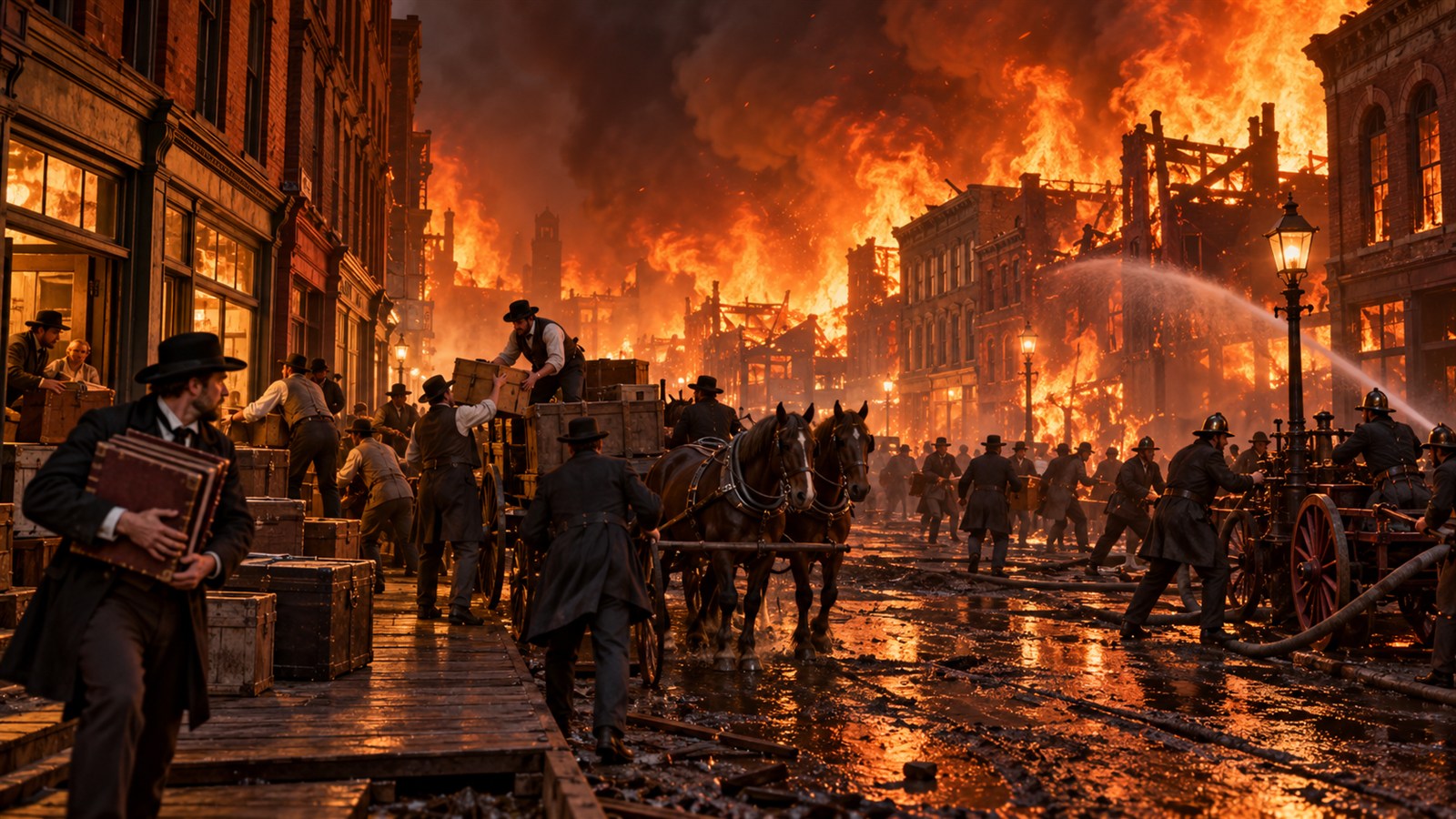
On the evening of October 8, 1871, a fire began on Chicago's West Side and spread through a city made dangerously combustible by drought, wind, wooden buildings, plank sidewalks, crowded yards, and industrial fuel. It burned into October 10, killed about 300 people, left roughly 100,000 residents without homes, and destroyed more than 17,000 structures. The famous story blaming Mrs. O'Leary's cow is unsupported, and the precise ignition remains uncertain. What is clear is that the blaze tore through a fast-growing commercial center, consuming warehouses, stores, hotels, newspaper offices, banks, rail facilities, and public records along with neighborhoods.
The direct property loss was enormous, often estimated near $200 million in contemporary dollars. Insurers faced thousands of claims concentrated in one event; dozens failed, while stronger firms paid and reassessed how they priced urban risk. Businesses lost inventory and premises, but many tried to reopen from temporary quarters within days. Rail connections brought relief supplies, workers, and building materials, demonstrating both Chicago's national importance and the value of transport networks during recovery. Credit became essential because owners needed funds before insurance disputes, asset sales, or ordinary revenue could restore cash flow.
Rebuilding created a vast market for architects, contractors, brick, stone, steel, glass, equipment, and finance. New fire limits discouraged wooden construction in the central district, and building practices gradually changed, although regulation and enforcement remained contested. Property values, land assembly, and speculation influenced what returned and who could afford to remain. The rebuilt city did not simply reproduce what had burned; it grew taller, denser, and more capital intensive. Chicago's recovery later supported innovations associated with modern commercial architecture, but the gains were uneven, and displaced low-income residents faced the hardest path back.
The fire became a case study in correlated risk. A policy that seems safe when evaluated building by building can overwhelm an insurer when one event damages an entire district. Similar lessons now shape catastrophe modeling, reinsurance, building codes, emergency planning, and business-continuity systems. October 8 also reminds companies that resilience depends on shared infrastructure and public capacity, not just private precautions. Chicago's merchants rebuilt because transportation, capital, labor, government, and philanthropy converged on the city. The disaster's commercial legacy is therefore not a simple triumph narrative. It is a warning about concentrated exposure and a demonstration that reconstruction decisions can redirect an urban economy for generations. Records protection became another quiet lesson. Firms that could reconstruct accounts, ownership, and obligations were better positioned to claim insurance and resume trade. Modern continuity plans still begin with that same principle: preserve the information needed to operate when the ordinary workplace disappears.
The Great Chicago Fire began on October 8, 1871, and burned into October 10.
The blaze destroyed more than 17,000 structures and displaced roughly 100,000 people.
Commercial losses included stores, warehouses, hotels, banks, newspapers, and transport facilities.
Concentrated claims caused many insurers to fail and changed the pricing of urban fire risk.
Reconstruction expanded demand for capital, labor, fire-resistant materials, and professional design.
The fire remains a lesson in correlated risk, shared infrastructure, and unequal recovery.
Explore more of "On This Day ..."
Discover more events from the same date across news, politics, technology, sports, and other fields. Each link highlights significant moments that shaped history on different fronts.