

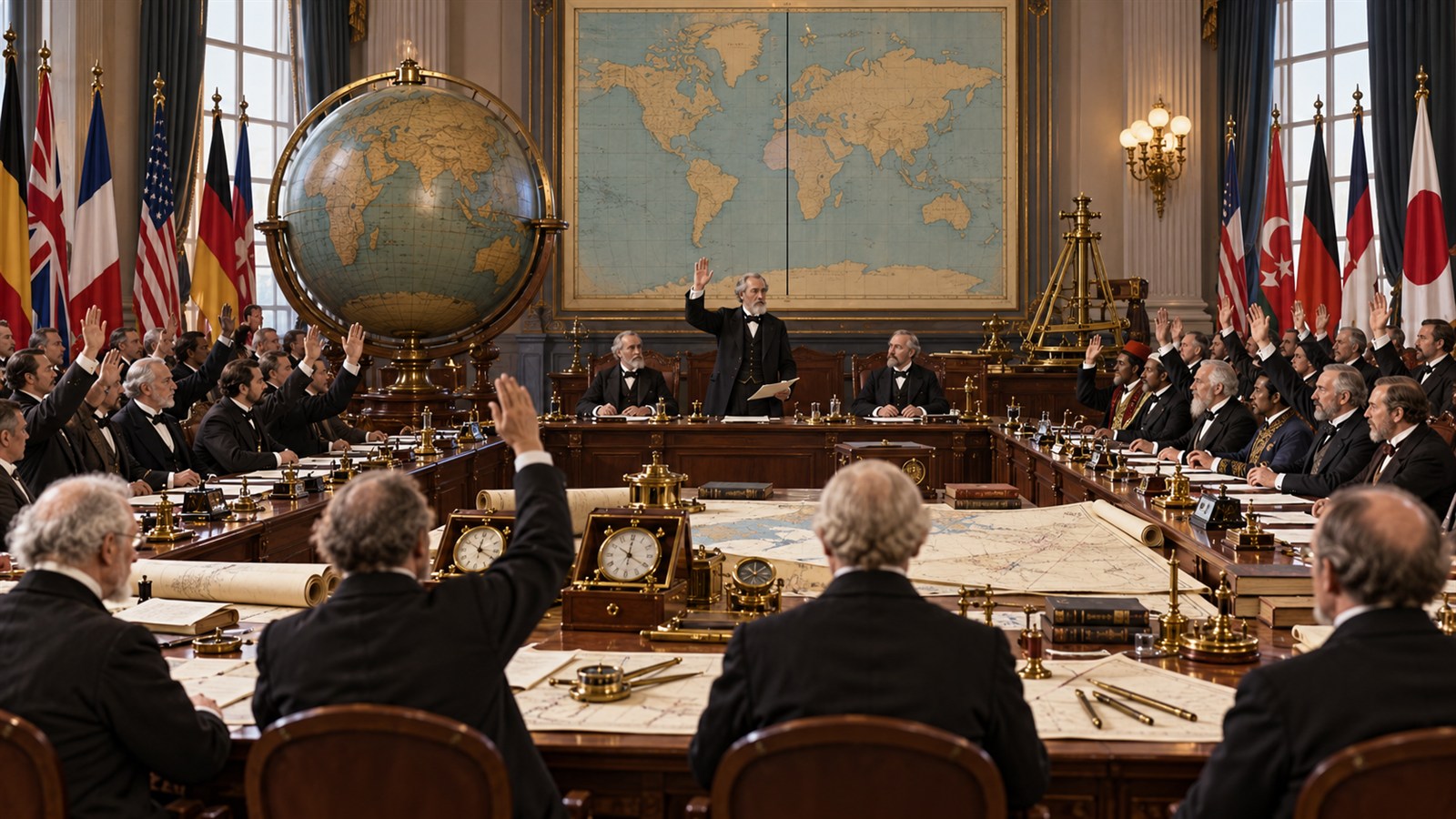
On This Day in Business: October 13, 1884
On October 13, 1884, delegates at the International Meridian Conference in Washington voted to recommend the meridian passing through the Royal Observatory at Greenwich as the world's common zero for longitude. Nations had used different reference meridians on maps and nautical charts, which complicated navigation, timekeeping, and the exchange of information. Greenwich already had a large practical advantage: nearly two-thirds of the world's shipping tonnage used charts based on it. Selecting a shared reference reduced conversion work and the risk of mistakes without requiring every country to adopt an unfamiliar system at once.
The conference brought together representatives from twenty-five nations. Its resolutions addressed longitude, a universal day, and time reckoning, though implementation remained a national process rather than an instant global command. The decision fit an economy increasingly connected by steamships, railways, telegraphs, finance, and scheduled services. A shipment, train connection, insurance contract, or market message could cross jurisdictions that defined local time differently. Common reference points allowed separate organizations to coordinate while retaining their own operations. Standardization created value not by producing a physical good but by making many existing goods and services work together more predictably.
Greenwich was not chosen because nature marks one longitude as zero. The meridian reflected accumulated scientific investment, British maritime power, widespread chart use, and the desire to minimize disruption. France abstained from the principal vote and continued to use Paris references for a time. Even after international agreement, standardized time zones spread unevenly and local practices persisted. The history therefore shows that standards succeed when installed bases, institutions, and incentives align, not simply because experts describe a technically neat solution.
Modern satellite navigation uses a reference meridian slightly east of the historic Airy line, but Greenwich remains the cultural center of global longitude and time. The October vote helped reduce friction for navigation, communications, logistics, and international contracts. Its business lesson is familiar in digital markets: incompatible systems impose hidden costs, while a shared standard expands the useful network. The winner may not be the only possible design; it may be the one already embedded in the most tools and workflows. Once adopted, such standards become infrastructure—largely invisible, difficult to replace, and essential to the precise coordination on which commerce depends. Standard time later strengthened the same coordination. Factories, exchanges, railways, and telegraph offices could schedule activity against comparable clocks, reducing disputes and missed connections. The commercial gain came from millions of small interactions becoming easier to plan and verify.
Conference delegates voted for the Greenwich meridian as the common zero of longitude on October 13, 1884.
Different national meridians had complicated maps, navigation, timekeeping, and international coordination.
Greenwich already appeared on charts used by most of the world's shipping tonnage.
The conference recommended standards, but countries still adopted them through their own laws and practices.
The choice reflected installed infrastructure and maritime power as well as scientific reasoning.
A shared meridian reduced transaction costs across transport, communications, finance, and logistics.
Explore more of "On This Day ..."
Discover more events from the same date across news, politics, technology, sports, and other fields. Each link highlights significant moments that shaped history on different fronts.