

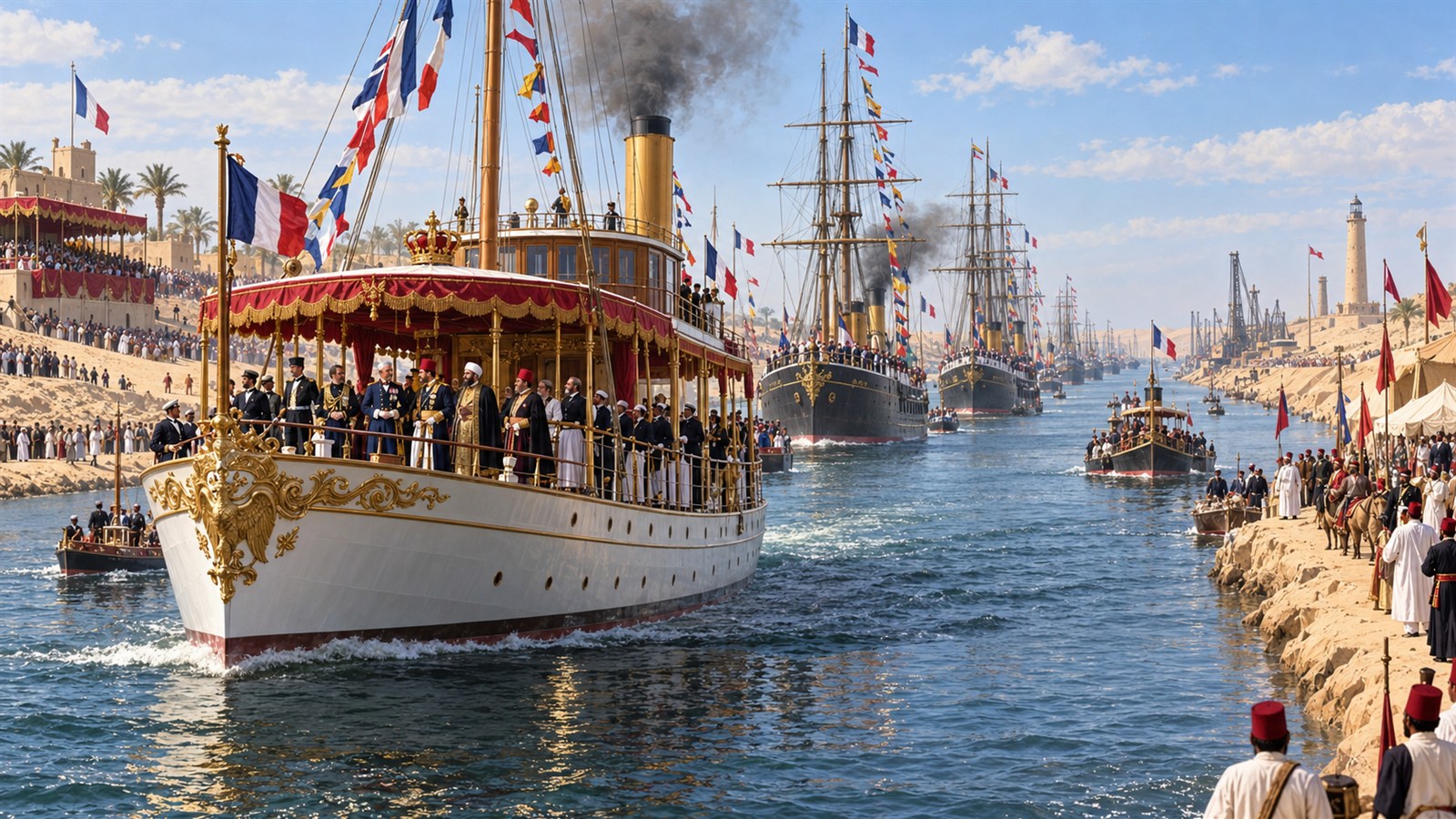
On This Day in Business: November 17, 1869
On November 17, 1869, the Suez Canal opened with an international procession of ships led through the new waterway. The canal crossed Egypt's Isthmus of Suez and connected the Mediterranean with the Red Sea, allowing traffic between Europe and Asian markets to avoid the long route around the Cape of Good Hope. The event was the visible end of years of surveys, financing, engineering, negotiation, and labor. Infrastructure businesses concentrate risk before they produce benefits, so sponsors must coordinate technical design with rights of way, regulation, capital, and the practical needs of the customers expected to use the system.
Construction had begun in 1859 and required enormous excavation, financing, labor, and political negotiation. The Suez Canal Company operated under a concession, while Egypt carried heavy financial exposure. The opening ceremony displayed engineering achievement and geopolitical competition at the same time because control of the route promised influence over trade and naval movement. Once operating, the asset changed more than travel time. It reorganized where firms could locate, how inventories moved, which markets became reachable, and how reliably people could plan. Those second-order effects often created more economic value than the toll, fare, rent, or fee collected directly by the operator.
For shipping companies, the canal could reduce distance, fuel, time, and working capital tied up in cargo. Ports, insurers, merchants, and ship designs adjusted to the new route. The canal also became a strategic chokepoint whose fees, capacity, closures, and governance affected supply chains far beyond Egypt. Scale also brought public obligations. Safety, access, maintenance, environmental effects, and monopoly power could not be treated as side issues because a failure in shared infrastructure reached far beyond the owner. Durable performance required governance strong enough to protect both commerce and the communities carrying its costs.
Suez demonstrates that transport infrastructure changes commercial geography. A faster route can make some ports and products more competitive while exposing the world economy to concentration risk. Firms benefit from efficiency but must plan for disruption, alternative routing, inventory buffers, and political uncertainty when a large share of trade depends on one narrow passage. The modern lesson is to judge infrastructure across its full life cycle. Construction headlines fade quickly; maintenance, capacity, resilience, and public legitimacy determine whether the asset keeps creating value. The best projects connect engineering discipline with transparent rules and a realistic plan for decades of operation. In practical terms, the advantage came from linking a clear customer promise to disciplined execution. Capital had to be allocated before demand was certain, employees and partners had to coordinate, and leaders had to keep learning after the initial milestone passed into history.
The Suez Canal opened on November 17, 1869.
It directly linked the Mediterranean and Red Sea.
A ceremonial convoy entered the canal on opening day.
The route shortened many voyages between Europe and Asia.
Shipping, ports, insurance, and trade patterns adapted around the canal.
Its efficiency also created a globally important chokepoint.
Explore more of "On This Day ..."
Discover more events from the same date across news, politics, technology, sports, and other fields. Each link highlights significant moments that shaped history on different fronts.