

On This Day in Business: November 20, 1985
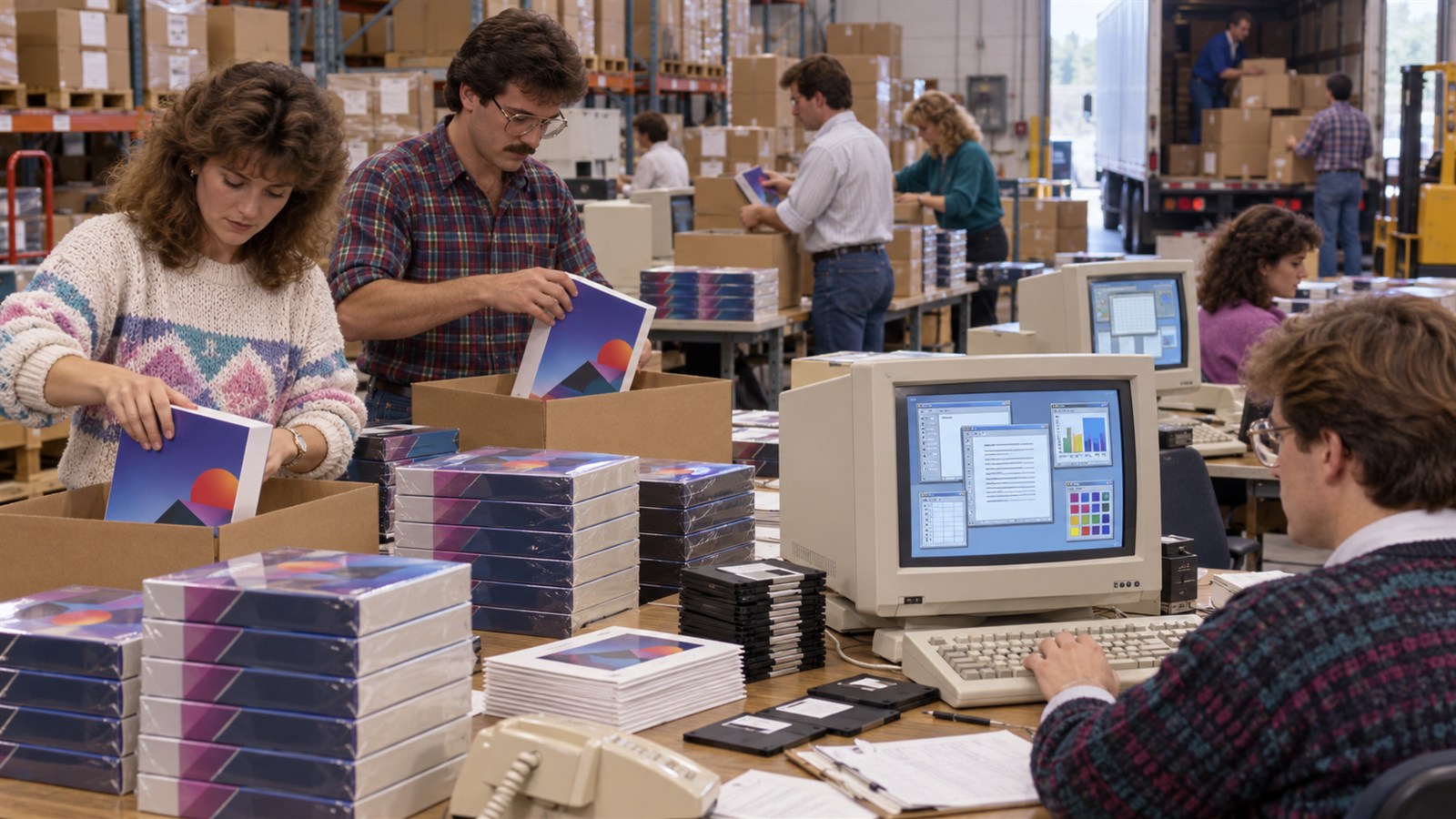
On November 20, 1985, Microsoft announced retail shipment of Windows 1.0 to dealers and distributors. The software ran as a graphical environment on top of MS-DOS and included tiled windows, menus, mouse support, and utility applications. It arrived two years after Microsoft had first announced the project, making shipment itself an important credibility test. The immediate product was only one layer of the opportunity. A platform becomes valuable when developers, distributors, customers, and complementary products can coordinate around it. That makes compatibility, documentation, pricing, and timing as important as the features visible in the first demonstration.
Hardware limits shaped the experience. Many PCs had little memory, slow processors, and displays that constrained graphics, while users already understood command-line DOS. Microsoft therefore had to persuade buyers that a mouse-driven environment justified new habits and sometimes new equipment. Developers likewise had to decide whether the young platform would reach enough customers. Adoption also carried switching costs. Buyers had to learn new interfaces, convert files, test hardware, and trust that support would continue. The vendor therefore needed an ecosystem, not merely code: tools, training, partners, and a roadmap that reduced the perceived risk of committing to the new standard.
The first version was not a runaway commercial success, but it gave Microsoft code, partners, feedback, and a base for improvement. Later releases benefited from more capable PCs and stronger applications. Persistence allowed the company to turn an initially modest product into a central layer of the computer industry. As participation increased, network effects strengthened the proposition. More users attracted more applications and services, which attracted still more users. That flywheel could create durable advantage, but it also made governance consequential because technical decisions by one company affected an expanding community.
Windows 1.0 is a reminder that platform strategy unfolds across versions. Early releases can be valuable because they create organizational learning and give external partners something concrete to test. That does not excuse weak execution, but it means managers should judge a foundational product by its learning curve and ecosystem progress as well as first-year sales. For today's technology leaders, the lesson is to design the surrounding market along with the product. Open interfaces, dependable support, backward compatibility, and clear incentives can turn a clever invention into infrastructure. Neglect those relationships and even superior technology may remain an isolated demonstration. In practical terms, the advantage came from linking a clear customer promise to disciplined execution. Capital had to be allocated before demand was certain, employees and partners had to coordinate, and leaders had to keep learning after the initial milestone passed into history.
Windows 1.0 shipped to dealers on November 20, 1985.
It ran as a graphical environment on top of MS-DOS.
The product used tiled windows, menus, and mouse input.
Hardware limitations slowed early adoption.
The first release created experience and a base for later versions.
Microsoft's persistence eventually made Windows a dominant PC platform.
Explore more of "On This Day ..."
Discover more events from the same date across news, politics, technology, sports, and other fields. Each link highlights significant moments that shaped history on different fronts.