

On This Day in Business: December 1, 1913
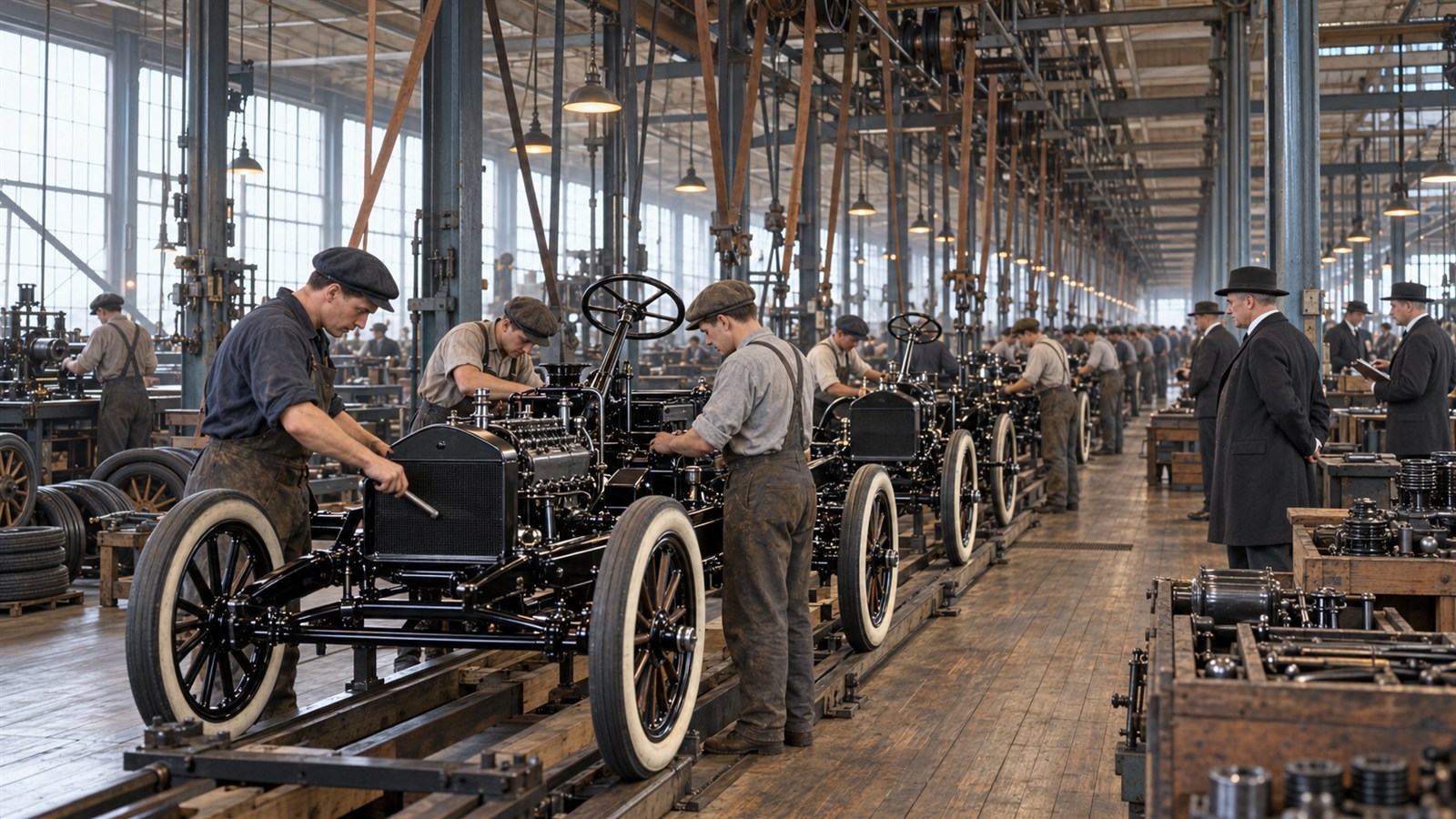
On December 1, 1913, Ford put its moving chassis assembly line through a defining full-scale production day at Highland Park, Michigan. Company records describe 177 workers completing 606 Model T chassis on the lengthened line, concentrating a series of earlier experiments into a tightly sequenced system. The business importance was operational rather than ceremonial. Management had to translate a promising design into repeatable work, coordinate labor and suppliers, control cost, and protect quality as volume increased. The milestone mattered because it showed that process discipline could turn technical capability into an advantage customers could actually receive.
Ford engineers had tested moving work on individual components before linking chassis tasks. Instead of teams walking with a vehicle, the work came to fixed stations. Standard parts, specialized tools, gravity slides, and carefully timed motions reduced travel and waiting while making imbalances visible to supervisors. Scaling also redistributed risk across employees, vendors, investors, and local communities. Capacity created opportunity, but it also fixed capital in specialized equipment and made interruptions expensive. Leaders needed measures that revealed bottlenecks quickly and incentives that rewarded steady improvement instead of short bursts of output.
The system helped shorten Model T assembly time and supported higher output at lower unit cost. Greater productivity allowed Ford to cut prices and expand the automobile market, although the pace and repetition imposed new strains on workers and contributed to labor turnover that management later addressed with higher pay. Competitors could see the finished product, yet the harder asset to copy was the system behind it: training, sequencing, standards, maintenance, and accumulated learning. Those capabilities compound when workers can surface problems and managers convert experience into better routines without losing sight of safety or demand.
The December milestone did not spring from one invention or one day. It represented cumulative experimentation in layout, parts interchangeability, material flow, and job design. Its legacy is the operating idea that a complex product can move through a stable sequence while people, tools, and supplies arrive exactly when needed. For modern operators, the lesson is to treat production as a living network. Capacity, workforce development, supplier resilience, and customer expectations must reinforce one another. A headline milestone creates momentum, but durable returns come from thousands of ordinary decisions made reliably after the public moment has passed. In practical terms, the advantage came from linking a clear public or customer promise to disciplined execution. Capital and attention had to be committed before demand was certain, partners had to coordinate, and leaders had to keep learning after the first milestone passed into history. The strongest legacy was not the announcement alone, but the repeatable capability, institution, or market that people built around it afterward.
Ford scaled a complete moving chassis line on December 1, 1913.
The Highland Park test joined earlier experiments on individual components.
Workers stayed at stations while chassis moved through a planned sequence.
Standard parts and timed tasks increased output and exposed bottlenecks.
Lower costs helped Ford reduce Model T prices and broaden demand.
The system also intensified repetitive work and forced labor-policy changes.
Explore more of "On This Day ..."
Discover more events from the same date across news, politics, technology, sports, and other fields. Each link highlights significant moments that shaped history on different fronts.