

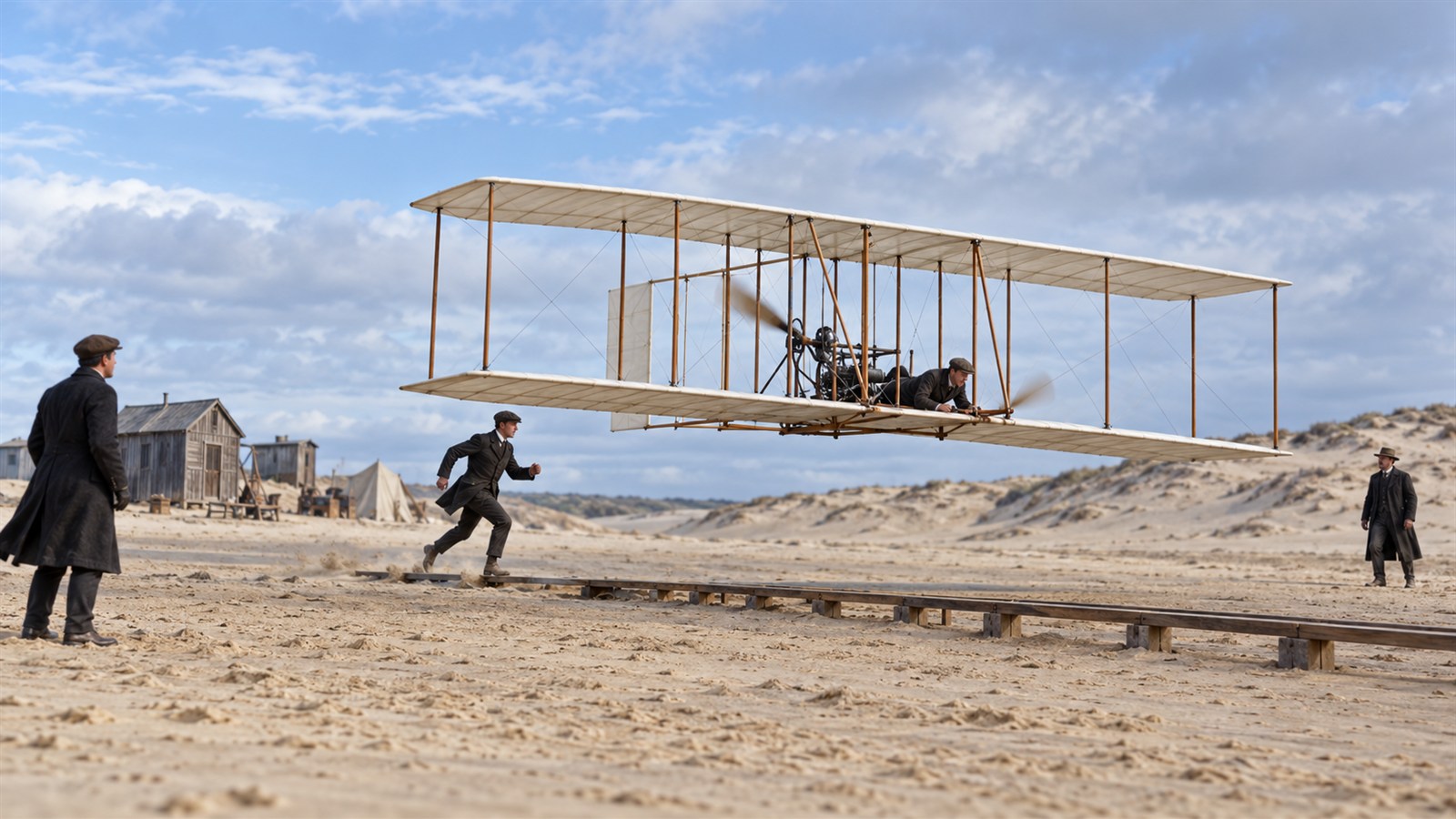
On This Day in Business: December 17, 1903
On December 17, 1903, Orville and Wilbur Wright made four controlled powered flights near Kitty Hawk, North Carolina. Orville's first attempt lasted twelve seconds and covered 120 feet; the final flight, with Wilbur at the controls, traveled 852 feet in fifty-nine seconds. The immediate invention was only one layer of the opportunity. Commercial value depended on interfaces, complementary products, training, support, and confidence that the new system would keep improving. Early adopters were not simply buying hardware or software; they were accepting workflow change and uncertainty about an emerging standard.
The achievement joined three problems the brothers had studied methodically: lift, propulsion, and control. Wind-tunnel tests improved wing data, a lightweight engine supplied power, and wing warping with coordinated rudder movement let the pilot manage the aircraft rather than merely endure a brief hop. Adoption required translation between specialists and ordinary users. Performance claims had to become understandable tasks, while cost, reliability, and compatibility determined whether an impressive demonstration could survive outside the laboratory. Documentation and service therefore mattered nearly as much as the breakthrough itself.
Aviation did not become a large business that day. Aircraft reliability, manufacturing, training, navigation, airports, safety rules, mail contracts, and passenger confidence all had to develop. Military and government demand later financed capacity that commercial operators could extend into transport networks. As more organizations participated, learning and network effects strengthened the proposition. New uses attracted investment, investment improved tools, and better tools brought additional users. That cycle could create durable advantage, but it also made governance important because technical choices by a small group affected a widening market.
The flights illustrate the gap between invention and industry. A working prototype resolves essential technical uncertainty, but markets require systems around it. The Wrights' disciplined testing, protection of intellectual property, and pursuit of customers mattered alongside the machine itself, even as patent disputes later complicated the emerging field. The modern lesson is to design the ecosystem along with the product. Dependable support, open pathways for complements, sensible standards, and clear incentives can turn a clever prototype into infrastructure. Without those surrounding relationships, even remarkable technology may remain isolated or arrive before customers are ready. In practical terms, the advantage came from linking a clear public or customer promise to disciplined execution. Capital and attention had to be committed before demand was certain, partners had to coordinate, and leaders had to keep learning after the first milestone passed into history. The strongest legacy was not the announcement alone, but the repeatable capability, institution, or market that people built around it afterward.
The Wright brothers flew four times on December 17, 1903.
The first flight lasted twelve seconds and covered 120 feet.
The final flight covered 852 feet in fifty-nine seconds.
Control was as important as lift and propulsion.
Commercial aviation required factories, pilots, airports, rules, and public trust.
The event marked invention's beginning, not a finished transportation market.
Explore more of "On This Day ..."
Discover more events from the same date across news, politics, technology, sports, and other fields. Each link highlights significant moments that shaped history on different fronts.