

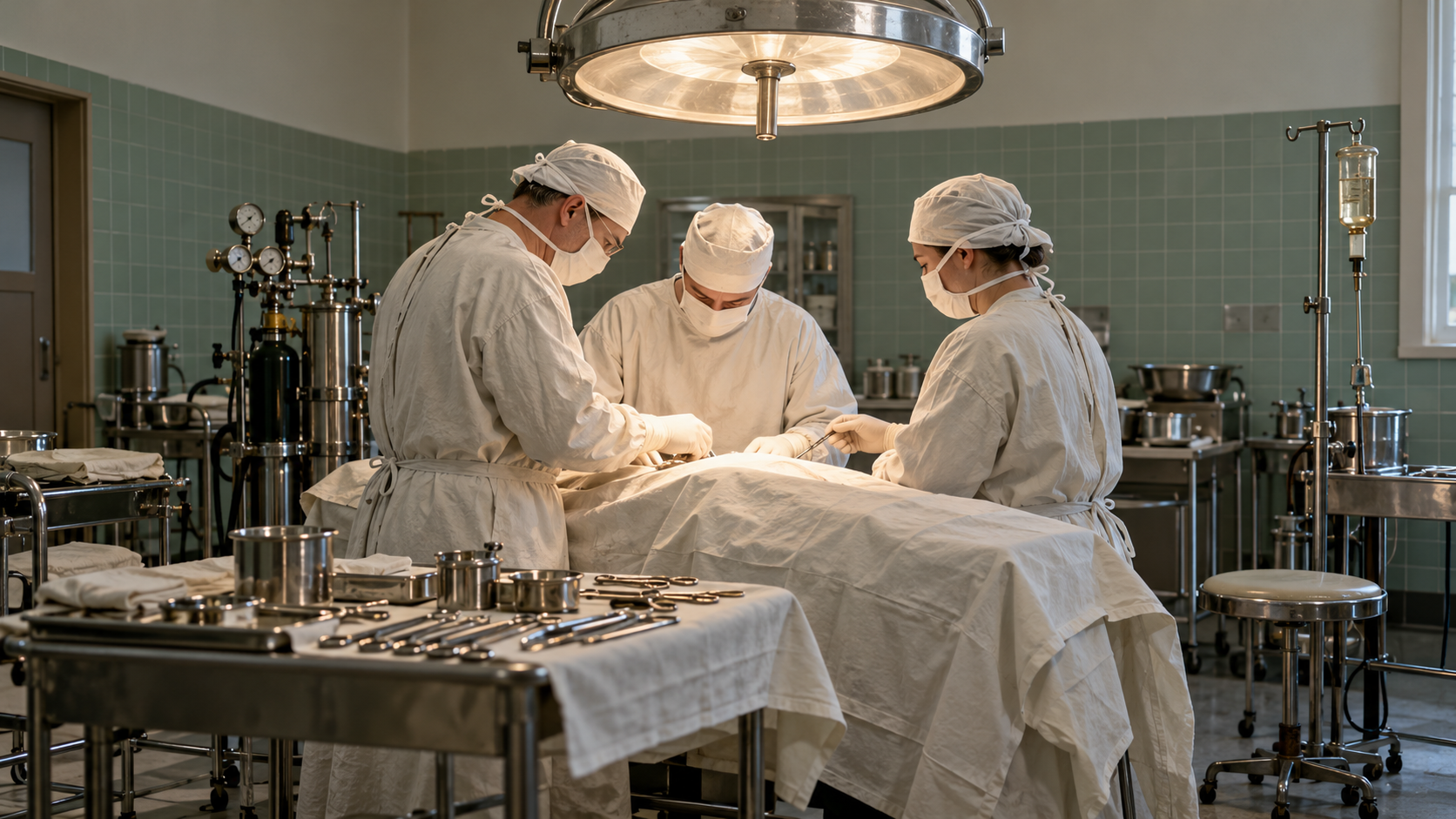
On This Day in Health: June 17, 1950
On June 17, 1950, a surgical team led by Richard Lawler transplanted a deceased donor's kidney into Ruth Tucker at Little Company of Mary Hospital in Evergreen Park, Illinois, near Chicago. Tucker had polycystic kidney disease, an inherited condition in which cysts damage the kidneys. Surgeon James West also played a central role in the operation. The procedure became a landmark in the early history of internal kidney transplantation in the United States. It demonstrated that surgeons could connect another person's kidney inside a recipient's body, while leaving unresolved the biological problem that would dominate the field: immune rejection.
The operation occurred before long-term dialysis was widely available and before effective transplant immunosuppression became established. Surgeons had experimented with organ grafts for decades, and earlier human kidney transplant attempts had taken place outside this Illinois hospital. Connecting blood vessels was only part of the challenge. A transplanted kidney also needed a blood supply, a route for urine to drain and protection from an immune system that recognized unfamiliar tissue. Blood-group matching could address one source of incompatibility, but it could not solve every difference between donor and recipient. Lawler's team therefore entered an area where surgical feasibility had advanced beyond the ability to control rejection reliably.
Tucker survived the immediate operation and eventually returned home. That outcome attracted attention because replacing an organ had seemed an extraordinary prospect, especially at a community hospital. It did not, however, establish a dependable treatment that could simply be repeated for every patient with kidney failure. The donor kidney was later removed after it failed, and Tucker's remaining native kidney provided enough function for her to survive for several more years. Accounts have differed over how much function the graft supplied and how it contributed to her recovery. Her survival should therefore be distinguished from sustained survival supported by a permanently functioning transplanted kidney.
Later milestones made that distinction clearer. In December 1954, a Boston team performed a kidney transplant between identical twins, avoiding the major genetic differences that trigger rejection and achieving lasting graft function. Subsequent improvements in immune suppression and tissue assessment helped extend transplantation to broader groups of patients. Those developments followed rather than accompanied Tucker's surgery. The significance of June 17 lies in a pioneering operation that tested whether the technical connections could work and helped bring the obstacles into sharper focus. Tucker's experience belongs in the history of transplantation as an important early step, alongside the patients, donors and medical teams whose later work transformed a hazardous experiment into an established form of care.
Ruth Tucker had polycystic kidney disease at a time when the options for advanced kidney failure were extremely limited. Little Company of Mary was a community hospital in the Chicago suburb of Evergreen Park.
Richard Lawler and James West worked on an operation involving a deceased donor's kidney. Earlier human transplant attempts had already occurred elsewhere, so this event should not be described as the world's first attempt at a human kidney transplant.
Tucker survived surgery and left hospital, providing an important demonstration of surgical feasibility. A successful immediate recovery did not answer the question of whether a donor kidney could function indefinitely.
The graft eventually failed and was removed. Historical accounts differ on its contribution to her subsequent survival, making it essential to distinguish the patient's recovery from proven long-term graft function.
The 1954 Boston transplant between identical twins provided a later, distinct milestone in sustained kidney transplantation. Genetic identity helped avoid rejection in a way the 1950 deceased-donor operation could not.
Modern transplantation required progress in surgery, immunology, donor assessment and continuing care. The Illinois operation helped demonstrate both the possibilities of organ replacement and the limits of surgical skill alone.
Explore more of "On This Day ..."
Discover more events from the same date across news, politics, technology, sports, and other fields. Each link highlights significant moments that shaped history on different fronts.