

On This Day in Health: July 9, 2014
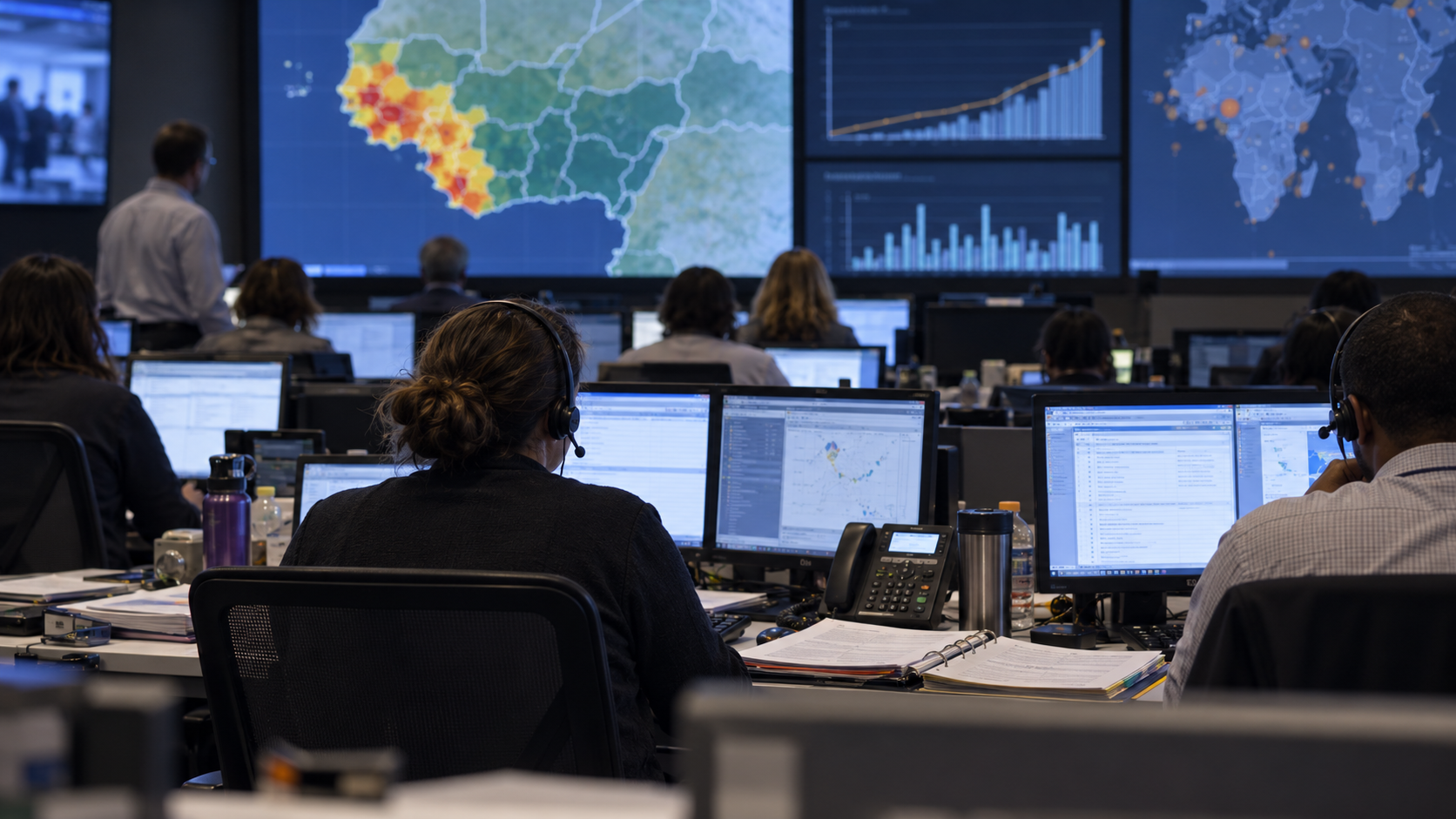
On July 9, 2014, the Centers for Disease Control and Prevention activated its Emergency Operations Center in Atlanta to support the response to the Ebola outbreak spreading in West Africa. Cases had first been reported in southeastern Guinea in March and transmission had extended into Liberia and Sierra Leone. Activation brought epidemiology, laboratory science, logistics, communications, emergency management, and other specialties into a shared incident structure. It also increased deployments and formalized a consultation service for American health departments and clinicians evaluating people who might have been exposed. The step occurred before the epidemic reached its peak and before the first Ebola diagnosis made in the United States.
An Emergency Operations Center does not replace field work. It creates a central system for setting priorities, tracking information, assigning staff, coordinating agencies, and supporting responders who are working across many locations. CDC teams assisted ministries of health with surveillance, contact tracing, infection prevention, laboratory testing, safe transport, and public communication. Domestically, the agency helped laboratories obtain validated tests and advised hospitals and health departments about suspected cases. The response later expanded to thousands of participating CDC staff, including specialists deployed to affected countries. Coordination was essential because ordinary health systems in the hardest-hit areas were being overwhelmed by sustained urban and rural transmission.
The July activation did not mean the danger was understood or controlled. Early case counts were incomplete, treatment capacity was scarce, and responders faced fear, misinformation, unsafe burial practices, and severe shortages. The EOC was elevated to CDC's highest activation level in August as conditions worsened. In September, a traveler from Liberia became the first person diagnosed with Ebola in the United States, and two nurses who cared for him were infected. Those events exposed gaps in hospital readiness and protective procedures. Guidance changed as evidence and operational experience accumulated, demonstrating that emergency coordination must adapt rather than simply issue a fixed plan.
The 2014–2016 epidemic became the largest recorded Ebola outbreak, causing more than 28,000 reported cases and 11,000 deaths, principally in Guinea, Liberia, and Sierra Leone. CDC described its response as the largest in the agency's history at that time. The EOC remained activated until March 31, 2016. Its work contributed to testing, preparedness, contact monitoring, and international support, but the epidemic was ended through the combined efforts of national governments, local communities, health workers, laboratories, aid organizations, and global partners. July 9 marks the moment CDC shifted into coordinated emergency operations, an early institutional response whose value and limitations became clearer as the crisis grew.
EOC activation organized multiple specialties under an incident-management structure. It helped CDC assign staff, track decisions, and coordinate domestic and international work.
The activation occurred months before the first U.S. diagnosis. Early deployments and consultation focused on West Africa and preparedness for possible imported cases.
Coordination could not compensate for every shortage. Treatment beds, laboratories, protective equipment, trained staff, and trusted local communication remained critical constraints.
Guidance evolved as responders learned more. Later U.S. cases revealed weaknesses in hospital infection control and prompted additional training and procedures.
The response eventually involved thousands of CDC staff and remained active until March 2016. It was the agency's largest emergency response at the time.
Ending transmission depended on affected communities and many partners. The Atlanta EOC supported that work but was only one part of the international effort.
Explore more of "On This Day ..."
Discover more events from the same date across news, politics, technology, sports, and other fields. Each link highlights significant moments that shaped history on different fronts.