

On This Day in Health: July 27, 1921
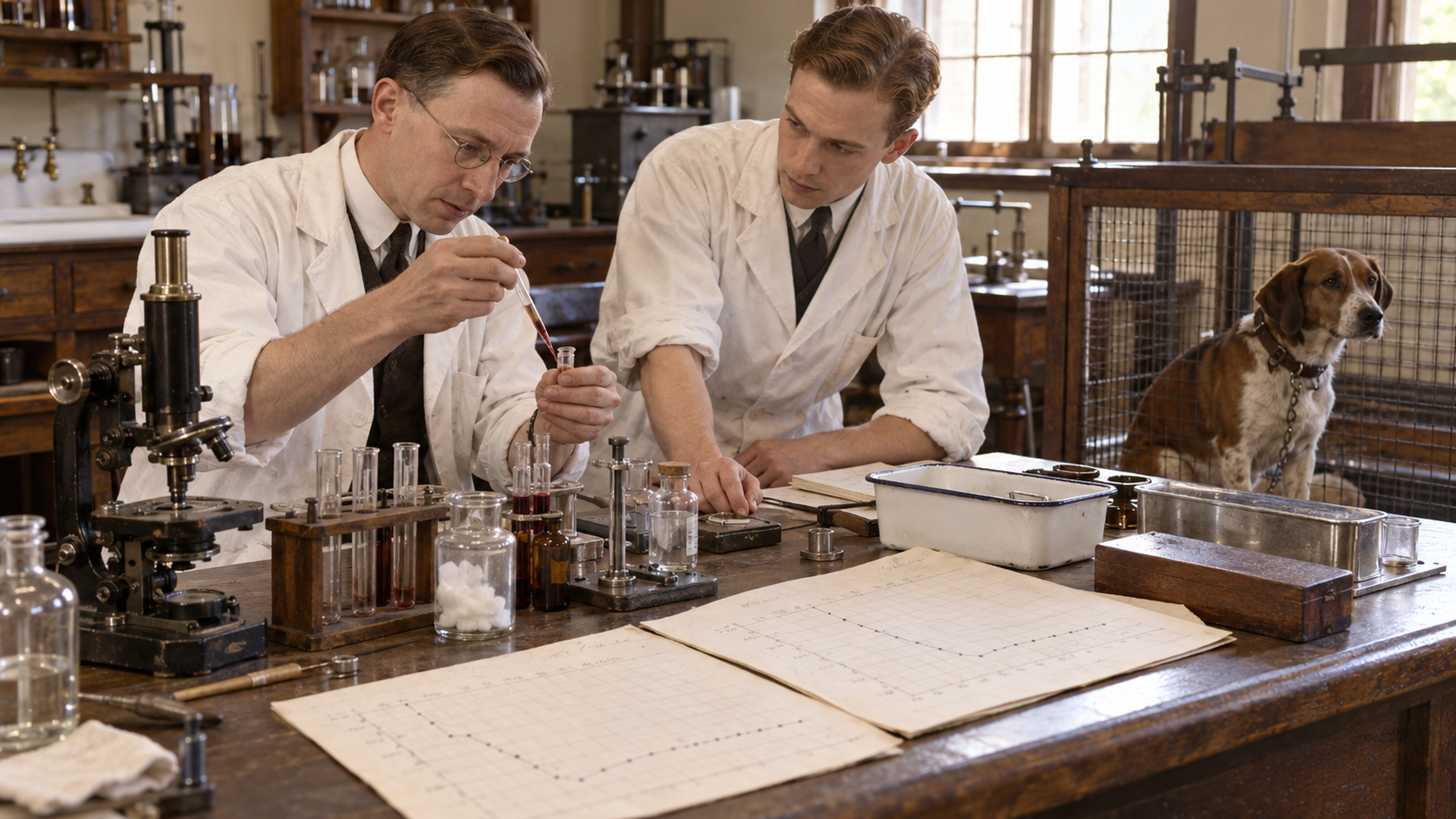
On July 27, 1921, Frederick Banting and Charles Best achieved a crucial experimental result at the University of Toronto while searching for the pancreatic substance that controls blood sugar. Working in laboratory space provided by physiology professor John Macleod, they prepared a pancreatic extract and tested it in a dog made diabetic by removal of its pancreas. The extract lowered the animal's blood glucose and improved its condition. Their material was still crude, their methods were evolving, and many experiments remained ahead. Yet the result offered persuasive evidence that an internal pancreatic secretion could be isolated and used to counter diabetes.
Before insulin therapy, type 1 diabetes was usually fatal. Physicians could prolong some lives with severe carbohydrate restriction, but patients often became dangerously undernourished while the disease continued. Banting, a young surgeon, had proposed tying off pancreatic ducts so digestive tissue would degenerate while the islets believed to produce the antidiabetic substance remained. Best, a medical student with laboratory experience, helped conduct surgery, chemical tests, and glucose measurements. Macleod supplied facilities, guidance, and later broader scientific support. Their summer work did not appear from nowhere; it drew on decades of research linking the pancreas, islet cells, and carbohydrate metabolism.
The July experiment was a beginning rather than a finished medicine. The Toronto group had to repeat the findings, improve extraction, determine dosing, and produce material safe enough for people. Biochemist James Collip joined later in 1921 and made decisive progress purifying the extract. In January 1922, fourteen-year-old Leonard Thompson became the first person with diabetes to receive the team's preparation. An initial injection caused problems and limited benefit, but a more purified course soon lowered his blood sugar and improved his condition. The collaboration among Banting, Best, Macleod, Collip, clinicians, and production specialists transformed a laboratory signal into a practical therapy.
Insulin rapidly changed diabetes from an almost certain death sentence into a manageable chronic disease for many patients who could obtain treatment. Banting and Macleod received the 1923 Nobel Prize in Physiology or Medicine; Banting shared his award money with Best, and Macleod shared his with Collip. The discovery also raised enduring questions about credit, animal research, manufacturing, patents, affordability, and access. Modern insulins, delivery devices, and glucose monitoring are far more advanced than the Toronto extracts, but they trace back to the evidence assembled in 1921. July 27 marks the experimental turning point within a larger collaborative achievement that has sustained millions of lives.
Banting began laboratory work at the University of Toronto in spring 1921 with Charles Best, space and equipment from John Macleod, and a hypothesis about pancreatic islet secretion.
The July 27 experiment showed that a pancreatic extract could lower blood glucose in a diabetic dog, providing a pivotal proof that the team's approach had therapeutic potential.
The extract remained crude, inconsistent, and unsuitable for routine human treatment; successful therapy required repeated experiments, better purification, clinical oversight, and scalable production.
James Collip's biochemical work helped produce a preparation that successfully treated Leonard Thompson in January 1922 after an unsatisfactory first injection.
Insulin converted type 1 diabetes from a rapidly fatal condition into one that could be managed, although treatment requires lifelong monitoring and reliable access to medicine.
The discovery was collaborative, and later debates over Nobel credit and commercial supply continue to shape how medical innovation, ownership, and access are understood.
Explore more of "On This Day ..."
Discover more events from the same date across news, politics, technology, sports, and other fields. Each link highlights significant moments that shaped history on different fronts.