

On This Day in Health: September 25, 1866
On September 25, 1866, Thomas Hunt Morgan was born in Lexington, Kentucky. He became an experimental biologist whose fruit-fly research demonstrated that genes occupy positions on chromosomes, providing a physical framework for heredity with lasting importance for medicine. This date matters because it fixes a broad medical story to a specific moment, place, and group of people. It also shows how health history is shaped by institutions and practical choices as well as laboratory discoveries.
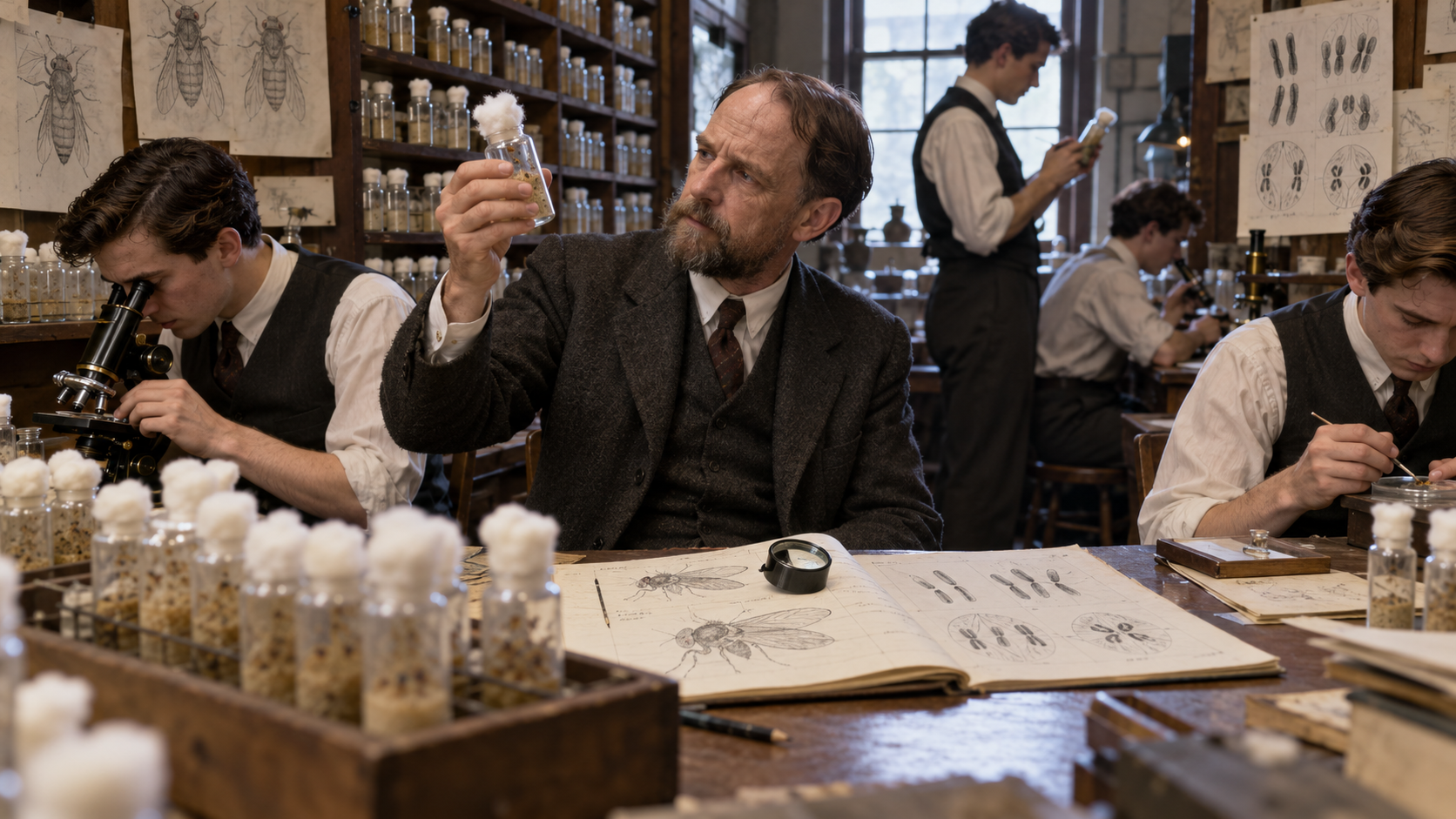
The background was already developing before that day. After Mendel's work was rediscovered around 1900, scientists debated how inherited factors related to cells and chromosomes. Morgan initially doubted simple Mendelian explanations. At Columbia University, he and a small group bred large numbers of Drosophila melanogaster because the flies reproduced quickly and showed visible traits. Those conditions defined what participants could attempt and what patients or communities could reasonably expect. They also explain why later accounts sometimes compress years of preparation into a single anniversary. Looking at that preparation keeps credit broad and makes the turning point easier to understand without turning it into a miracle story.
What happened on the date was consequential but limited. A white-eyed male fly led Morgan's team to link a trait with the X chromosome. Alfred Sturtevant used recombination frequencies to make a genetic map, while Calvin Bridges and others connected unusual inheritance patterns with chromosome behavior. The work made genes experimentally locatable. The fly room depended on collaboration, and the traditional focus on Morgan can obscure the contributions of students, technicians, and his wife, Lilian Vaughan Morgan. Fly genetics also offered a model, not a direct explanation of every human trait or disease. The distinction is important: the event did not instantly solve the underlying health problem, and later progress depended on follow-up research, training, policy, funding, and public trust. Contemporary evidence also helps separate what participants knew then from interpretations added after the result became famous.
Its longer legacy reaches beyond the original setting. Morgan received the 1933 Nobel Prize for discoveries concerning the chromosome's role in heredity. Drosophila became a major biomedical model for development, neurobiology, behavior, cancer, and genetic disease, and chromosome mapping prepared the way for molecular genetics. Modern sequencing works at a scale Morgan could not imagine, but researchers still rely on his central idea: inherited variation can be mapped, tested, and connected to biological function. Seen in context, the anniversary is useful because it connects a concrete historical episode with continuing questions about evidence, access, safety, and responsibility in health care. That connection is stronger when the people affected, the limits of the achievement, and the work still unfinished remain part of the account.
A white-eyed male fly led Morgan's team to link a trait with the X chromosome. Alfred Sturtevant used recombination frequencies to make a genetic map, while Calvin Bridges and others connected unusual inheritance patterns with chromosome behavior. The work made genes experimentally locatable.
The fly room depended on collaboration, and the traditional focus on Morgan can obscure the contributions of students, technicians, and his wife, Lilian Vaughan Morgan. Fly genetics also offered a model, not a direct explanation of every human trait or disease.
Morgan received the 1933 Nobel Prize for discoveries concerning the chromosome's role in heredity. Drosophila became a major biomedical model for development, neurobiology, behavior, cancer, and genetic disease, and chromosome mapping prepared the way for molecular genetics.
After Mendel's work was rediscovered around 1900, scientists debated how inherited factors related to cells and chromosomes. Morgan initially doubted simple Mendelian explanations. At Columbia University, he and a small group bred large numbers of Drosophila melanogaster because the flies reproduced quickly and showed visible traits.
Thomas Hunt Morgan was born in Lexington, Kentucky. He became an experimental biologist whose fruit-fly research demonstrated that genes occupy positions on chromosomes, providing a physical framework for heredity with lasting importance for medicine.
Modern sequencing works at a scale Morgan could not imagine, but researchers still rely on his central idea: inherited variation can be mapped, tested, and connected to biological function.
Explore more of "On This Day ..."
Discover more events from the same date across news, politics, technology, sports, and other fields. Each link highlights significant moments that shaped history on different fronts.