

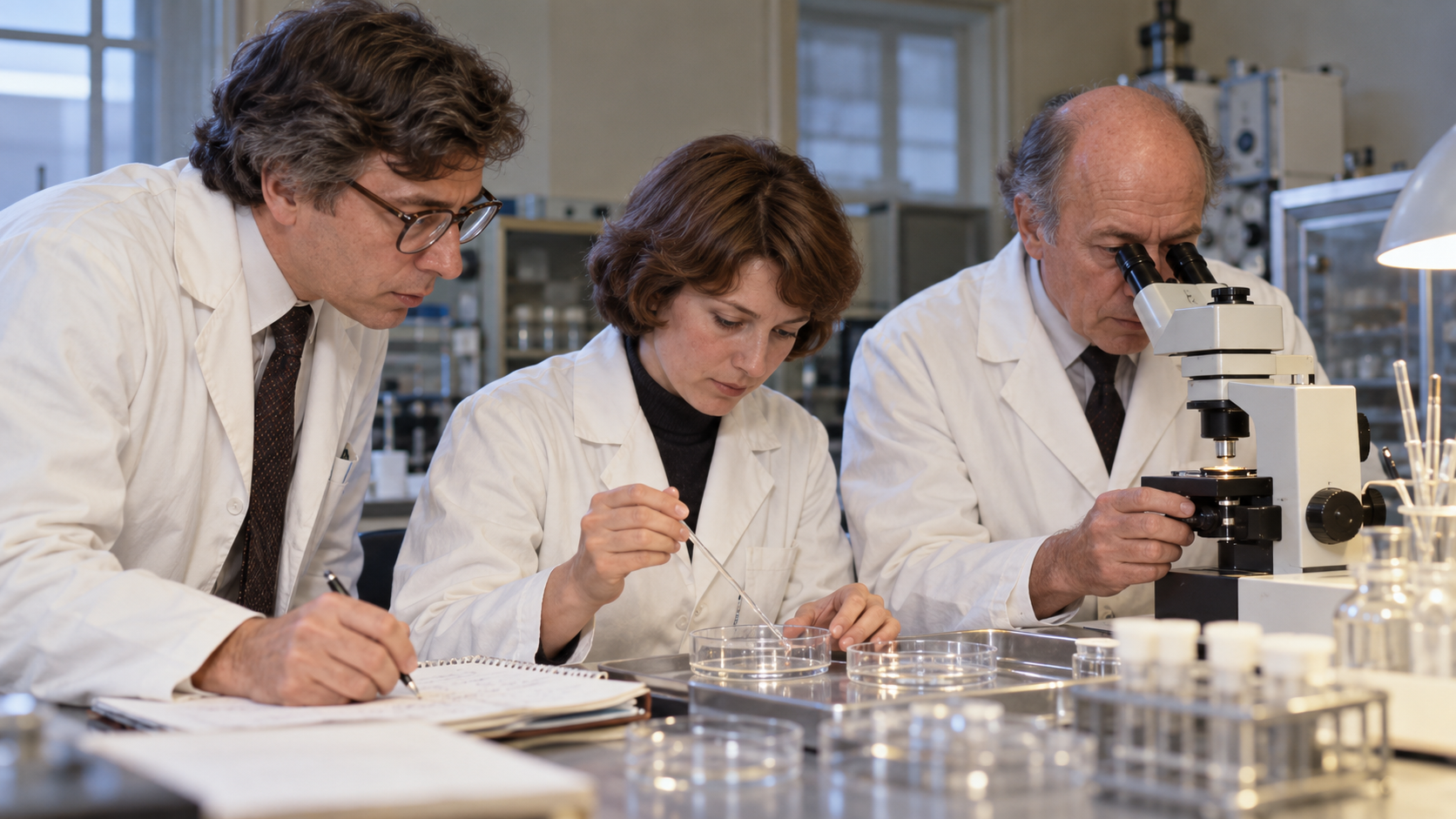
On This Day in Health: September 27, 1925
On September 27, 1925, Robert Geoffrey Edwards was born in Batley, England. The reproductive physiologist later worked with gynecologist Patrick Steptoe and embryologist Jean Purdy to develop in vitro fertilization, offering a new route to pregnancy for people facing infertility. This date matters because it fixes a broad medical story to a specific moment, place, and group of people. It also shows how health history is shaped by institutions and practical choices as well as laboratory discoveries.
The background was already developing before that day. Edwards studied how human eggs mature and how sperm fertilizes them. Steptoe brought laparoscopic skill that allowed eggs to be collected from the ovaries, while Purdy managed laboratory work, observed embryos, and helped build the clinical program. The research faced repeated failure, limited funding, and intense ethical scrutiny. Those conditions defined what participants could attempt and what patients or communities could reasonably expect. They also explain why later accounts sometimes compress years of preparation into a single anniversary. Looking at that preparation keeps credit broad and makes the turning point easier to understand without turning it into a miracle story.
What happened on the date was consequential but limited. The team refined hormone timing, egg retrieval, laboratory culture, and embryo transfer. Their work led to the birth of Louise Brown in 1978, the first child born after IVF. Edwards and Steptoe later established Bourn Hall, a clinic devoted to fertility treatment and research. Early accounts often minimized Purdy's contribution, and access to IVF has remained unequal because treatment can be costly and insurance coverage limited. Multiple-embryo transfer also increased risks of multiple pregnancy until practice shifted toward fewer embryos and improved selection. The distinction is important: the event did not instantly solve the underlying health problem, and later progress depended on follow-up research, training, policy, funding, and public trust. Contemporary evidence also helps separate what participants knew then from interpretations added after the result became famous.
Its longer legacy reaches beyond the original setting. Edwards received the 2010 Nobel Prize for the development of IVF. The methods opened paths to intracytoplasmic sperm injection, embryo freezing, donor treatment, fertility preservation, and genetic testing, while generating continuing debates over consent, storage, parenthood, and equity. Millions of births later, IVF is both routine and emotionally demanding. Its history shows that reproductive innovation depends on laboratory science, clinical teamwork, transparent ethics, and care for patients through uncertain outcomes. Seen in context, the anniversary is useful because it connects a concrete historical episode with continuing questions about evidence, access, safety, and responsibility in health care. That connection is stronger when the people affected, the limits of the achievement, and the work still unfinished remain part of the account.
The team refined hormone timing, egg retrieval, laboratory culture, and embryo transfer. Their work led to the birth of Louise Brown in 1978, the first child born after IVF. Edwards and Steptoe later established Bourn Hall, a clinic devoted to fertility treatment and research.
Early accounts often minimized Purdy's contribution, and access to IVF has remained unequal because treatment can be costly and insurance coverage limited. Multiple-embryo transfer also increased risks of multiple pregnancy until practice shifted toward fewer embryos and improved selection.
Edwards received the 2010 Nobel Prize for the development of IVF. The methods opened paths to intracytoplasmic sperm injection, embryo freezing, donor treatment, fertility preservation, and genetic testing, while generating continuing debates over consent, storage, parenthood, and equity.
Edwards studied how human eggs mature and how sperm fertilizes them. Steptoe brought laparoscopic skill that allowed eggs to be collected from the ovaries, while Purdy managed laboratory work, observed embryos, and helped build the clinical program. The research faced repeated failure, limited funding, and intense ethical scrutiny.
Robert Geoffrey Edwards was born in Batley, England. The reproductive physiologist later worked with gynecologist Patrick Steptoe and embryologist Jean Purdy to develop in vitro fertilization, offering a new route to pregnancy for people facing infertility.
Millions of births later, IVF is both routine and emotionally demanding. Its history shows that reproductive innovation depends on laboratory science, clinical teamwork, transparent ethics, and care for patients through uncertain outcomes.
Explore more of "On This Day ..."
Discover more events from the same date across news, politics, technology, sports, and other fields. Each link highlights significant moments that shaped history on different fronts.