

On This Day in Health: October 24, 1632
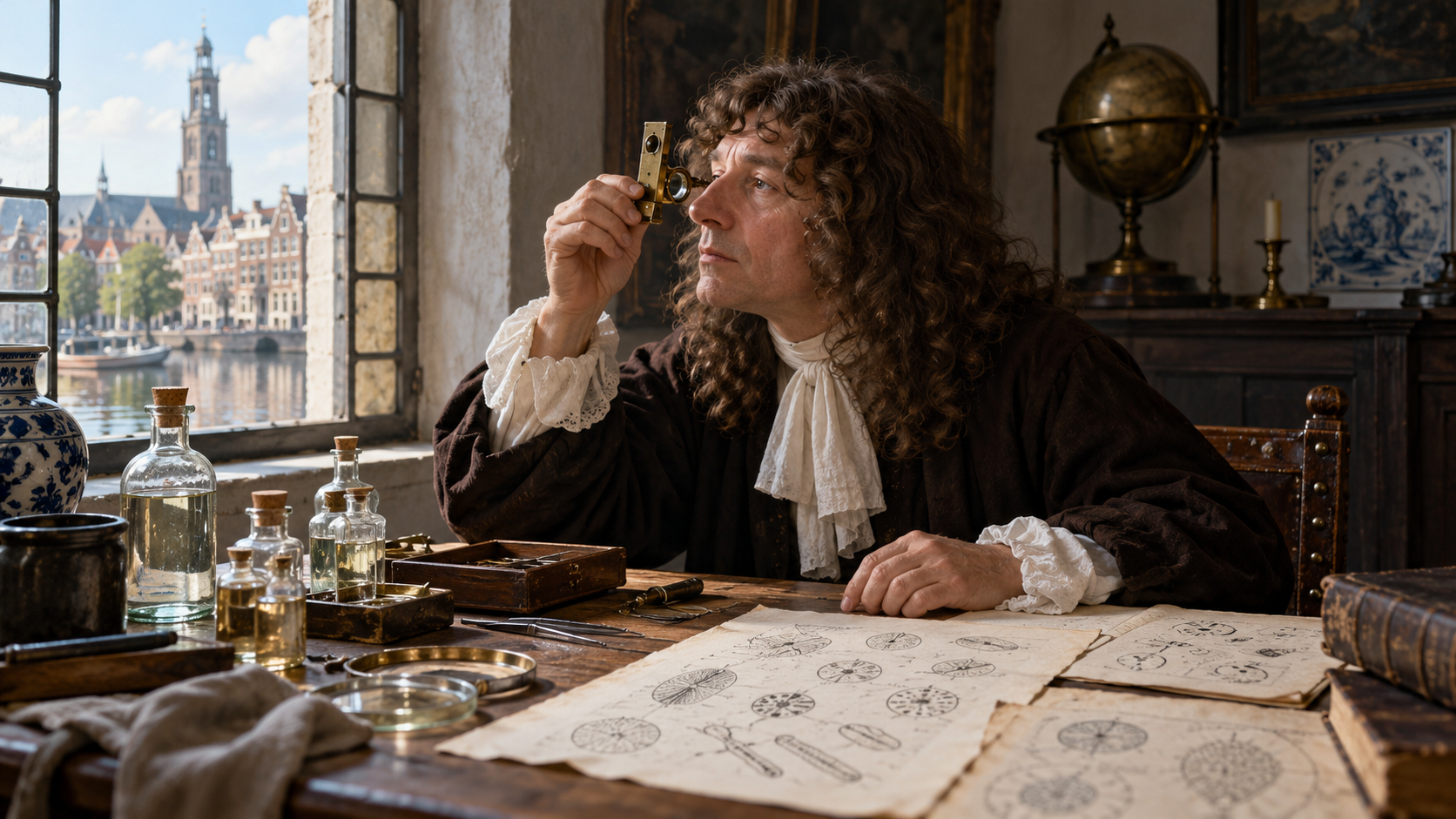
On October 24, 1632, Antonie van Leeuwenhoek was born in Delft in the Dutch Republic. A cloth merchant and civic official rather than a university professor, he became one of history's most skilled makers and users of simple microscopes. This date matters because it fixes a broad medical story to a specific moment, place, and group of people. It also shows how health history is shaped by institutions and practical choices as well as laboratory discoveries.
The background was already developing before that day. Robert Hooke and others had shown that magnification could reveal hidden structure, but available lenses often produced distortion. Leeuwenhoek learned to make tiny, powerful lenses and prepared specimens with unusual patience and practical ingenuity. Those conditions defined what participants could attempt and what patients or communities could reasonably expect. The available tools, social expectations, and professional structures all shaped the result. Change also depended on cooperation among people whose roles were not always recorded equally. They also explain why later accounts sometimes compress years of preparation into a single anniversary. Looking at that preparation keeps credit broad and makes the turning point easier to understand without turning it into a miracle story.
What happened on the date was consequential but limited. Beginning in the 1670s, he reported observations of protozoa, bacteria, blood cells, sperm cells, muscle fibers, and microscopic structures to the Royal Society. Independent witnesses were sometimes asked to confirm findings that readers found hard to believe. He did not develop germ theory or connect specific microbes with specific diseases. His instruments were difficult to use, he guarded parts of his craft, and interpretation remained limited by the absence of staining, culture methods, and modern experimental controls. The distinction is important: the event did not instantly solve the underlying health problem, and later progress depended on follow-up research, training, policy, funding, and public trust. Contemporary evidence also helps separate what participants knew then from interpretations added after the result became famous.
Its longer legacy reaches beyond the original setting. His letters made a previously invisible biological world part of science and supplied foundations for microbiology, cell biology, reproductive biology, and the study of infection. Modern microscopes visualize molecules and living cells at extraordinary resolution, yet the discipline still depends on careful preparation, repeated observation, transparent methods, and restraint about what an image alone can prove. Seen in context, the anniversary is useful because it connects a concrete historical episode with continuing questions about evidence, access, safety, and responsibility in health care. That connection is stronger when the people affected, the limits of the achievement, and the work still unfinished remain part of the account.
Beginning in the 1670s, he reported observations of protozoa, bacteria, blood cells, sperm cells, muscle fibers, and microscopic structures to the Royal Society. Independent witnesses were sometimes asked to confirm findings that readers found hard to believe.
He did not develop germ theory or connect specific microbes with specific diseases. His instruments were difficult to use, he guarded parts of his craft, and interpretation remained limited by the absence of staining, culture methods, and modern experimental controls.
His letters made a previously invisible biological world part of science and supplied foundations for microbiology, cell biology, reproductive biology, and the study of infection.
Robert Hooke and others had shown that magnification could reveal hidden structure, but available lenses often produced distortion. Leeuwenhoek learned to make tiny, powerful lenses and prepared specimens with unusual patience and practical ingenuity.
Antonie van Leeuwenhoek was born in Delft in the Dutch Republic. A cloth merchant and civic official rather than a university professor, he became one of history's most skilled makers and users of simple microscopes.
Modern microscopes visualize molecules and living cells at extraordinary resolution, yet the discipline still depends on careful preparation, repeated observation, transparent methods, and restraint about what an image alone can prove.
Explore more of "On This Day ..."
Discover more events from the same date across news, politics, technology, sports, and other fields. Each link highlights significant moments that shaped history on different fronts.