

On This Day in Health: October 28, 1914
On October 28, 1914, Jonas Edward Salk was born in New York City. He became the physician-scientist who led development of an inactivated poliovirus vaccine during the most feared years of the American polio epidemic. This date matters because it fixes a broad medical story to a specific moment, place, and group of people. It also shows how health history is shaped by institutions and practical choices as well as laboratory discoveries.
The background was already developing before that day. Polio could cause paralysis and death, especially among children, and summer outbreaks disrupted communities. Work by many virologists made it possible to grow poliovirus in tissue culture and distinguish the three major types needed for a broadly protective vaccine. Those conditions defined what participants could attempt and what patients or communities could reasonably expect. The available tools, social expectations, and professional structures all shaped the result. Change also depended on cooperation among people whose roles were not always recorded equally. They also explain why later accounts sometimes compress years of preparation into a single anniversary. Looking at that preparation keeps credit broad and makes the turning point easier to understand without turning it into a miracle story.
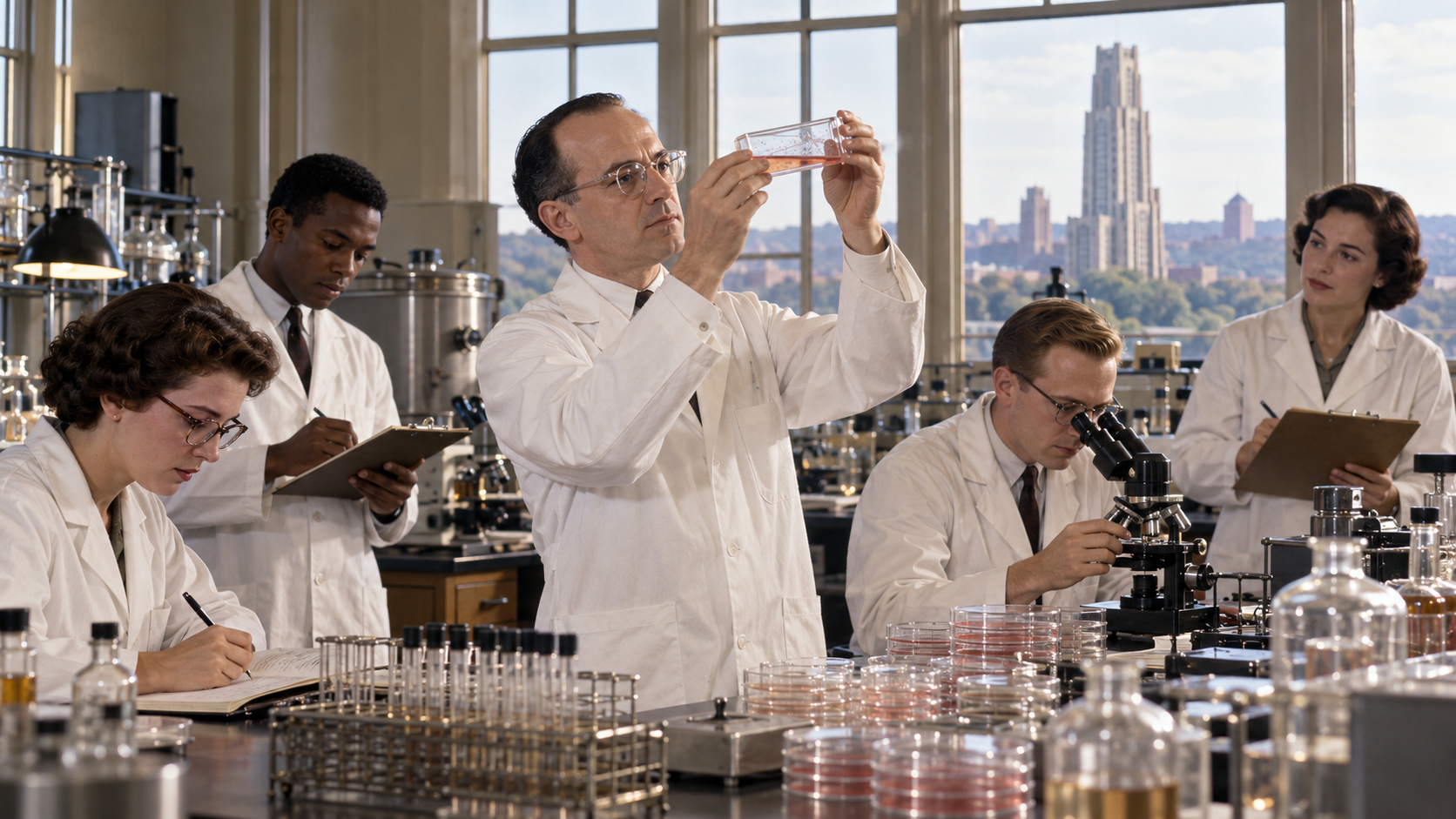
What happened on the date was consequential but limited. At the University of Pittsburgh, Salk's team used formalin-inactivated virus and tested the preparation with the National Foundation for Infantile Paralysis. A 1954 field trial enrolled more than a million children, and results announced in 1955 found the vaccine safe and effective. The vaccine's success depended on laboratory workers, trial organizers, schools, families, donors, regulators, and manufacturing quality. The Cutter incident, in which incompletely inactivated vaccine caused polio, exposed the need for stronger production controls. The distinction is important: the event did not instantly solve the underlying health problem, and later progress depended on follow-up research, training, policy, funding, and public trust. Contemporary evidence also helps separate what participants knew then from interpretations added after the result became famous.
Its longer legacy reaches beyond the original setting. Vaccination rapidly reduced disease where coverage was high, and Salk later founded an institute designed for collaborative biological research. Global eradication efforts now use both inactivated and oral vaccines according to context. Polio remains endemic in a few settings, showing that scientific tools require sustained trust, surveillance, delivery, and political commitment. Seen in context, the anniversary is useful because it connects a concrete historical episode with continuing questions about evidence, access, safety, and responsibility in health care. That connection is stronger when the people affected, the limits of the achievement, and the work still unfinished remain part of the account.
At the University of Pittsburgh, Salk's team used formalin-inactivated virus and tested the preparation with the National Foundation for Infantile Paralysis. A 1954 field trial enrolled more than a million children, and results announced in 1955 found the vaccine safe and effective.
The vaccine's success depended on laboratory workers, trial organizers, schools, families, donors, regulators, and manufacturing quality. The Cutter incident, in which incompletely inactivated vaccine caused polio, exposed the need for stronger production controls.
Vaccination rapidly reduced disease where coverage was high, and Salk later founded an institute designed for collaborative biological research.
Polio could cause paralysis and death, especially among children, and summer outbreaks disrupted communities. Work by many virologists made it possible to grow poliovirus in tissue culture and distinguish the three major types needed for a broadly protective vaccine.
Jonas Edward Salk was born in New York City. He became the physician-scientist who led development of an inactivated poliovirus vaccine during the most feared years of the American polio epidemic.
Global eradication efforts now use both inactivated and oral vaccines according to context. Polio remains endemic in a few settings, showing that scientific tools require sustained trust, surveillance, delivery, and political commitment.
Explore more of "On This Day ..."
Discover more events from the same date across news, politics, technology, sports, and other fields. Each link highlights significant moments that shaped history on different fronts.