

On This Day in Health: November 6, 1958
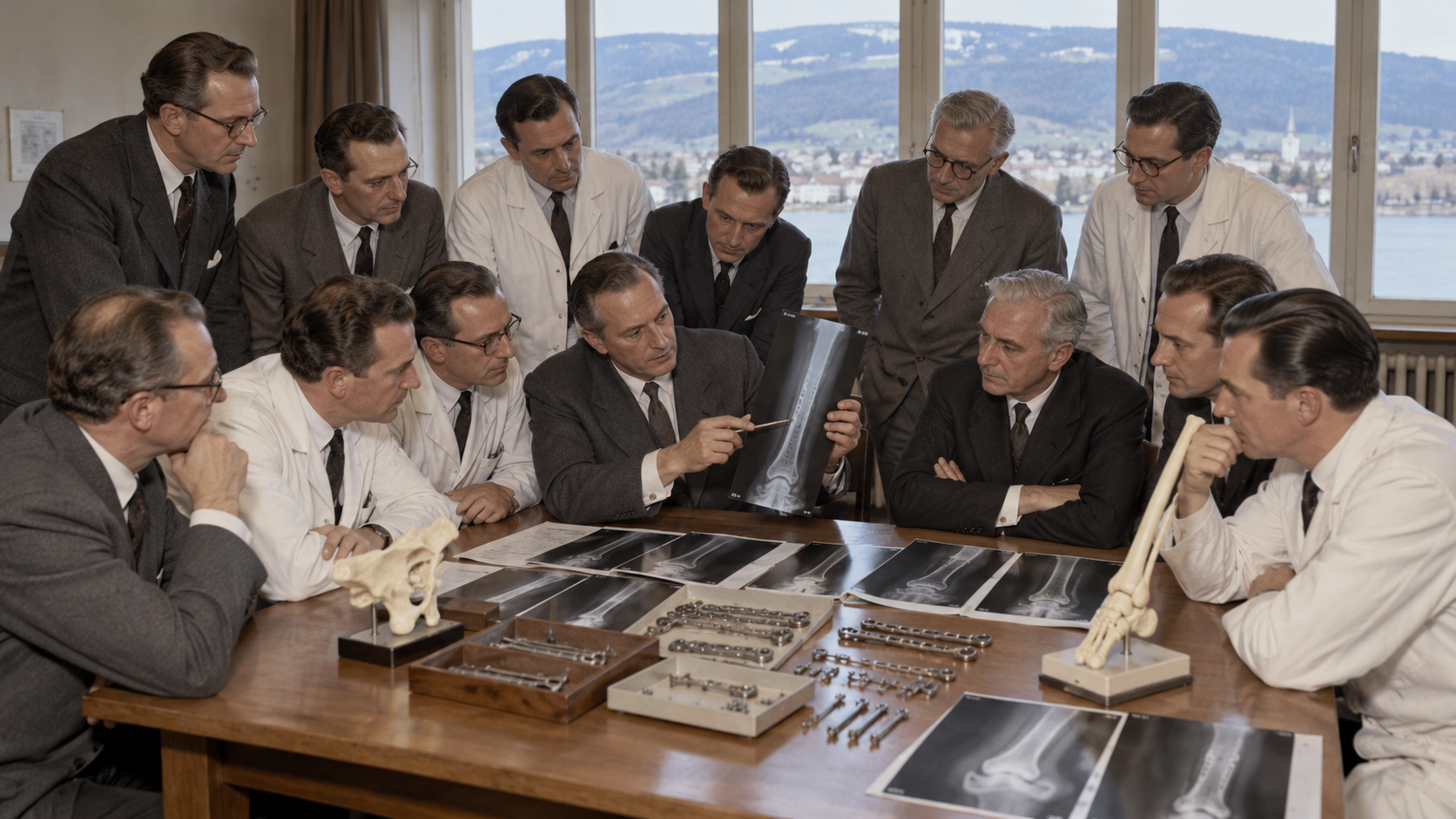
On November 6, 1958, thirteen Swiss surgeons met in Biel and founded the organization that became the AO Foundation for the study and treatment of fractures. This date matters because it fixes a broad medical story to a specific moment, place, and group of people. It also shows how health history is shaped carefully by institutions and practical choices as well as laboratory discoveries.
The background was already developing before that day. Many fractures were managed with prolonged traction or casts, and operative fixation produced inconsistent results. Poor implant design, infection, disrupted blood supply, and inadequate rehabilitation could leave patients with deformity, stiffness, or nonunion. Those conditions defined what participants could attempt and what patients or communities could reasonably expect. The available tools, social expectations, and professional structures all shaped the result. Change also depended on cooperation among people whose roles were not always recorded equally. They explain why later accounts sometimes compress years of preparation into a single anniversary. Looking at that preparation keeps credit broad and makes the turning point easier to understand without turning it into a miracle story.
What happened on the date was consequential but limited. The group developed principles of anatomical reduction when needed, stable fixation, preservation of blood supply, and early movement. Shared instruments, standardized implants, documentation, courses, and research allowed surgeons to compare and improve methods. Rigid fixation was sometimes applied too broadly, and early approaches could damage soft tissue or bone blood supply. Fractures differ by patient, energy, anatomy, resources, and goals, so a principle cannot substitute for judgment or informed consent. The distinction is important: the event did not instantly solve the underlying health problem, and later progress depended on follow-up research, training, policy, funding, and public trust. Contemporary evidence also helps separate what participants knew then from interpretations added after the result became famous.
Its longer legacy reaches beyond the original setting. AO methods reshaped trauma surgery and created an international education and research network spanning orthopaedics, spine, craniofacial surgery, and veterinary care. Current fracture care balances mechanical stability with biology, uses less invasive techniques when appropriate, and measures infection, healing, function, pain, and patient priorities rather than radiographs alone. Seen in context, the anniversary is useful because it connects a concrete historical episode with continuing questions about evidence, access, safety, and responsibility in health care. That connection is stronger when the people affected, the limits of the achievement, and the work still unfinished remain part of the account.
The group developed principles of anatomical reduction when needed, stable fixation, preservation of blood supply, and early movement. Shared instruments, standardized implants, documentation, courses, and research allowed surgeons to compare and improve methods.
Rigid fixation was sometimes applied too broadly, and early approaches could damage soft tissue or bone blood supply. Fractures differ by patient, energy, anatomy, resources, and goals, so a principle cannot substitute for judgment or informed consent.
AO methods reshaped trauma surgery and created an international education and research network spanning orthopaedics, spine, craniofacial surgery, and veterinary care.
Many fractures were managed with prolonged traction or casts, and operative fixation produced inconsistent results. Poor implant design, infection, disrupted blood supply, and inadequate rehabilitation could leave patients with deformity, stiffness, or nonunion.
thirteen Swiss surgeons met in Biel and founded the organization that became the AO Foundation for the study and treatment of fractures.
Current fracture care balances mechanical stability with biology, uses less invasive techniques when appropriate, and measures infection, healing, function, pain, and patient priorities rather than radiographs alone.
Explore more of "On This Day ..."
Discover more events from the same date across news, politics, technology, sports, and other fields. Each link highlights significant moments that shaped history on different fronts.