

On This Day in Health: December 2, 1982
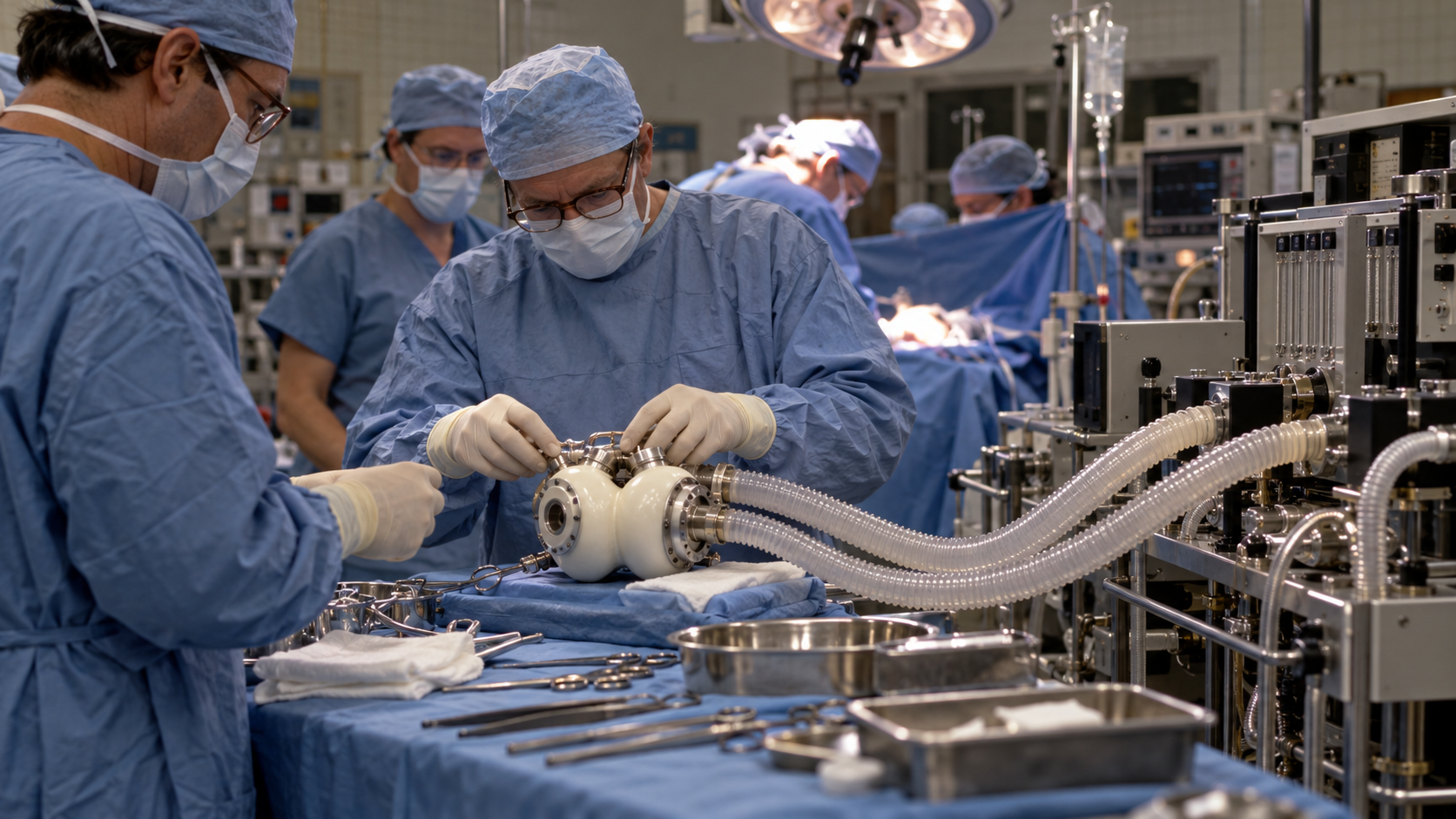
On December 2, 1982, surgeon William DeVries implanted the Jarvik-7 in Barney Clark at the University of Utah Medical Center, making Clark the first recipient of a permanent artificial heart. This anniversary fixes a broad health story to a specific moment, place, and group of people. It also shows that medical change grows from observation, institutions, practical tools, and sustained cooperation rather than from one dramatic act alone.
The background was already developing before that day. Mechanical support had developed through decades of pump engineering, animal experiments, heart-lung machines, and temporary assist devices. Clark had end-stage cardiomyopathy and was not expected to survive with conventional treatment. Those conditions shaped what clinicians, researchers, patients, and communities could attempt and what they could reasonably expect. The available evidence, technology, professional rules, and social assumptions all affected the result. Many contributors worked outside the part of the story that was later celebrated. Patients and families also supplied observations, accepted risks, and lived with consequences that formal histories often reduced to a few technical lines. Looking at that preparation keeps credit broad and prevents a complex change from becoming a simple hero story.
What happened on the date was consequential but limited. The air-driven device replaced the pumping action of both ventricles during a lengthy operation. Clark regained consciousness and lived for 112 days while a large external console powered the heart. His course included bleeding, infection, neurologic problems, kidney failure, and restricted mobility. The experiment raised difficult questions about consent, suffering, cost, publicity, and how success should be defined. The distinction matters because the event did not instantly solve the underlying health problem. Later progress depended on replication, training, regulation, funding, safer equipment, and public trust. Different hospitals and communities could adopt the advance at very different speeds, especially when cost, infrastructure, or social exclusion limited access. Contemporary records also help separate what participants knew at the time from interpretations added after the result became famous.
Its longer legacy reaches beyond the original setting. The case supplied crucial engineering and clinical lessons for later artificial hearts and ventricular assist devices, while showing that mechanical circulation required more than a durable pump. Modern devices are smaller and more reliable and can bridge patients to transplant or support long-term life, but complications, access, caregiving demands, and quality of life remain central. Seen in context, the anniversary connects a concrete historical episode with continuing questions about evidence, access, safety, and responsibility in health care. That connection is strongest when the people affected, the limits of the achievement, and the work still unfinished remain part of the account.
The air-driven device replaced the pumping action of both ventricles during a lengthy operation. Clark regained consciousness and lived for 112 days while a large external console powered the heart.
His course included bleeding, infection, neurologic problems, kidney failure, and restricted mobility. The experiment raised difficult questions about consent, suffering, cost, publicity, and how success should be defined.
The case supplied crucial engineering and clinical lessons for later artificial hearts and ventricular assist devices, while showing that mechanical circulation required more than a durable pump.
Mechanical support had developed through decades of pump engineering, animal experiments, heart-lung machines, and temporary assist devices. Clark had end-stage cardiomyopathy and was not expected to survive with conventional treatment.
surgeon William DeVries implanted the Jarvik-7 in Barney Clark at the University of Utah Medical Center, making Clark the first recipient of a permanent artificial heart.
Modern devices are smaller and more reliable and can bridge patients to transplant or support long-term life, but complications, access, caregiving demands, and quality of life remain central.
Explore more of "On This Day ..."
Discover more events from the same date across news, politics, technology, sports, and other fields. Each link highlights significant moments that shaped history on different fronts.