

On This Day in Lifestyles: March 19, 1918
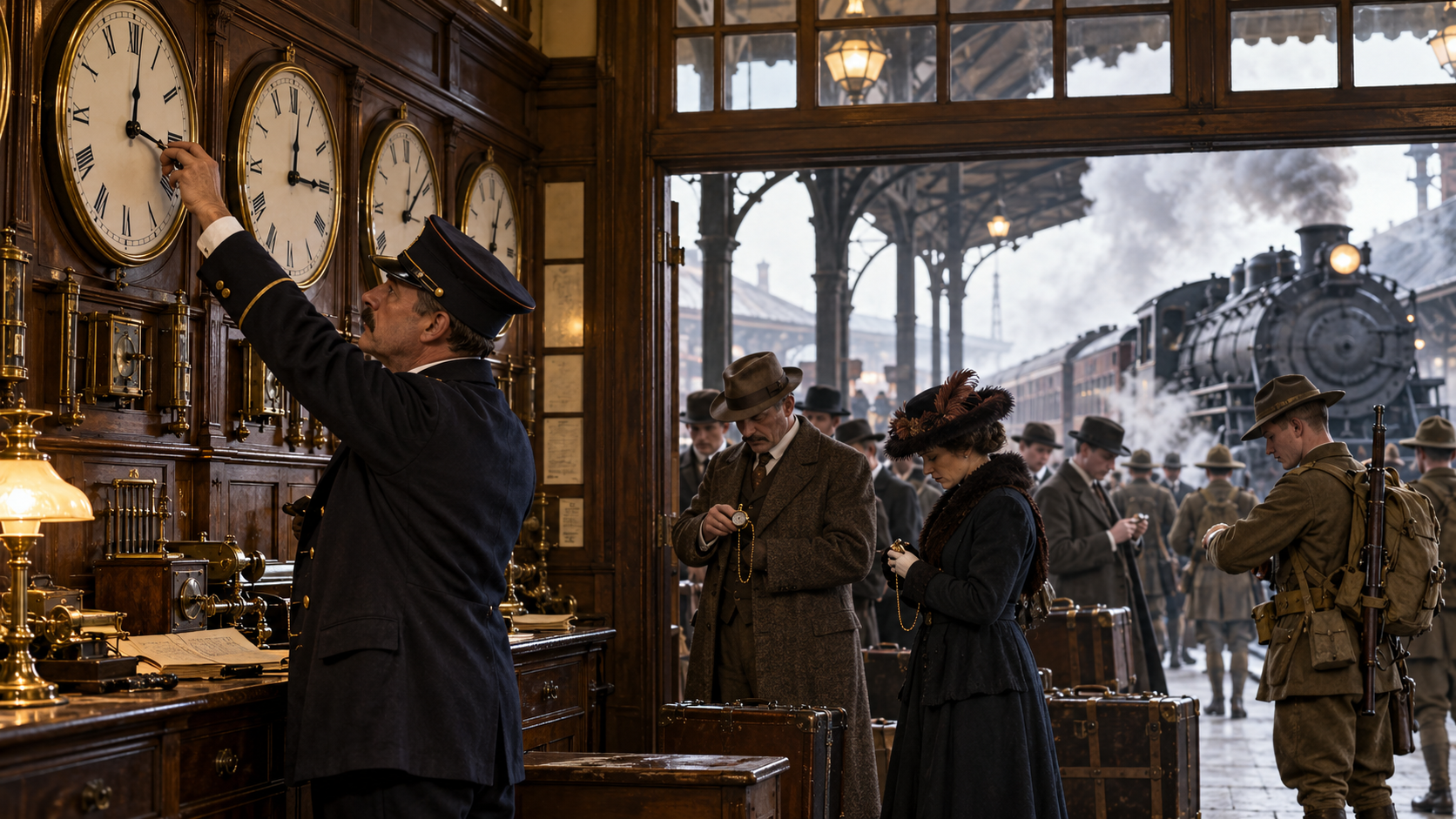
On March 19, 1918, The Standard Time Act established federal recognition of the United States’ time zones and authorized seasonal daylight saving during World War I. Railroads had already adopted standardized zones in 1883, but the law brought national policy to a patchwork of local clocks and private practice. The date matters in lifestyle history because national coordination reached into the hour-by-hour organization of ordinary life. Rather than remaining an isolated announcement or demonstration, the moment gave people a new way to think about waking, commuting, working, traveling, farming, attending school, and planning leisure by a shared clock. Its importance became visible through familiar places, objects, and routines, where a broad historical change could be felt at human scale.
Before standardization, towns often set noon by the sun, producing many local times that complicated timetables, business, telegraphy, and travel. National transportation and communication networks needed clocks in distant places to agree well enough for schedules and safety. The setting shaped how contemporaries understood the event. railroad workers, passengers, farmers, factory employees, families, officials, teachers, and businesses encountered it through station clocks, timetables, telegraphs, laws, newspapers, workplace whistles, school bells, and household watches. Those details show that social change usually travels through ordinary systems such as workplaces, schools, shops, homes, streets, or public institutions. What seems inevitable in hindsight depended on people testing, organizing, purchasing, teaching, maintaining, or protecting the idea in real time.
Changing the clocks moved an abstract policy directly into kitchens, factories, schools, offices, stations, farms, and sleep routines. Supporters linked daylight saving with energy conservation and usable evening light, while opponents questioned disruption, especially for agriculture and household schedules. In daily life, people reset clocks and rearranged routines to match a national schedule rather than purely local solar time. The episode also exposed questions about coordination versus local preference, evening light versus darker mornings, and commercial goals versus biological rhythms. Access and influence were never perfectly even, and later generations adapted the original development to different communities, values, and technologies. Still, the event changed expectations by making clearer schedules across regions and networks easier to imagine, recognize, or demand.
Congress repealed the federal daylight-saving requirement after the war, and local variation returned before later national rules. Arguments over health, energy, commerce, geography, and the twice-yearly clock change continue more than a century later. Today, echoes remain in time-zone boundaries, daylight-saving debates, synchronized devices, travel planning, and questions about sleep and health. Looking back helps separate the documented milestone from the myths that often accumulate around famous anniversaries. It also reminds us that lifestyle history is built from choices about design, health, work, leisure, communication, memory, and public space. On this day, the 1918 law made time itself a subject of national infrastructure and recurring household argument.
The Standard Time Act established federal recognition of the United States’ time zones and authorized seasonal daylight saving during World War I. Railroads had already adopted standardized zones in 1883, but the law brought national policy to a patchwork of local clocks and private practice.
Before standardization, towns often set noon by the sun, producing many local times that complicated timetables, business, telegraphy, and travel. National transportation and communication networks needed clocks in distant places to agree well enough for schedules and safety.
Changing the clocks moved an abstract policy directly into kitchens, factories, schools, offices, stations, farms, and sleep routines. Supporters linked daylight saving with energy conservation and usable evening light, while opponents questioned disruption, especially for agriculture and household schedules.
The larger theme was that national coordination reached into the hour-by-hour organization of ordinary life.
Congress repealed the federal daylight-saving requirement after the war, and local variation returned before later national rules. Arguments over health, energy, commerce, geography, and the twice-yearly clock change continue more than a century later.
Today the story remains visible in time-zone boundaries, daylight-saving debates, synchronized devices, travel planning, and questions about sleep and health.
Explore more of “This Day in Lifestyles”
Discover more moments in everyday life, design, education, travel, food, fashion, and culture. Each story connects a calendar date with an event that changed how people lived.