

On This Day in Lifestyles: March 30, 1858
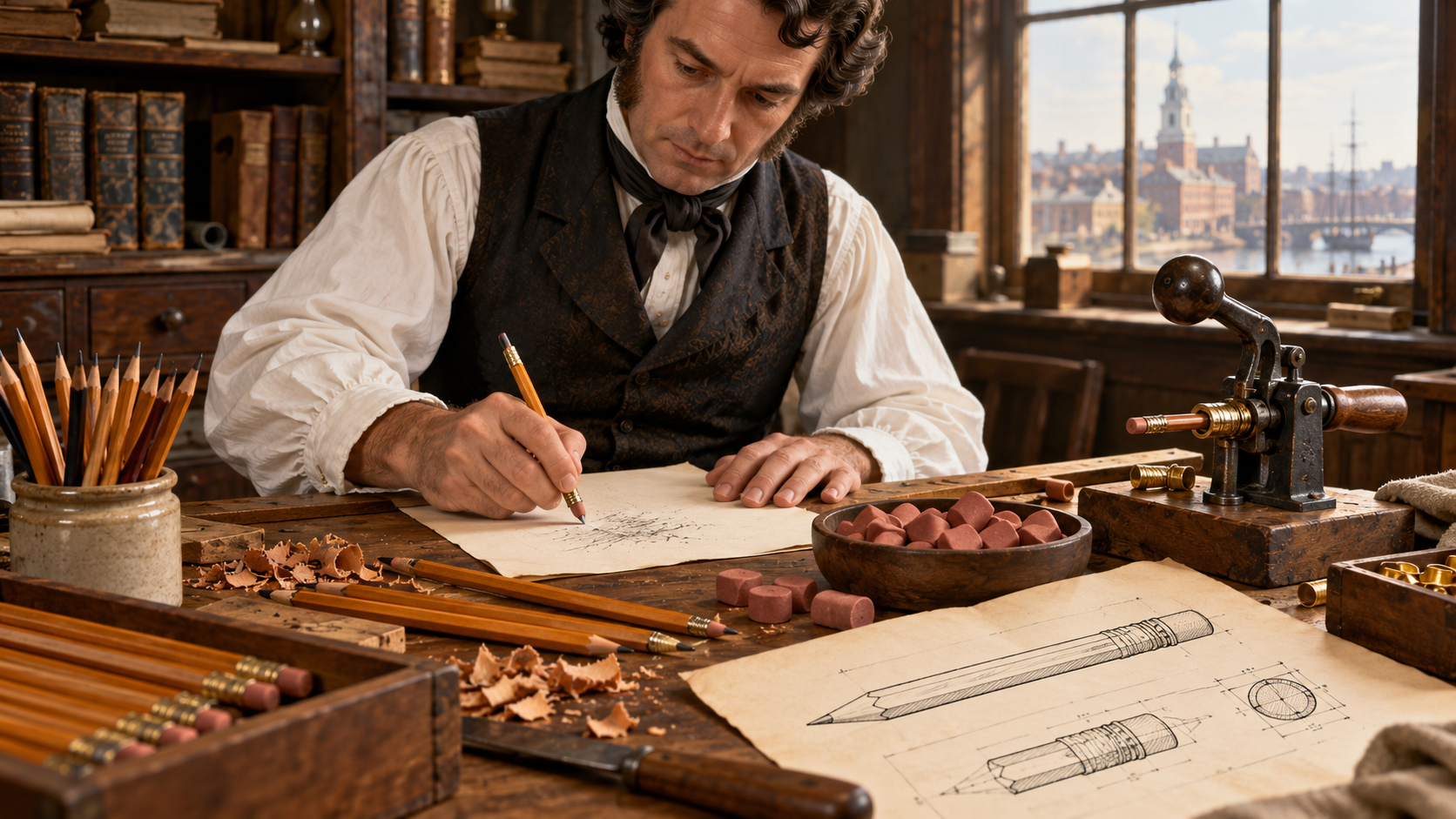
On March 30, 1858, Philadelphia stationer Hyman Lipman received U.S. Patent No. 19,783 for inserting an eraser into a groove at one end of a pencil. The practical combination placed the means of correction directly beside the writing point, reducing the need to carry two separate objects. The date matters in lifestyle history because two ordinary tools were combined into a convenient everyday design. Rather than remaining an isolated announcement or demonstration, the moment gave people a new way to think about writing, calculating, sketching, revising, learning, and carrying a compact tool from task to task. Its importance became visible through familiar places, objects, and routines, where a broad historical change could be felt at human scale.
Graphite pencils and natural-rubber erasers were already familiar, and Lipman’s claim centered on their arrangement rather than a new writing substance. In 1875, the U.S. Supreme Court later treated the combination as lacking a new joint function in a patent dispute, illustrating how useful objects can face complicated legal judgments. The setting shaped how contemporaries understood the event. stationers, students, teachers, clerks, artists, carpenters, patent lawyers, manufacturers, and everyday writers encountered it through patent drawings, stationery shops, schools, offices, catalogs, factories, desks, and pencil cases. Those details show that social change usually travels through ordinary systems such as workplaces, schools, shops, homes, streets, or public institutions. What seems inevitable in hindsight depended on people testing, organizing, purchasing, teaching, maintaining, or protecting the idea in real time.
The attached eraser suited classrooms, offices, workshops, shops, and homes where notes changed and mistakes were expected. It encouraged a style of writing in which revision was immediate, portable, and physically built into the tool. In daily life, writers could correct a mark without searching for a separate eraser, making revision feel like part of the same action. The episode also exposed questions about convenience versus patent novelty, disposable supplies, rubber and wood sourcing, breakage, and the meaning of ownership in design. Access and influence were never perfectly even, and later generations adapted the original development to different communities, values, and technologies. Still, the event changed expectations by making portable, immediate correction easier to imagine, recognize, or demand.
Many pencils still carry erasers in metal ferrules, while artists and drafters often prefer separate forms designed for precision. The object remains a small symbol of tentative thinking: marks can be made, reconsidered, and changed. Today, echoes remain in classrooms, workshops, studios, offices, test taking, sketching, and the enduring reassurance of an erasable mark. Looking back helps separate the documented milestone from the myths that often accumulate around famous anniversaries. It also reminds us that lifestyle history is built from choices about design, health, work, leisure, communication, memory, and public space. On this day, the 1858 patent attached the possibility of revision to the instrument that made the mark.
Philadelphia stationer Hyman Lipman received U.S. Patent No. 19,783 for inserting an eraser into a groove at one end of a pencil. The practical combination placed the means of correction directly beside the writing point, reducing the need to carry two separate objects.
Graphite pencils and natural-rubber erasers were already familiar, and Lipman’s claim centered on their arrangement rather than a new writing substance. In 1875, the U.S. Supreme Court later treated the combination as lacking a new joint function in a patent dispute, illustrating how useful objects can face complicated legal judgments.
The attached eraser suited classrooms, offices, workshops, shops, and homes where notes changed and mistakes were expected. It encouraged a style of writing in which revision was immediate, portable, and physically built into the tool.
The larger theme was that two ordinary tools were combined into a convenient everyday design.
Many pencils still carry erasers in metal ferrules, while artists and drafters often prefer separate forms designed for precision. The object remains a small symbol of tentative thinking: marks can be made, reconsidered, and changed.
Today the story remains visible in classrooms, workshops, studios, offices, test taking, sketching, and the enduring reassurance of an erasable mark.
Explore more of “This Day in Lifestyles”
Discover more moments in everyday life, design, education, travel, food, fashion, and culture. Each story connects a calendar date with an event that changed how people lived.