

On This Day in Lifestyles: June 15, 1844
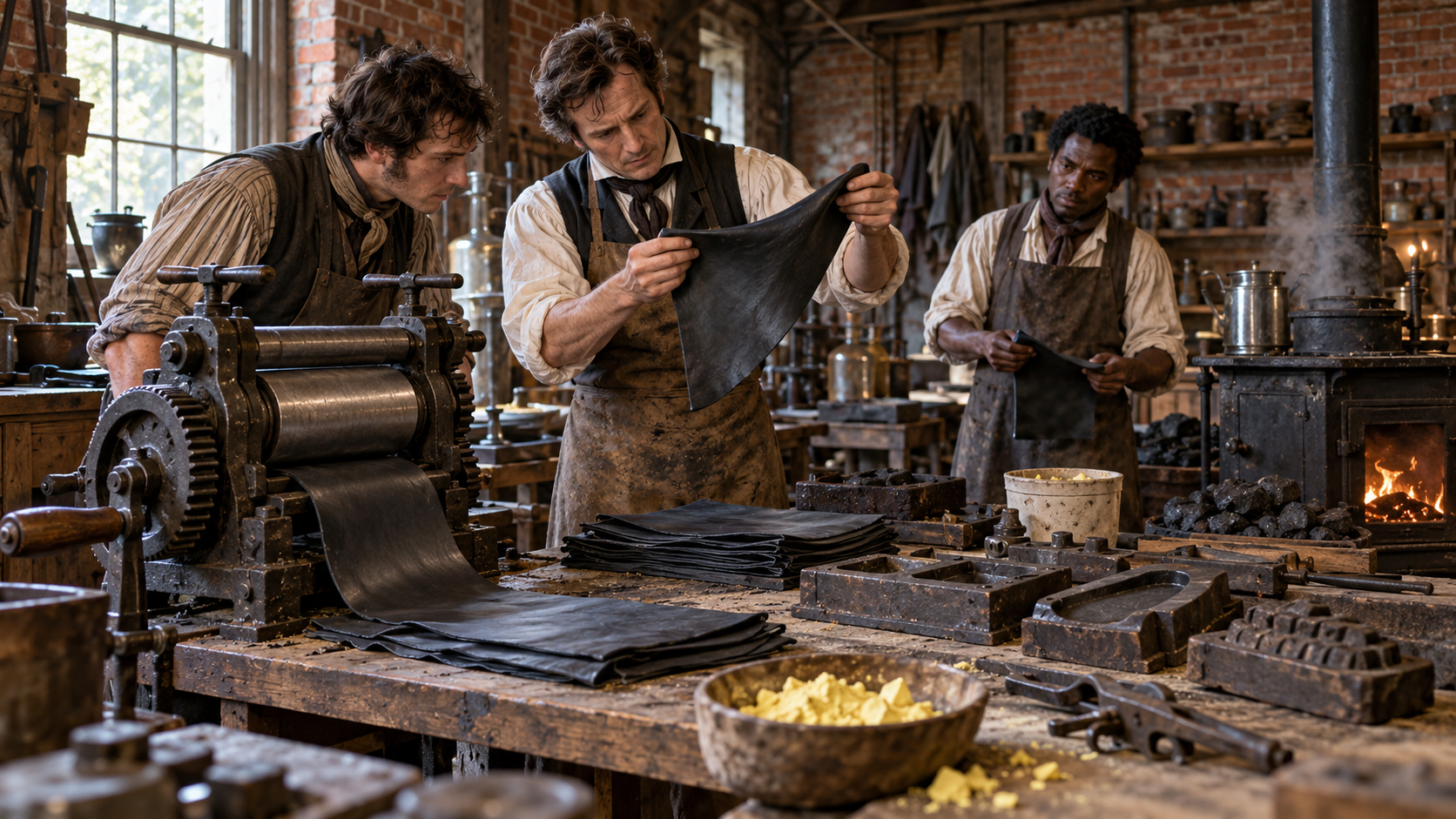
On June 15, 1844, Charles Goodyear received U.S. Patent No. 3,633 for an improvement in India-rubber fabrics, protecting a heat-and-sulfur process associated with durable rubber. The date matters in lifestyle history because materials become lifestyle history when improved performance makes new forms of clothing, travel, work, health, and convenience possible. It was not merely a headline for institutions or specialists; it touched the settings, objects, expectations, and shared rituals through which people organized ordinary days. Goodyear and workshop assistants handled sulfur, rubber sheets, rollers, molds, and heated equipment in a risky experimental environment far removed from a modern laboratory. Seen at human scale, the episode shows how a public milestone becomes meaningful through repeated personal choices, conversations, and memories.
Natural rubber could become sticky in heat and brittle in cold, limiting its usefulness. After years of experiments, debt, and setbacks, Goodyear developed treatments that made rubber more stable across temperatures, although disputes over priority and patents continued. The setting is essential to understanding why the event attracted attention. New ideas rarely arrive in isolation: they meet existing technology, commerce, custom, law, and desire. Contemporary newspapers, broadcasts, public spaces, shops, schools, workplaces, or homes carried the story outward, giving people practical ways to interpret it. Some welcomed the change, others doubted it, and many first encountered it indirectly. That mixture of novelty and familiarity helped the moment travel from a single date into a broader change in behavior.
Reliable rubber entered shoes, waterproof clothing, hoses, belts, medical goods, machinery, insulation, and eventually transportation. The material quietly changed what people wore, how factories ran, and what products could flex, seal, cushion, or resist water. In daily life, the consequences appeared through altered routines, new expectations, and different ways of spending time or money. Vulcanized rubber became essential to industrial and domestic life, but modern production also raises questions about plantation labor, synthetic feedstocks, tire waste, microplastics, and recycling. The benefits were never the whole story; major changes also exposed questions about access, responsibility, fairness, cost, and who had power to define progress. Those tensions deserve a place beside the celebration because they show how culture actually develops. The event mattered not because everyone experienced it in the same way, but because it opened a durable argument about how people wanted to live.
Today, the legacy remains visible: Seals, gloves, footwear, tires, cables, sporting goods, and countless small components still rely on rubber’s carefully engineered resilience. Familiarity can make that inheritance easy to overlook, yet the practices surrounding it were built through years of experimentation, adaptation, criticism, and use. Looking back does more than celebrate an anniversary. It reveals the chain between public decisions and private habits, between ambitious ideas and the small acts that make them ordinary. On this day, a hard-won materials process made flexibility durable enough for modern life. Remembering the full setting lets the milestone feel less like a frozen fact and more like a living part of modern experience.
On June 15, 1844, Charles Goodyear received U.S. Patent No. 3,633 for an improvement in India-rubber fabrics, protecting a heat-and-sulfur process associated with durable rubber.
Natural rubber could become sticky in heat and brittle in cold, limiting its usefulness. After years of experiments, debt, and setbacks, Goodyear developed treatments that made rubber more stable across temperatures, although disputes over priority and patents continued.
Reliable rubber entered shoes, waterproof clothing, hoses, belts, medical goods, machinery, insulation, and eventually transportation. The material quietly changed what people wore, how factories ran, and what products could flex, seal, cushion, or resist water.
The event matters in lifestyle history because materials become lifestyle history when improved performance makes new forms of clothing, travel, work, health, and convenience possible.
Vulcanized rubber became essential to industrial and domestic life, but modern production also raises questions about plantation labor, synthetic feedstocks, tire waste, microplastics, and recycling.
The legacy remains visible today: Seals, gloves, footwear, tires, cables, sporting goods, and countless small components still rely on rubber's carefully engineered resilience.
Explore more of “This Day in Lifestyles”
Discover more moments in everyday life, design, education, travel, food, fashion, and culture. Each story connects a calendar date with an event that changed how people lived.