

On This Day in Lifestyles: September 3, 1967
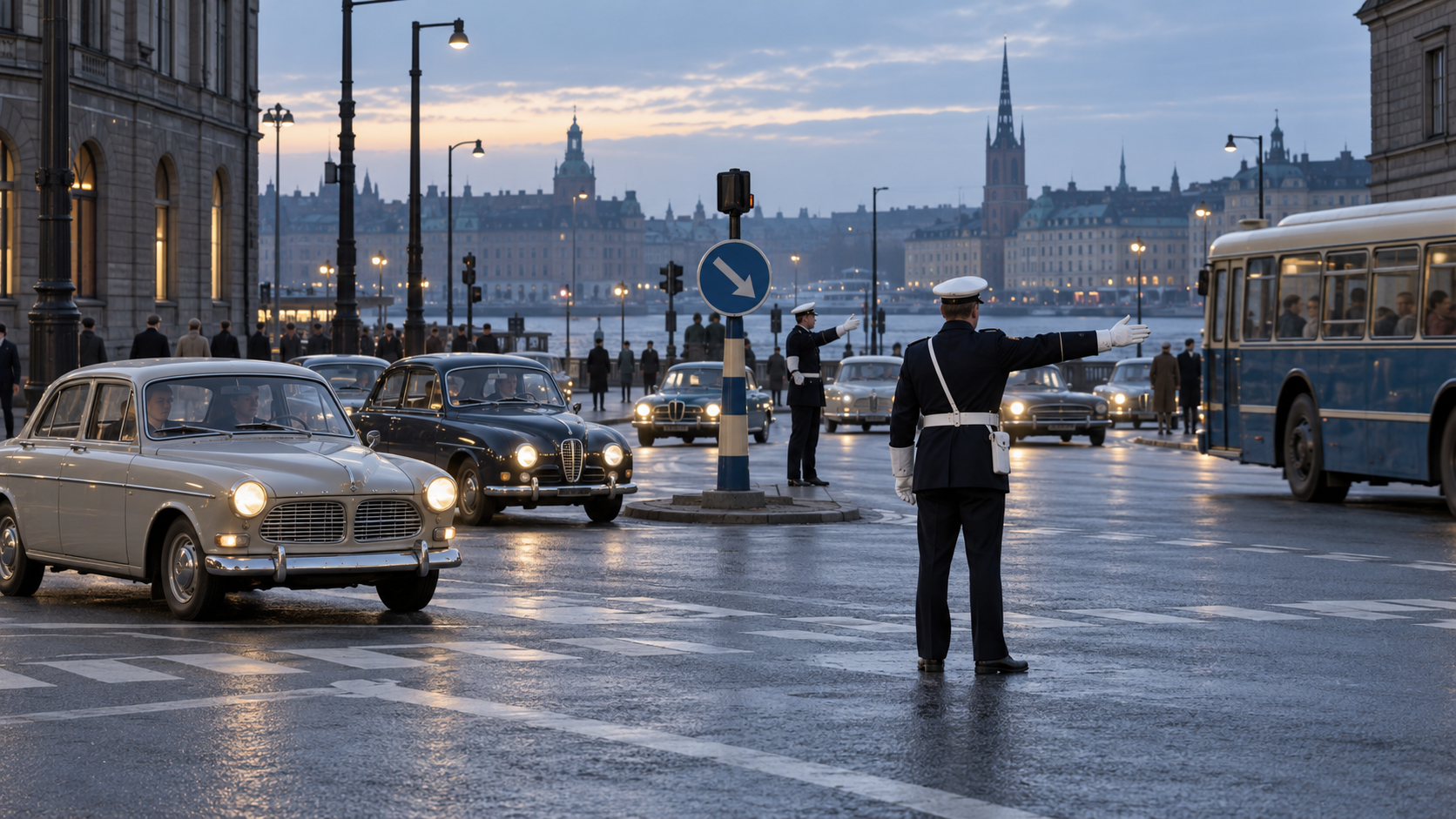
On September 3, 1967, Sweden changed from left-hand to right-hand road traffic in a coordinated national operation known as Dagen H. The date matters in lifestyle history because an entire country rewrote one of the most automatic habits of everyday travel. It was not merely a headline for institutions or specialists; it touched the settings, objects, expectations, and shared rituals through which people organized ordinary days. At a Stockholm intersection just before dawn, period cars and buses paused while police and road workers guided vehicles from the left lanes to the right beneath newly uncovered signs. Seen at human scale, the episode shows how a public milestone becomes meaningful through repeated personal choices, conversations, and memories.
At 4:50 a.m., permitted vehicles stopped, moved cautiously across the road, and waited until 5:00 before continuing on the right. Most private traffic was restricted during the transition. Crews had replaced or covered signs, repainted intersections, rebuilt bus stops, and modified thousands of buses in preparation. The setting is essential to understanding why the event attracted attention. New ideas rarely arrive in isolation: they meet existing technology, commerce, custom, law, and desire. Contemporary newspapers, public spaces, shops, schools, workplaces, or homes carried the story outward, giving people practical ways to interpret it. Some welcomed the change, others doubted it, and many first encountered it indirectly. That mixture of novelty and familiarity helped the moment travel from a single date into a broader change in behavior.
The switch aligned Sweden with neighboring countries and made overtaking more sensible in the many cars that already had left-side steering wheels. A vast public-information campaign used schools, radio, television, printed material, and a memorable H symbol to turn a risky change into a shared civic routine. In daily life, the consequences appeared through altered routines, new expectations, and different ways of spending time or money. Traffic deaths fell sharply at first as drivers behaved with unusual caution, although the improvement did not last at the same scale. The operation remains a case study in design, public communication, infrastructure planning, and the ability of millions of people to alter an ingrained habit together. The benefits were never the whole story; major changes also exposed questions about access, responsibility, fairness, cost, and who had power to define progress. Those tensions deserve a place beside the celebration because they show how culture actually develops. The event mattered not because everyone experienced it in the same way, but because it opened a durable argument about how people wanted to live.
Today, the legacy remains visible: road systems depend on shared rules, legible signs, vehicle design, public trust, and careful preparation whenever a familiar pattern changes. Familiarity can make that inheritance easy to overlook, yet the practices surrounding it were built through years of experimentation, adaptation, criticism, and use. Looking back does more than celebrate an anniversary. It reveals the chain between public decisions and private habits, between ambitious ideas and the small acts that make them ordinary. On this day, one historical moment became part of the texture of modern life. Remembering the full setting lets the milestone feel less like a frozen fact and more like a living part of experience.
On September 3, 1967, Sweden changed from left-hand to right-hand road traffic in a coordinated national operation known as Dagen H.
At 4:50 a.m., permitted vehicles stopped, moved cautiously across the road, and waited until 5:00 before continuing on the right. Most private traffic was restricted during the transition. Crews had replaced or covered signs, repainted intersections, rebuilt bus stops, and modified thousands of buses in preparation.
The switch aligned Sweden with neighboring countries and made overtaking more sensible in the many cars that already had left-side steering wheels. A vast public-information campaign used schools, radio, television, printed material, and a memorable H symbol to turn a risky change into a shared civic routine.
The event matters in lifestyle history because an entire country rewrote one of the most automatic habits of everyday travel.
Traffic deaths fell sharply at first as drivers behaved with unusual caution, although the improvement did not last at the same scale. The operation remains a case study in design, public communication, infrastructure planning, and the ability of millions of people to alter an ingrained habit together.
The legacy remains visible today: road systems depend on shared rules, legible signs, vehicle design, public trust, and careful preparation whenever a familiar pattern changes.
Explore more of “This Day in Lifestyles”
Discover more moments in everyday life, design, education, travel, food, fashion, and culture. Each story connects a calendar date with an event that changed how people lived.