

On This Day in Lifestyles: September 30, 1882
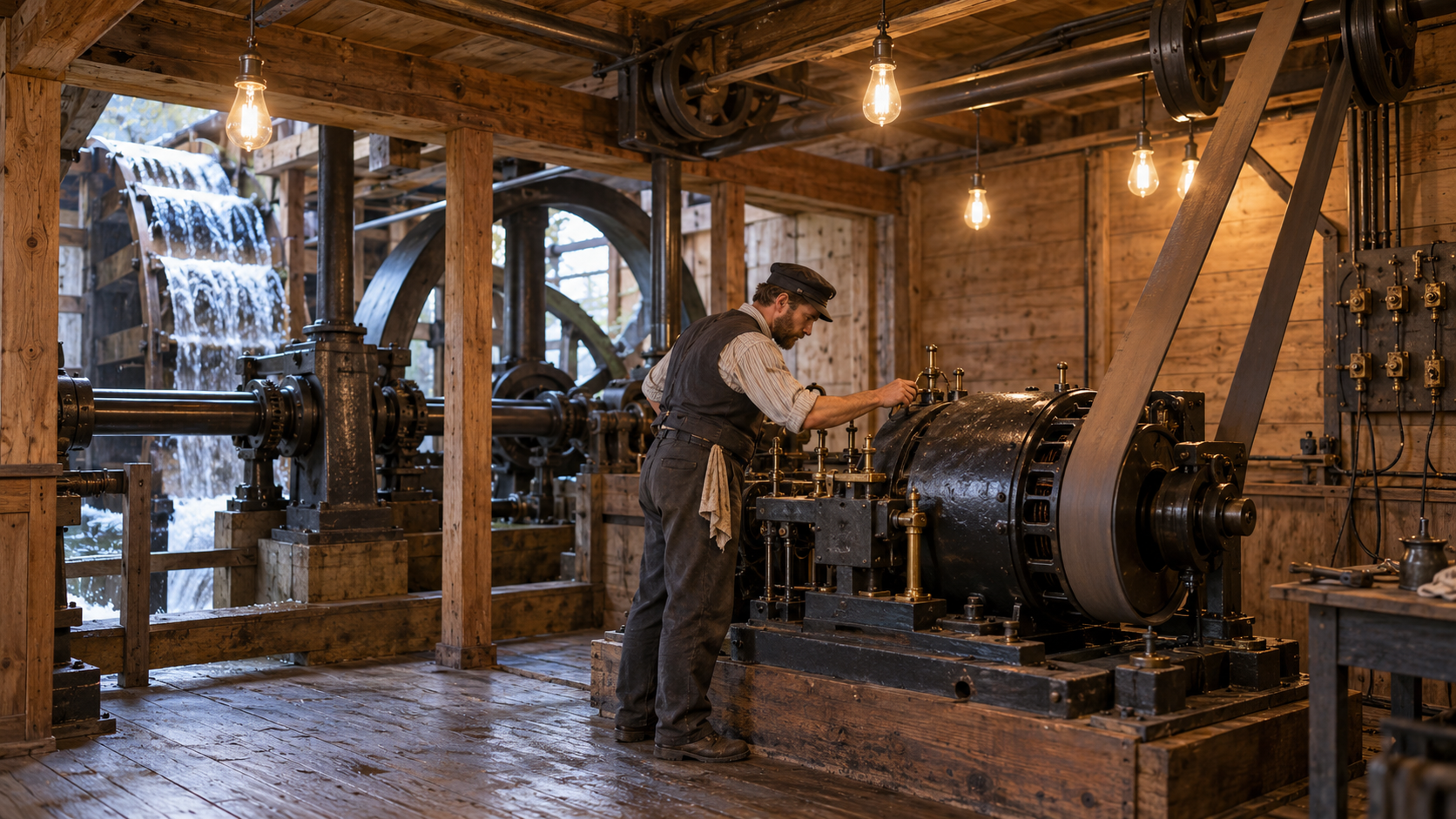
On September 30, 1882, the Vulcan Street Power Plant in Appleton, Wisconsin, began producing hydroelectric power for paper mills and a private residence. The date matters in lifestyle history because a river-powered dynamo brought centralized electric light into workplaces and a household. It was not merely a headline for institutions or specialists; it touched the settings, objects, expectations, and shared rituals through which people organized ordinary days. Inside the small wooden Vulcan Street station, an engineer adjusted a belt-driven Edison dynamo while water-powered machinery turned and incandescent lamps glowed nearby. Seen at human scale, the episode shows how a public milestone becomes meaningful through repeated personal choices, conversations, and memories.
An Edison K-type dynamo driven by water power from the Fox River supplied roughly twelve and a half kilowatts. The small wooden station served two paper mills and the home of mill owner H. J. Rogers, whose enthusiasm for Edison’s lighting system helped finance the experiment. The setting is essential to understanding why the event attracted attention. New ideas rarely arrive in isolation: they meet existing technology, commerce, custom, law, and desire. Contemporary newspapers, public spaces, shops, schools, workplaces, or homes carried the story outward, giving people practical ways to interpret it. Some welcomed the change, others doubted it, and many first encountered it indirectly. That mixture of novelty and familiarity helped the moment travel from a single date into a broader change in behavior.
The installation arrived only weeks after Edison’s Pearl Street steam station in New York and demonstrated another path to centralized electric lighting. Early voltage regulation, wiring, lamps, water flow, and mechanical reliability all required hands-on adjustment, and the service reached only a few customers. In daily life, the consequences appeared through altered routines, new expectations, and different ways of spending time or money. Hydroelectric stations expanded as cities and industries built power networks. Electric light extended work and leisure after dark, altered architecture and fire risk, displaced older fuels, and created new utilities, appliances, rates, labor, and dependence on continuous service. The benefits were never the whole story; major changes also exposed questions about access, responsibility, fairness, cost, and who had power to define progress. Those tensions deserve a place beside the celebration because they show how culture actually develops. The event mattered not because everyone experienced it in the same way, but because it opened a durable argument about how people wanted to live.
Today, the legacy remains visible: hydropower remains an important low-carbon source while dams and water systems raise serious questions about ecosystems, Indigenous lands, fisheries, drought, and regional energy choices. Familiarity can make that inheritance easy to overlook, yet the practices surrounding it were built through years of experimentation, adaptation, criticism, and use. Looking back does more than celebrate an anniversary. It reveals the chain between public decisions and private habits, between ambitious ideas and the small acts that make them ordinary. On this day, one historical moment became part of the texture of modern life. Remembering the full setting lets the milestone feel less like a frozen fact and more like a living part of experience.
On September 30, 1882, the Vulcan Street Power Plant in Appleton, Wisconsin, began producing hydroelectric power for paper mills and a private residence.
An Edison K-type dynamo driven by water power from the Fox River supplied roughly twelve and a half kilowatts. The small wooden station served two paper mills and the home of mill owner H. J. Rogers, whose enthusiasm for Edison's lighting system helped finance the experiment.
The installation arrived only weeks after Edison's Pearl Street steam station in New York and demonstrated another path to centralized electric lighting. Early voltage regulation, wiring, lamps, water flow, and mechanical reliability all required hands-on adjustment, and the service reached only a few customers.
The event matters in lifestyle history because a river-powered dynamo brought centralized electric light into workplaces and a household.
Hydroelectric stations expanded as cities and industries built power networks. Electric light extended work and leisure after dark, altered architecture and fire risk, displaced older fuels, and created new utilities, appliances, rates, labor, and dependence on continuous service.
The legacy remains visible today: hydropower remains an important low-carbon source while dams and water systems raise serious questions about ecosystems, Indigenous lands, fisheries, drought, and regional energy choices.
Explore more of “This Day in Lifestyles”
Discover more moments in everyday life, design, education, travel, food, fashion, and culture. Each story connects a calendar date with an event that changed how people lived.