

On This Day in Lifestyles: October 4, 1927
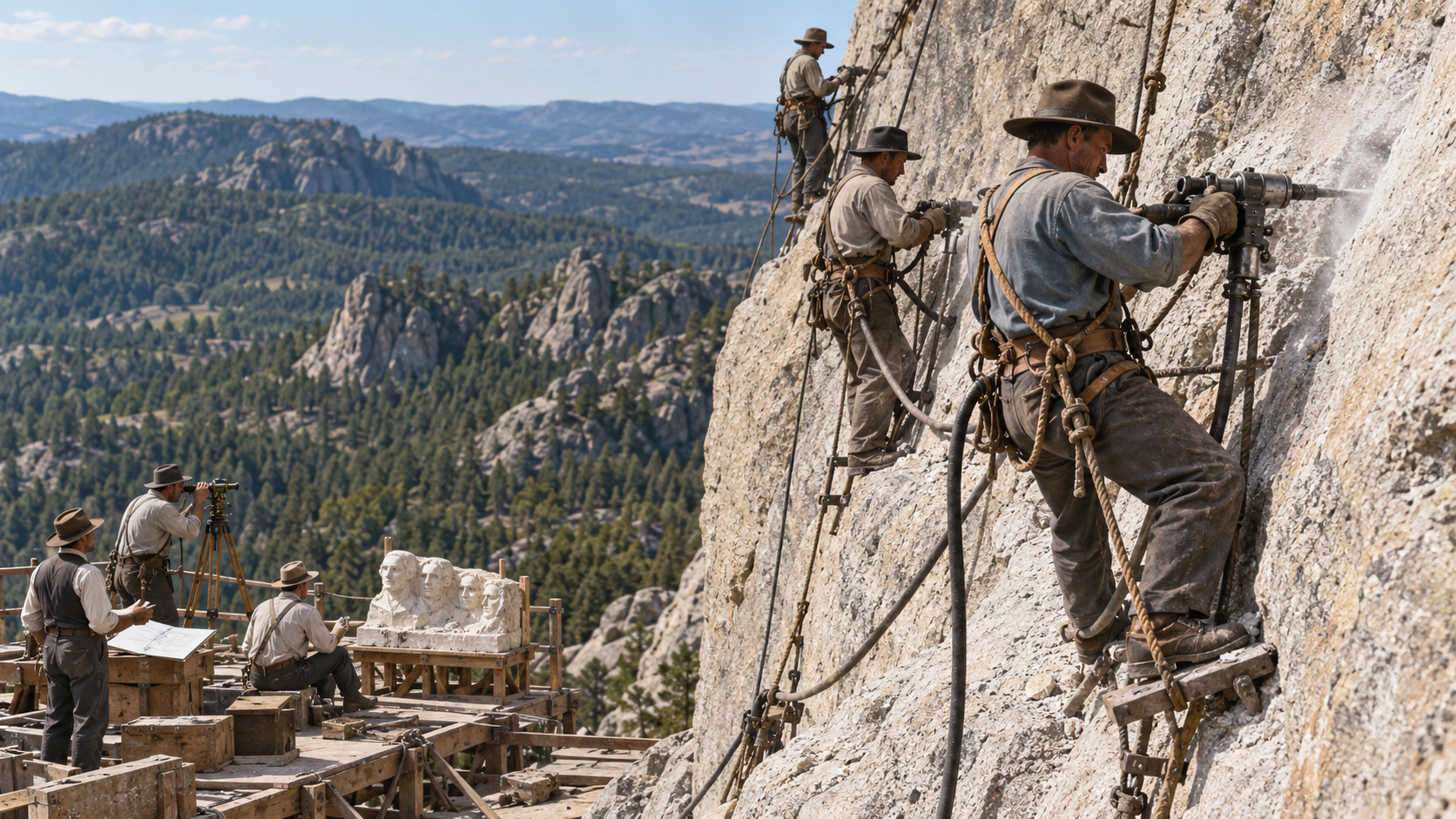
On October 4, 1927, workers began drilling and blasting granite at Mount Rushmore in the Black Hills of South Dakota. The date matters in lifestyle history because a monumental tourist landmark joined technical ambition to an unresolved history of land and national memory. It was not merely a headline for institutions or specialists; it touched the settings, objects, expectations, and shared rituals through which people organized ordinary days. A 1927 crew secured ropes and pneumatic drills on a raw granite face while surveyors studied scale models below and the Black Hills stretched beyond Seen at human scale, the episode shows how a public milestone becomes meaningful through repeated personal choices, conversations, and memories.
Sculptor Gutzon Borglum directed a project conceived to attract tourism and represent a national story through four presidential portraits. Crews used dynamite, pneumatic drills, cables, and suspended work platforms high above the mountain. The Black Hills are sacred to Lakota and other Indigenous peoples, and the United States took the land after violating the Fort Laramie Treaty, making the monument’s location inseparable from dispossession. The setting is essential to understanding why the event attracted attention. New ideas rarely arrive in isolation: they meet existing technology, commerce, custom, law, and desire. Contemporary newspapers, public spaces, shops, schools, workplaces, or homes carried the story outward, giving people practical ways to interpret it. Some welcomed the change, others doubted it, and many first encountered it indirectly. That mixture of novelty and familiarity helped the moment travel from a single date into a broader change in behavior.
The work demanded precise surveying and dangerous labor on a scale that captured national attention. Federal support and New Deal funding helped the carving continue during the Depression, bringing wages and visitors to the region. At the same time, the chosen figures and site promoted a celebratory national narrative that excluded the people whose homeland surrounded the mountain. In daily life, the consequences appeared through altered routines, new expectations, and different ways of spending time or money. Carving ended in 1941 with the monument unfinished compared with Borglum’s original plan. It became a major tourist destination and a familiar national image, while Indigenous leaders and historians continue to insist that visitors confront treaty rights, cultural meaning, and the fuller history of the Black Hills. The benefits were never the whole story; major changes also exposed questions about access, responsibility, fairness, cost, and who had power to define progress. Those tensions deserve a place beside the celebration because they show how culture actually develops. The event mattered not because everyone experienced it in the same way, but because it opened a durable argument about how people wanted to live.
Today, the legacy remains visible: historic attractions increasingly ask visitors to consider not only design and spectacle but also labor, land, sovereignty, and whose story a monument centers. Familiarity can make that inheritance easy to overlook, yet the practices surrounding it were built through years of experimentation, adaptation, criticism, and use. Looking back does more than celebrate an anniversary. It reveals the chain between public decisions and private habits, between ambitious ideas and the small acts that make them ordinary. On this day, one historical moment became part of the texture of modern life. Remembering the full setting lets the milestone feel less like a frozen fact and more like a living part of experience.
On October 4, 1927, workers began drilling and blasting granite at Mount Rushmore in the Black Hills of South Dakota.
Sculptor Gutzon Borglum directed a project conceived to attract tourism and represent a national story through four presidential portraits. Crews used dynamite, pneumatic drills, cables, and suspended work platforms high above the mountain. The Black Hills are sacred to Lakota and other Indigenous peoples, and the United States took the land after violating the Fort Laramie Treaty, making the monument's location inseparable from dispossession.
The work demanded precise surveying and dangerous labor on a scale that captured national attention. Federal support and New Deal funding helped the carving continue during the Depression, bringing wages and visitors to the region. At the same time, the chosen figures and site promoted a celebratory national narrative that excluded the people whose homeland surrounded the mountain.
The event matters in lifestyle history because a monumental tourist landmark joined technical ambition to an unresolved history of land and national memory.
Carving ended in 1941 with the monument unfinished compared with Borglum's original plan. It became a major tourist destination and a familiar national image, while Indigenous leaders and historians continue to insist that visitors confront treaty rights, cultural meaning, and the fuller history of the Black Hills.
The legacy remains visible today: historic attractions increasingly ask visitors to consider not only design and spectacle but also labor, land, sovereignty, and whose story a monument centers.
Explore more of “This Day in Lifestyles”
Discover more moments in everyday life, design, education, travel, food, fashion, and culture. Each story connects a calendar date with an event that changed how people lived.