

On This Day in Lifestyles: October 10, 1845
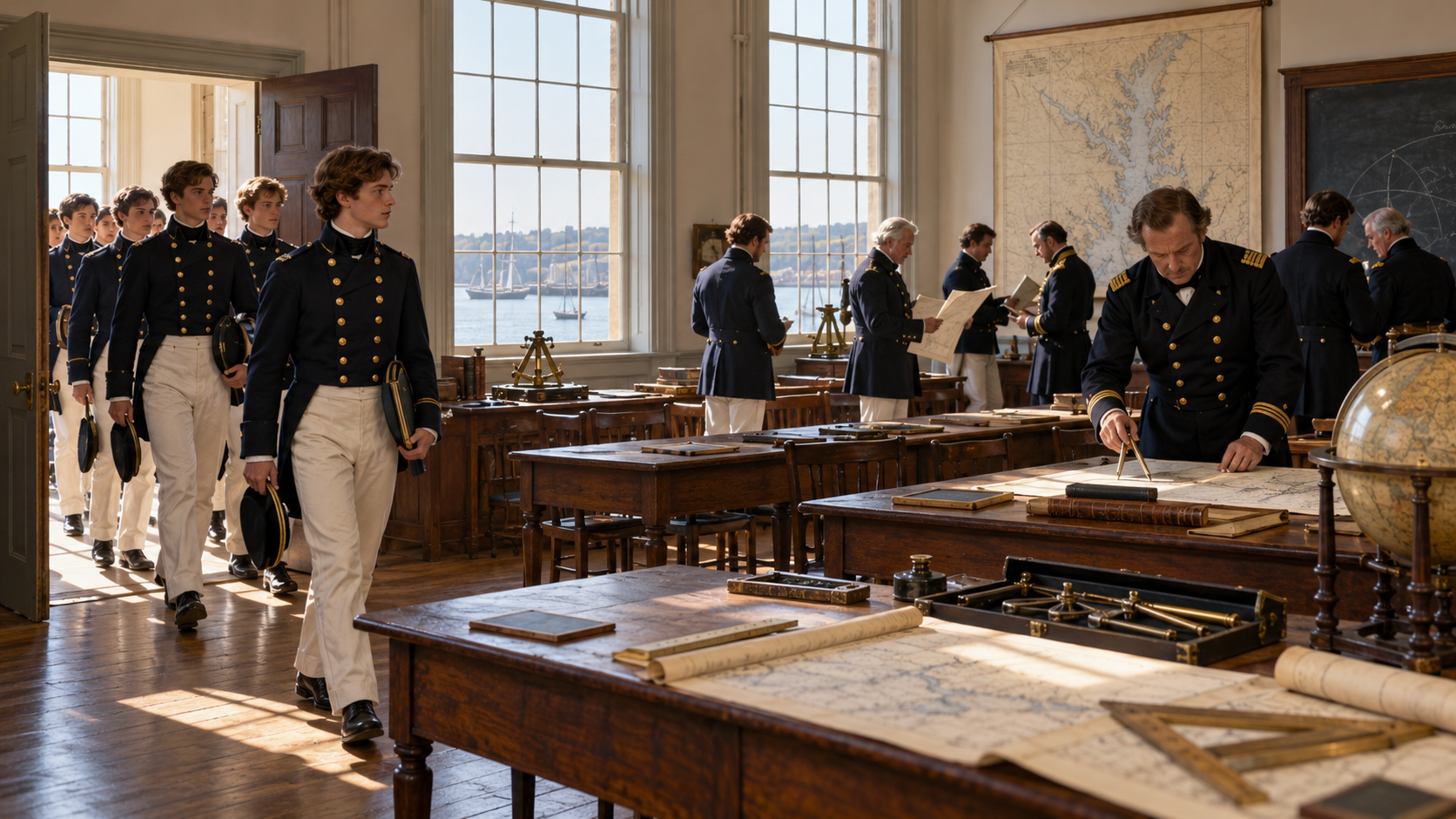
On October 10, 1845, the United States Naval School opened at Fort Severn in Annapolis with 50 midshipmen and seven professors. The date matters in lifestyle history because a small school helped turn naval service into a formal professional and educational path. It was not merely a headline for institutions or specialists; it touched the settings, objects, expectations, and shared rituals through which people organized ordinary days. Young midshipmen in 1845 uniforms entered a plain Fort Severn classroom where professors arranged navigation instruments, charts, slates, and mathematics texts Seen at human scale, the episode shows how a public milestone becomes meaningful through repeated personal choices, conversations, and memories.
Secretary of the Navy George Bancroft established the school to replace a looser system in which young midshipmen learned largely at sea and received brief instruction ashore. The first curriculum included mathematics, navigation, chemistry, English, French, and naval subjects. Students lived and studied within a former Army post whose grounds and buildings were modest compared with the later academy. The setting is essential to understanding why the event attracted attention. New ideas rarely arrive in isolation: they meet existing technology, commerce, custom, law, and desire. Contemporary newspapers, public spaces, shops, schools, workplaces, or homes carried the story outward, giving people practical ways to interpret it. Some welcomed the change, others doubted it, and many first encountered it indirectly. That mixture of novelty and familiarity helped the moment travel from a single date into a broader change in behavior.
A permanent school made officer education more systematic and tied professional advancement to classrooms, examinations, drills, and institutional discipline. The change reflected increasingly complex ships and navigation as well as a national effort to formalize expertise. Early enrollment was limited to men, and the school developed within a military system marked by hierarchy and the politics of its era. In daily life, the consequences appeared through altered routines, new expectations, and different ways of spending time or money. Renamed the United States Naval Academy in 1850, the institution expanded its campus, curriculum, research, athletics, and admissions. Women entered as midshipmen in 1976, and the academy continues to debate how tradition, service, technical education, leadership, and inclusion should fit together. The benefits were never the whole story; major changes also exposed questions about access, responsibility, fairness, cost, and who had power to define progress. Those tensions deserve a place beside the celebration because they show how culture actually develops. The event mattered not because everyone experienced it in the same way, but because it opened a durable argument about how people wanted to live.
Today, the legacy remains visible: service academies combine higher education with military preparation, shaping careers and public leadership while remaining accountable to changing national values. Familiarity can make that inheritance easy to overlook, yet the practices surrounding it were built through years of experimentation, adaptation, criticism, and use. Looking back does more than celebrate an anniversary. It reveals the chain between public decisions and private habits, between ambitious ideas and the small acts that make them ordinary. On this day, one historical moment became part of the texture of modern life. Remembering the full setting lets the milestone feel less like a frozen fact and more like a living part of experience.
On October 10, 1845, the United States Naval School opened at Fort Severn in Annapolis with 50 midshipmen and seven professors.
Secretary of the Navy George Bancroft established the school to replace a looser system in which young midshipmen learned largely at sea and received brief instruction ashore. The first curriculum included mathematics, navigation, chemistry, English, French, and naval subjects. Students lived and studied within a former Army post whose grounds and buildings were modest compared with the later academy.
A permanent school made officer education more systematic and tied professional advancement to classrooms, examinations, drills, and institutional discipline. The change reflected increasingly complex ships and navigation as well as a national effort to formalize expertise. Early enrollment was limited to men, and the school developed within a military system marked by hierarchy and the politics of its era.
The event matters in lifestyle history because a small school helped turn naval service into a formal professional and educational path.
Renamed the United States Naval Academy in 1850, the institution expanded its campus, curriculum, research, athletics, and admissions. Women entered as midshipmen in 1976, and the academy continues to debate how tradition, service, technical education, leadership, and inclusion should fit together.
The legacy remains visible today: service academies combine higher education with military preparation, shaping careers and public leadership while remaining accountable to changing national values.
Explore more of “This Day in Lifestyles”
Discover more moments in everyday life, design, education, travel, food, fashion, and culture. Each story connects a calendar date with an event that changed how people lived.