

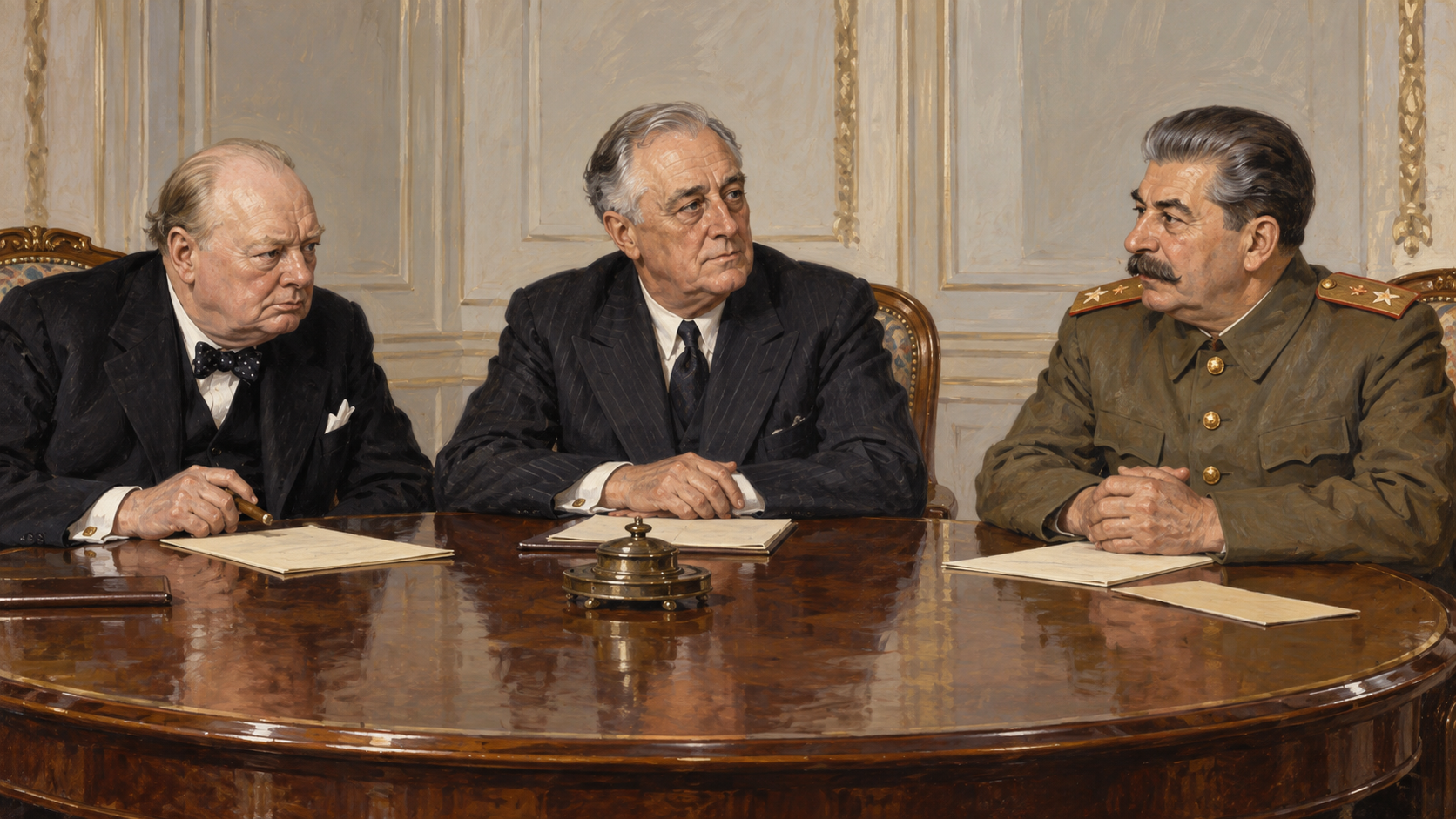
On This Day in Politics: February 4, 1945
On February 4, 1945, U.S. President Franklin D. Roosevelt, British Prime Minister Winston Churchill, and Soviet leader Joseph Stalin opened the Yalta Conference in Crimea. Their first plenary meeting began at Livadia Palace late that afternoon, bringing political leaders and senior military officials together as Allied armies advanced toward Germany’s defeat. The immediate discussion concerned military coordination, especially the relationship between operations on the Eastern and Western fronts. The conference would continue until February 11 and address the settlement that might follow the war. Its opening was therefore a working wartime meeting, rather than a single ceremony at which the entire postwar order was decided.
The alliance shared an urgent military objective but did not have a common vision of Europe’s political future. Germany remained at war, and the Allies still expected difficult fighting against Japan. Roosevelt and Churchill regarded Soviet entry into the Pacific conflict as strategically valuable. Meanwhile, the Red Army’s advance gave Stalin substantial influence over territories in Eastern Europe. These circumstances shaped what the leaders could bargain over and what they could realistically enforce. Diplomatic language about cooperation and self-government existed alongside competing security interests. Yalta’s location and elaborate arrangements brought the delegations together, but proximity did not remove the differences between their governments.
The first day’s exchanges show how closely diplomacy remained connected to battlefield problems. Soviet General Alexey Antonov reported on the eastern campaign, while General George Marshall described the situation facing Anglo-American forces in the west. The leaders discussed transport, enemy deployments, and the coordination of future offensives. During the following week, negotiations broadened to Germany’s occupation, reparations, Poland, and the planned United Nations. The leaders agreed that France would participate in governing occupied Germany and worked out a Security Council voting arrangement that included permanent-member vetoes. They also reached an agreement on Soviet entry into the war against Japan in return for concessions in East Asia. These were conference outcomes developed over several days, not all decisions made on February 4.
Yalta initially appeared to demonstrate that wartime cooperation might survive victory. That confidence weakened as disputes over Eastern Europe and the implementation of political commitments intensified. Roosevelt died in April, and his successor, Harry S. Truman, inherited growing disagreements with the Soviet government. Later criticism often treated Yalta as the moment Europe was divided, but that interpretation compresses military realities, subsequent decisions, and unresolved disputes into one gathering. The conference mattered because it linked the final conduct of the war with plans for international institutions and occupied territory. Its lasting significance also lies in the limits of summit agreements: shared wording could conceal different expectations, and promises depended on power and implementation after the delegates departed.
The delegations did not all stay in one building. The Americans occupied Livadia Palace, while the Soviet and British delegations used separate residences nearby.
The meeting combined military and diplomatic work. The leaders needed to coordinate active campaigns while considering the political consequences of victory.
The first plenary session concentrated on the military situation. Its minutes record reports from Antonov and Marshall and discussion of coordinated operations against Germany.
The main political agreements emerged during the week that followed. Dating the conference's opening accurately should not turn February 4 into the date of every agreement associated with Yalta.
Arrangements for the United Nations and Germany's occupation gave the conference consequences beyond the battlefield. They were part of the institutional settlement taking shape as the war ended.
American records of the political discussions include separate notes and minutes rather than one complete, jointly approved transcript. That evidence deserves careful reading when assessing what participants understood.
Explore more of "On This Day ..."
Discover more events from the same date across news, politics, technology, sports, and other fields. Each link highlights significant moments that shaped history on different fronts.