

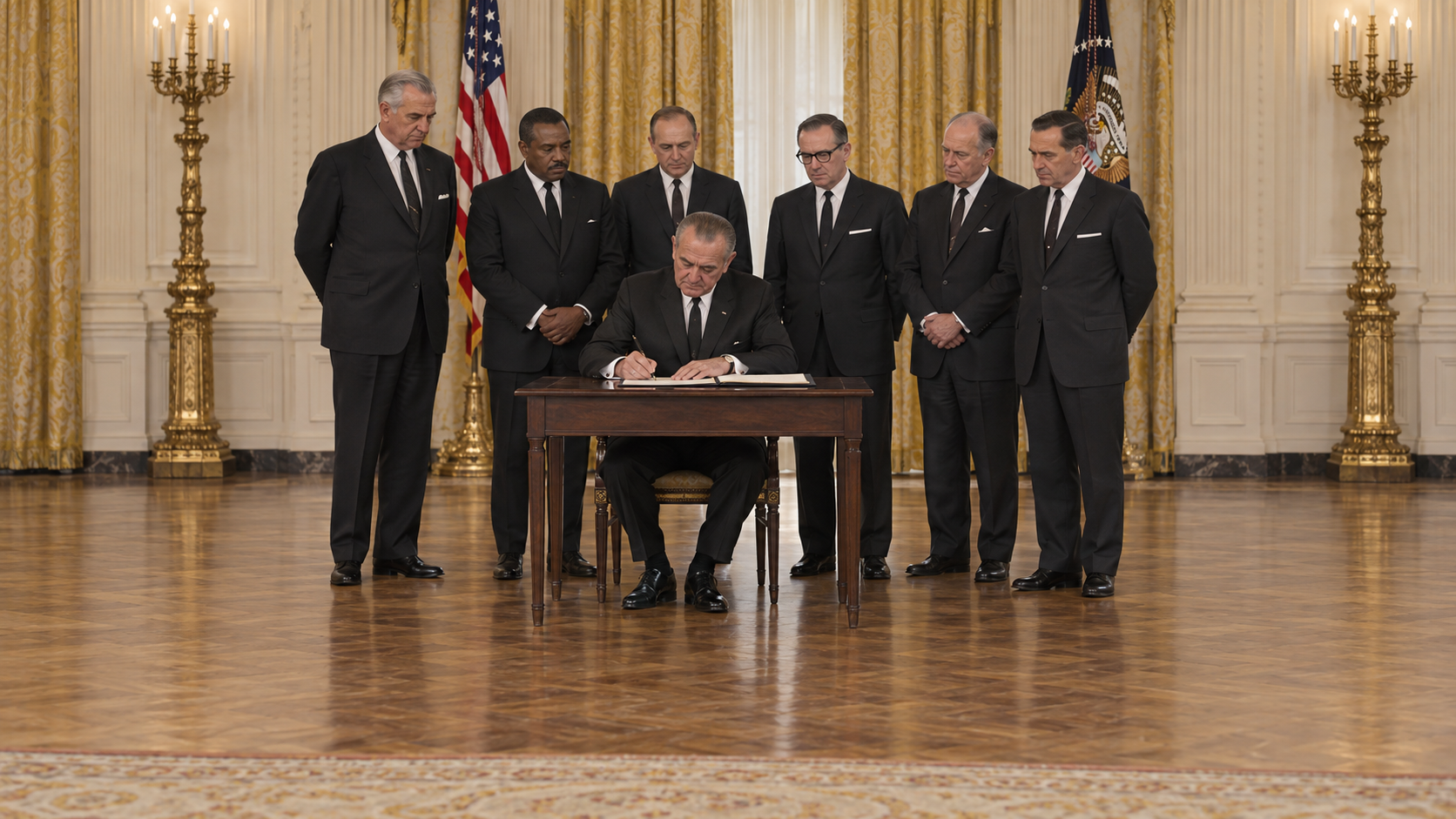
On This Day in Politics: April 11, 1968
On April 11, 1968, President Lyndon B. Johnson signed the Civil Rights Act of 1968 at the White House. The legislation included the Fair Housing Act, a landmark federal response to discrimination in access to housing. Johnson spoke in the East Room a week after the assassination of Martin Luther King Jr., placing the signing in a moment of national grief and unrest. The law established an important public standard, but a signature could not instantly transform every housing market or eliminate discriminatory conduct. The event is best understood as a decisive legislative commitment whose effectiveness would also depend on enforcement and subsequent action.
The campaign for federal fair-housing legislation had encountered sustained resistance. In his remarks, Johnson recalled requesting a housing-discrimination law in 1966 and renewing the appeal in 1967 without securing enactment. The successful 1968 bill followed earlier civil-rights achievements involving public accommodations, employment, and voting. Housing presented another fundamental setting in which unequal treatment shaped daily life and opportunity. The original protections prohibited discrimination based on race, color, religion, or national origin in housing sales and rentals. Keeping that original scope distinct from later additions avoids crediting the April signing with every protection eventually incorporated into federal fair-housing law.
Johnson used the ceremony to argue for progress through legislation and to acknowledge that injustice had deep roots. He condemned King’s assassination and the violence that followed, while presenting the new statute as evidence that democratic institutions could respond. His remarks also made clear that he considered further domestic measures necessary. This combination of achievement and unfinished work is important to the historical meaning of the day. Official descriptions of a legal breakthrough expressed the administration’s aims; they did not establish that discrimination had disappeared. The law created duties and a basis for action, while people seeking homes still had to encounter those promises in practice.
Later amendments demonstrate that the framework continued to evolve. In 1988, Congress expanded protection to disability and familial status and strengthened the Department of Housing and Urban Development’s enforcement powers. Those later changes belong to the law’s development rather than its original enactment. April became Fair Housing Month, with the signing date serving as a recurring occasion to review the commitment to equal housing opportunity. The political legacy of April 11 lies in bringing housing discrimination firmly within the reach of federal civil-rights policy. It also offers a useful distinction between making a right part of national law and building the institutions and practices needed to make that right effective.
Johnson signed the law one week after Martin Luther King Jr.’s assassination.
Earlier efforts to secure federal fair-housing legislation had failed.
The original protections addressed race, color, religion, and national origin.
Enactment established a legal standard but did not instantly eliminate discrimination.
Congress added disability and familial-status protections in 1988.
The signing remains a landmark in the development of federal civil-rights policy.
Explore more of "On This Day ..."
Discover more events from the same date across news, politics, technology, sports, and other fields. Each link highlights significant moments that shaped history on different fronts.