

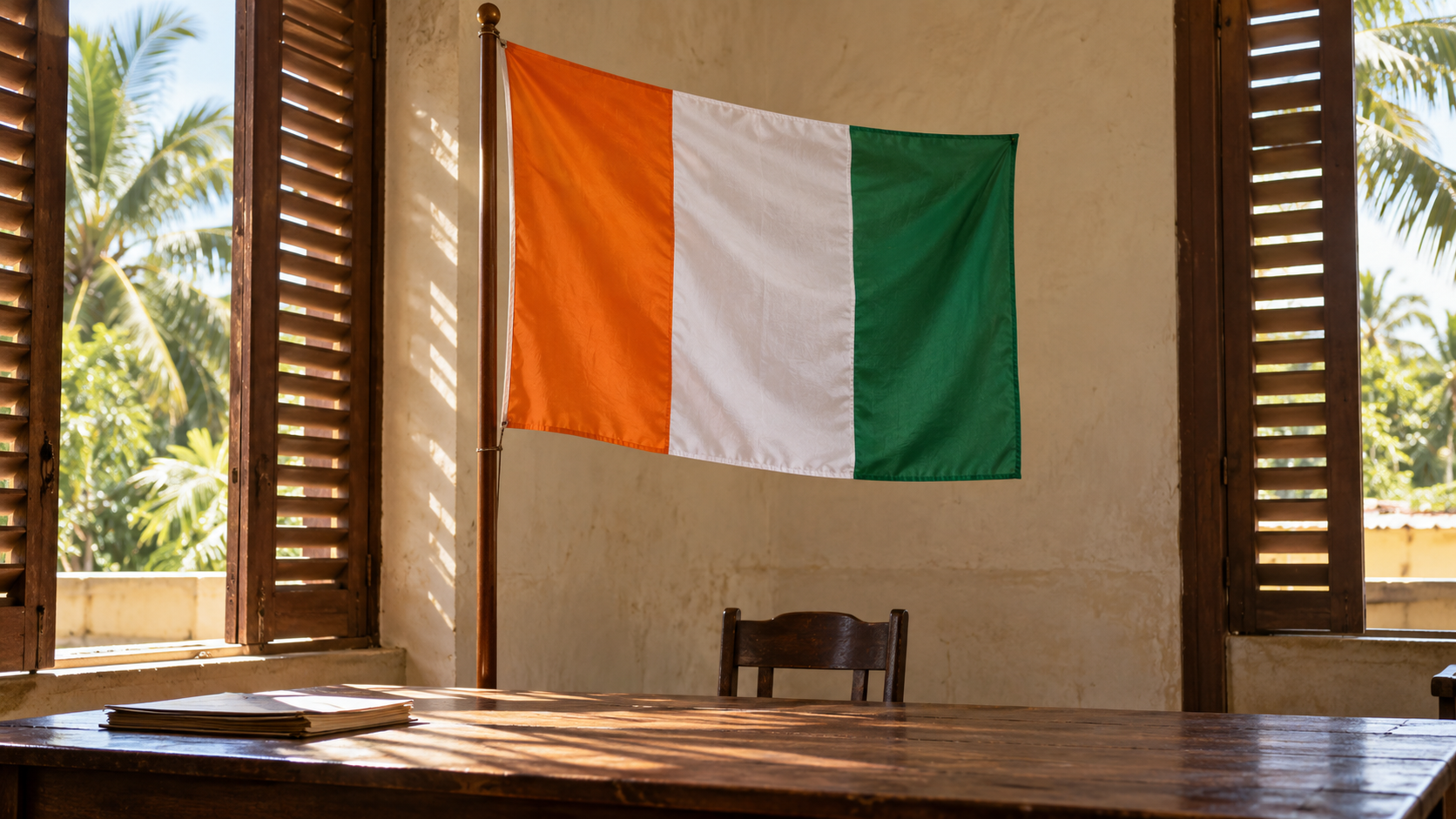
On This Day in Politics: August 7, 1960
On August 7, 1960, Ivory Coast became independent of France, with Abidjan serving as the center of the new state's political life. Prime Minister Félix Houphouët-Boigny stood at the center of the transition from colonial rule to sovereignty. The country, now generally known as Côte d'Ivoire, joined the succession of African states achieving independence that year. The change carried immediate international consequences: the United States recognized the republic on the same date, and its consulate in Abidjan became an embassy. Independence therefore meant more than a national celebration. It established a government entitled to conduct relations with other countries in its own name.
The transfer followed an earlier period of internal self-government within the French Community. A republic had been proclaimed in December 1958, and a constitution, elected legislature, and government followed in 1959. Those institutions gave the territory an administrative framework, but they did not yet supply full international sovereignty. Houphouët-Boigny had worked through political organizations and French institutions while pursuing greater authority for his country. His approach favored negotiation and continued cooperation with France. This path differed from the idea that independence necessarily required a complete diplomatic or economic break with the former colonial power. Existing institutions provided a starting point for the sovereign state, even as colonial relationships continued to shape its choices.
The decisive change on August 7 was the end of French sovereignty over the territory. President Dwight D. Eisenhower sent recognition to Houphouët-Boigny, and Donald R. Norland, the American consul, became chargé d'affaires when the mission was elevated to embassy status. These practical steps illustrate how an independence proclamation altered the diplomatic map. Relations that had previously passed through a colonial framework became relations between sovereign governments. The transition also left substantial work ahead. Political institutions had to function under national authority, while the government faced decisions about finance, defense, and foreign relations. Recognition could acknowledge the new state immediately; it could not by itself settle every question about how independence would operate.
Houphouët-Boigny became the country's first president and remained its dominant political figure for decades. His government preserved close connections with France, and coffee and cocoa exports became central to the country's development. Sovereignty did not bring an immediate system of competitive multiparty politics: the ruling party's dominance was a major feature of the early independent state. That limitation matters when describing the anniversary. The end of colonial authority and the expansion of political competition were separate processes. August 7 marks the former, while the latter followed a much longer and contested course. The date's lasting significance lies in the creation of an internationally recognized Ivorian state, with its own government responsible for decisions previously constrained by French rule and its own place in African and global diplomacy.
Internal self-government preceded full independence. The republic's creation within the French Community in 1958 was an earlier constitutional step, not the end of French sovereignty.
The institutions formed in 1959 gave the future state a legislature and government. Independence changed their international standing and the responsibilities they would carry.
American recognition and the elevation of the Abidjan consulate occurred on the anniversary itself. They provide concrete evidence of the diplomatic transition from territory to sovereign republic.
Maintaining relations with France did not cancel independence. It reflected the leadership's choice to pursue cooperation after the formal transfer of sovereignty.
Houphouët-Boigny's long presidency connected the independence generation with the country's later political development. The continuity of leadership also accompanied prolonged ruling-party dominance.
The national anniversary celebrates sovereignty, while the history of democratic competition requires a separate account. Treating those two milestones as interchangeable would obscure the limits of the early political system.
Explore more of "On This Day ..."
Discover more events from the same date across news, politics, technology, sports, and other fields. Each link highlights significant moments that shaped history on different fronts.