

On This Day in Pop: May 29, 1913
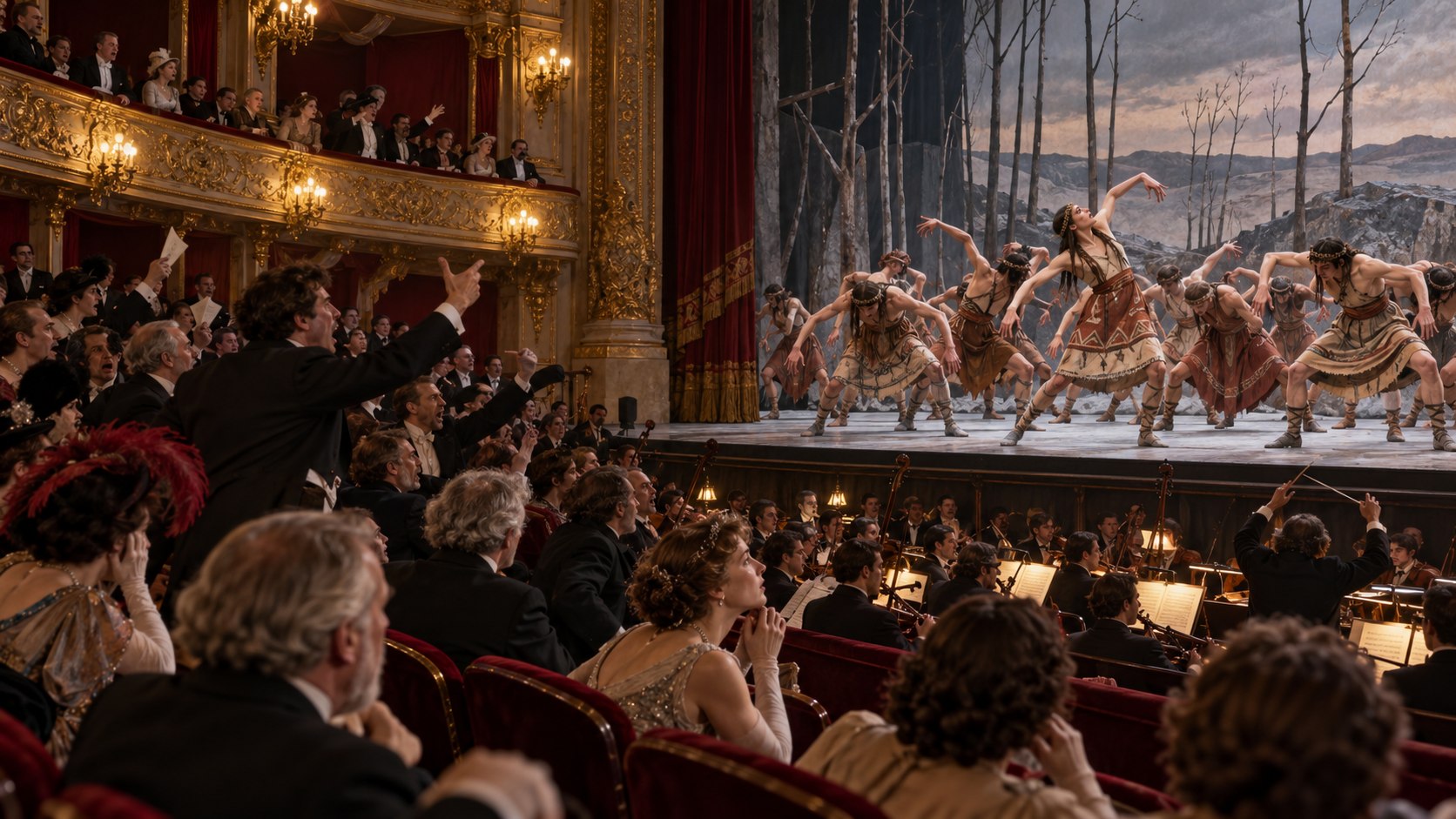
On May 29, 1913, Igor Stravinsky’s ballet The Rite of Spring premiered at the Théâtre des Champs-Élysées in Paris. Sergei Diaghilev’s Ballets Russes presented the work, with Vaslav Nijinsky’s choreography, Nicolas Roerich’s scenario and designs, and Pierre Monteux conducting. The score opens with a bassoon pushed into an unusually high register and proceeds through layered rhythms, sharp accents and blocks of orchestral sound. Onstage, turned-in feet, heavy jumps and group formations rejected the graceful line many spectators expected from ballet. Noise from laughter, argument and protest became so intense that dancers struggled to hear the orchestra and Nijinsky shouted counts from the wings. The event entered cultural memory as a riot, though accounts differ about the scale and causes of the disturbance.
The ballet depicts imagined rituals in pagan Russia culminating in a chosen young woman’s sacrificial dance. Roerich’s archaeological and folkloric interests shaped the scenario and visual world, while Stravinsky transformed collected or remembered folk materials through radical orchestration and rhythm. The audience reaction was not simply a judgment on the music; choreography, social factions, anticipation around the Ballets Russes and behavior inside a fashionable new theater all contributed. Later retellings sometimes exaggerate physical violence or portray a clean battle between conservatives and modernists. Surviving testimony is inconsistent, so the safest conclusion is that the premiere was genuinely disruptive without assuming every legendary detail. The orchestra continued under Monteux, and the performance reached its end.
The Rite of Spring quickly moved into the concert hall, where listeners could encounter the score without the original staging, and it became one of the twentieth century’s most influential compositions. Choreographers repeatedly created new versions, while its rhythmic force reached film scores, jazz, rock and modern dance. Disney’s Fantasia introduced the music to a mass audience through a prehistoric sequence that differed from the ballet’s human ritual. May 29 matters because the premiere shows modernism as a live social event rather than an abstract style label. Musicians, dancers and spectators confronted unfamiliar rules in the same room, and their noisy disagreement became part of the work’s history. Its continuing power lies not in repeating the scandal but in the score’s capacity to make pulse, weight and orchestral color feel physically new. The original choreography was later reconstructed from notes, drawings, photographs and memory, underscoring how performance can disappear even when a score survives. Every revival must decide whether to recover the first staging or create a new physical answer to the music.
The premiere occurred at the Théâtre des Champs-Élysées on May 29, 1913.
Stravinsky composed, Nijinsky choreographed, Roerich designed and Monteux conducted.
Audience noise disrupted communication between dancers and orchestra.
Accounts differ on how violent the legendary riot actually became.
Concert performances soon established the score apart from the original choreography.
The work profoundly influenced composition, dance, film and later popular music.
Explore more of "On This Day ..."
Discover more events from the same date across news, politics, technology, sports, and other fields. Each link highlights significant moments that shaped history on different fronts.