

On This Day in Pop: June 21, 1948
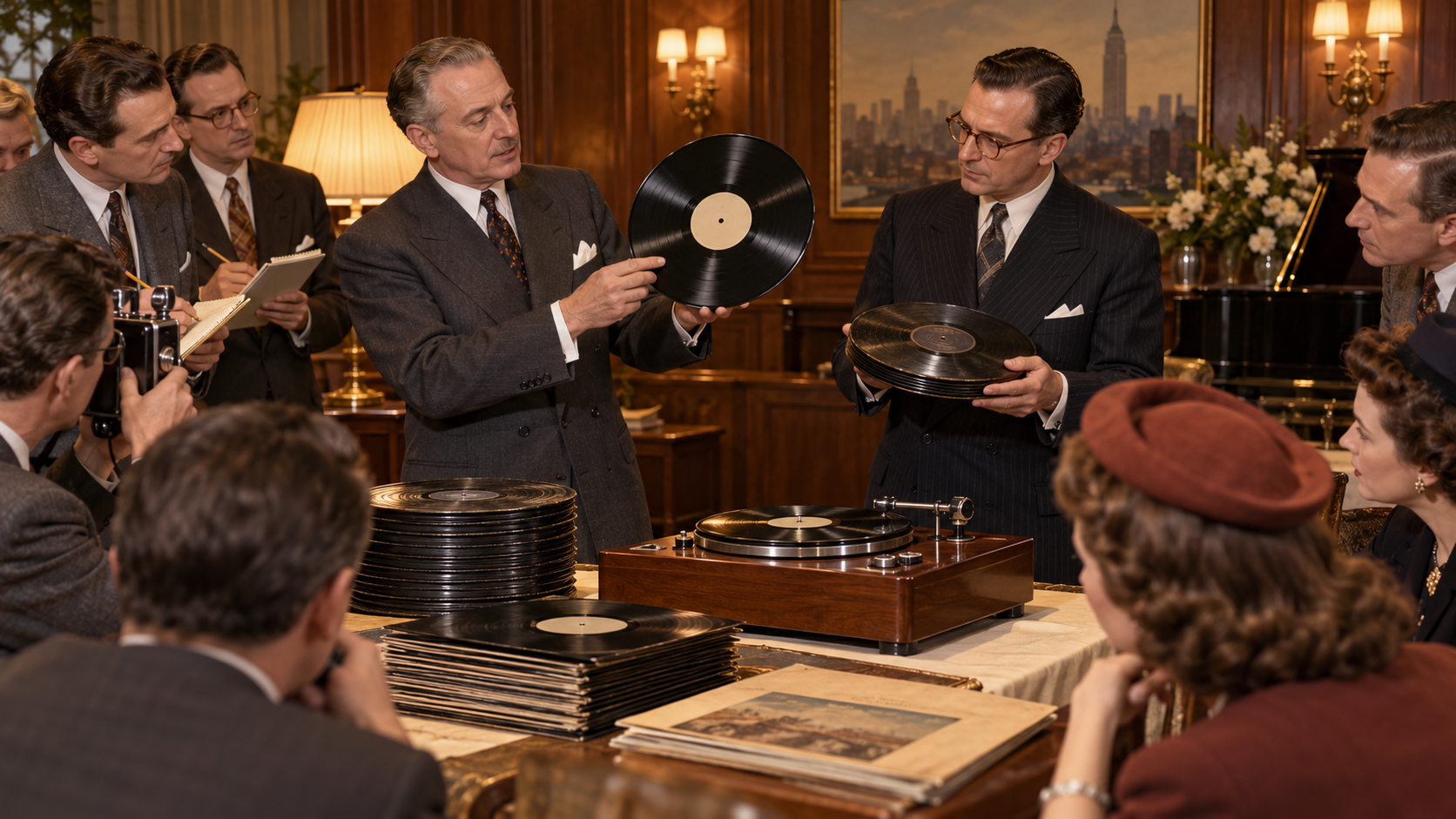
On June 21, 1948, Columbia Records introduced its new long-playing microgroove record at a press event in New York. Developed under Peter Goldmark’s leadership, the vinyl disc rotated at 33⅓ revolutions per minute and could hold roughly twenty minutes of music on each side. Earlier commercial records commonly spun at 78 rpm, were made from brittle shellac and required multiple discs for a symphony or extended work. Columbia’s LP used narrower grooves and slower speed to place a complete movement—or much of an album—on a lighter, quieter surface. The first catalog centered on classical music, where uninterrupted playing time solved an obvious problem, and the initial release program included hundreds of titles prepared for the new format.
The introduction mattered because format changes alter art as well as storage. A listener no longer had to rise every few minutes to change a disc, and composers, conductors and record producers could think in longer arcs. Sleeves gained more visual space than 78 albums, encouraging cover design, liner notes and a stronger sense of the record as a curated object. The LP also made home libraries easier to build and helped establish the album as the prestige unit of recorded music. RCA initially answered with the smaller 45 rpm single, producing a brief format contest before players capable of handling multiple speeds made the two systems complementary: albums for extended listening, singles for individual songs and jukeboxes.
Over the following decades, the LP shaped classical, jazz, folk, rock and spoken-word culture. Musicians planned sequences around two sides, critics reviewed albums as coherent works, and listeners learned the ritual of lowering a stylus, turning a record and studying its sleeve. Cassettes, compact discs and streaming later displaced vinyl’s dominance, but each successor inherited the album concept the LP had strengthened. Vinyl’s twenty-first-century revival showed that physical limitation can become part of value; people returned for large artwork, deliberate listening and the tactile evidence of ownership. The June 21 demonstration therefore did more than unveil better engineering. It created a practical span of time—about forty minutes across two sides—in which generations of artists would learn to make a world.
Remembering columbia introduces the modern long-playing record on June 21 is valuable because anniversaries turn a familiar cultural object back into a specific decision, release or broadcast. The surrounding technology, business and audience conditions explain why the moment could happen then, while its later uses show that meaning never stops changing. Seen at that scale, the date is not trivia. It is a checkpoint between creation and memory: a place to separate what occurred from the legend accumulated around it and to ask why the work still attracts attention.
Columbia introduced its 33⅓ rpm microgroove long-playing record in New York on June 21, 1948.
The moment reached audiences through the media and distribution systems of 1948, influencing how the initial response developed.
The vinyl format offered much longer playing time and greater durability than brittle 78 rpm shellac discs.
Its early impact was substantial but not universal, and later retellings sometimes compressed a more complicated contemporary response.
The LP helped establish the album as a coherent artistic and commercial form across many genres.
Anniversary coverage continues to place The LP Spins Forward within the broader history of popular culture while distinguishing documented evidence from later legend.
Explore more of "On This Day ..."
Discover more events from the same date across news, politics, technology, sports, and other fields. Each link highlights significant moments that shaped history on different fronts.