

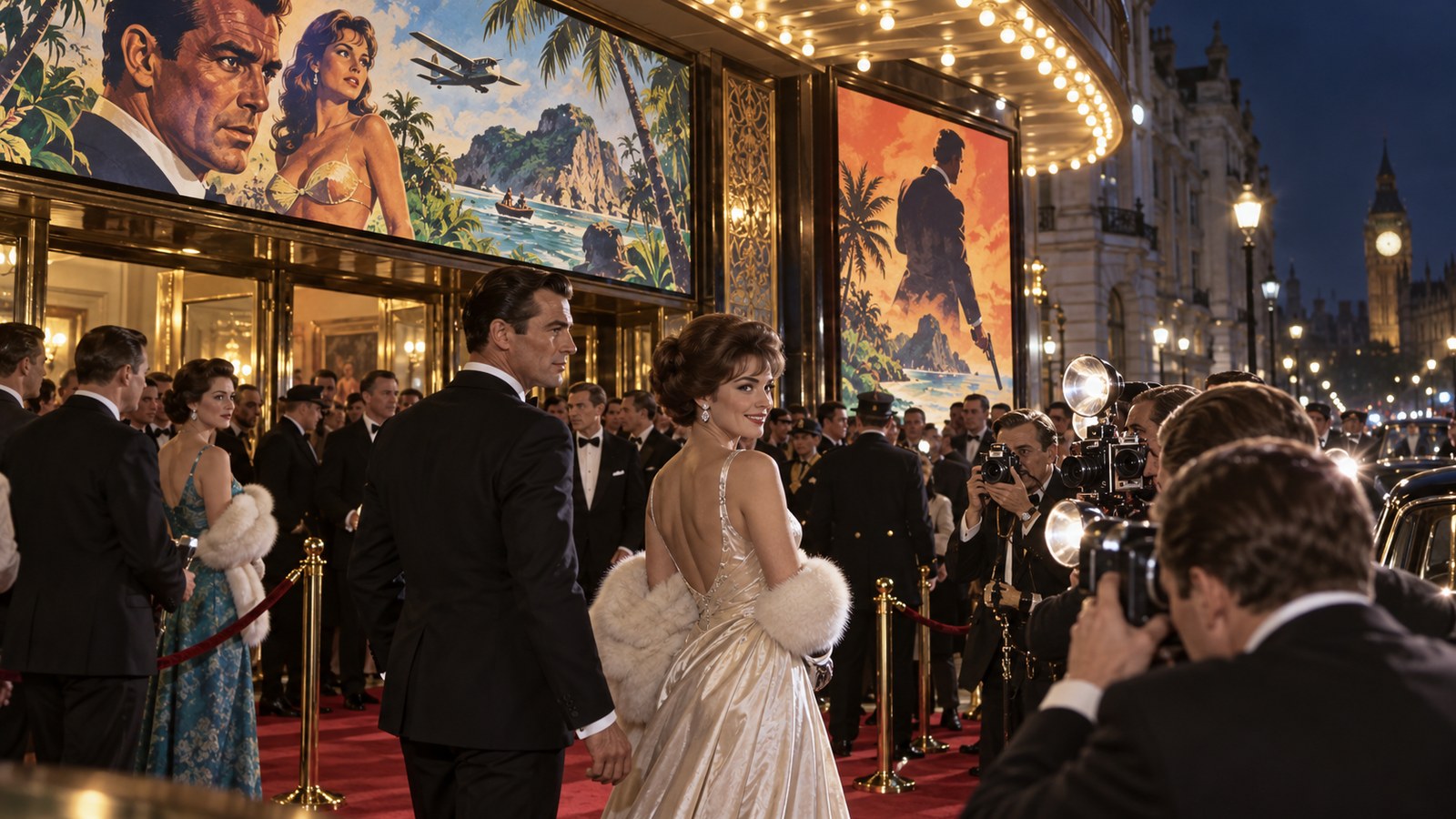
On This Day in Pop: October 5, 1962
On October 5, 1962, Dr. No opened in British cinemas and introduced James Bond to feature films. Sean Connery’s Bond traveled from London to Jamaica, combining investigation, violence, glamour and dry humor in a story adapted from Ian Fleming’s novel. Ursula Andress’s arrival from the sea became one of the film’s defining images. Producers Albert R. Broccoli and Harry Saltzman assembled a modestly budgeted production with director Terence Young, designer Ken Adam and composer Monty Norman. Their choices established motifs, attitudes and a visual confidence that later installments expanded. The date captures the event before later reputation made its consequences look inevitable, when audiences encountered a new release, performance or institution with only the expectations available at the time.
The release tested whether Fleming’s Cold War spy could work as a continuing screen character. Its mixture of danger, travel, technology and sexual display created excitement while also fixing gender and colonial assumptions that later films would inherit and contest. Popular culture is never made by a famous name alone. Writers, performers, producers, technicians, broadcasters, retailers, venues and audiences shape what becomes visible and what survives. Their collaboration also determines which experiments reach the public and which disappear before they can build momentum. Looking at those conditions turns an anniversary from a list entry into a record of choices, limits and competing interests.
Strong ticket sales led quickly to From Russia with Love and a durable international series. Connery’s performance shaped popular expectations for screen spies, influencing both serious thrillers and comic imitations. That afterlife matters because influence does not move in a straight line. Reruns, reissues, new technology, criticism and community memory can change the meaning of a work long after its first appearance. Durable pop history therefore holds creative achievement beside questions of labor, access, power and representation.
The opening is remembered less as a self-contained film than as the launch of a cinematic grammar: the gun-barrel image, stylized credits, exotic locations and controlled entrance of a hero who appears to know the room before anyone else. Returning to this October date means separating what participants knew then from what later audiences added. Recordings, photographs, broadcasts and recollections keep the moment active, but they also select and reshape it. That distinction protects against hindsight: a chart position, premiere, publication, concert or opening may become a neat milestone later, but the people present still faced uncertainty. Reading the moment in both directions—through its original conditions and its accumulated meanings—keeps celebration from replacing history. The distance between the immediate event and its continuing interpretation is what makes this episode worth revisiting.
Dr. No opened in the United Kingdom on October 5, 1962.
On October 5, 1962, Dr. No opened in British cinemas and introduced James Bond to feature films.
Sean Connery played James Bond.
The release tested whether Fleming's Cold War spy could work as a continuing screen character. Its mixture of danger, travel, technology and sexual display created excitement while also fixing gender and colonial assumptions that later films would inherit and contest.
It was the first feature in the long-running Eon Productions series.
Strong ticket sales led quickly to From Russia with Love and a durable international series. Connery's performance shaped popular expectations for screen spies, influencing both serious thrillers and comic imitations.
Explore more of "On This Day ..."
Discover more events from the same date across news, politics, technology, sports, and other fields. Each link highlights significant moments that shaped history on different fronts.