

On This Day in Pop: October 20, 1973
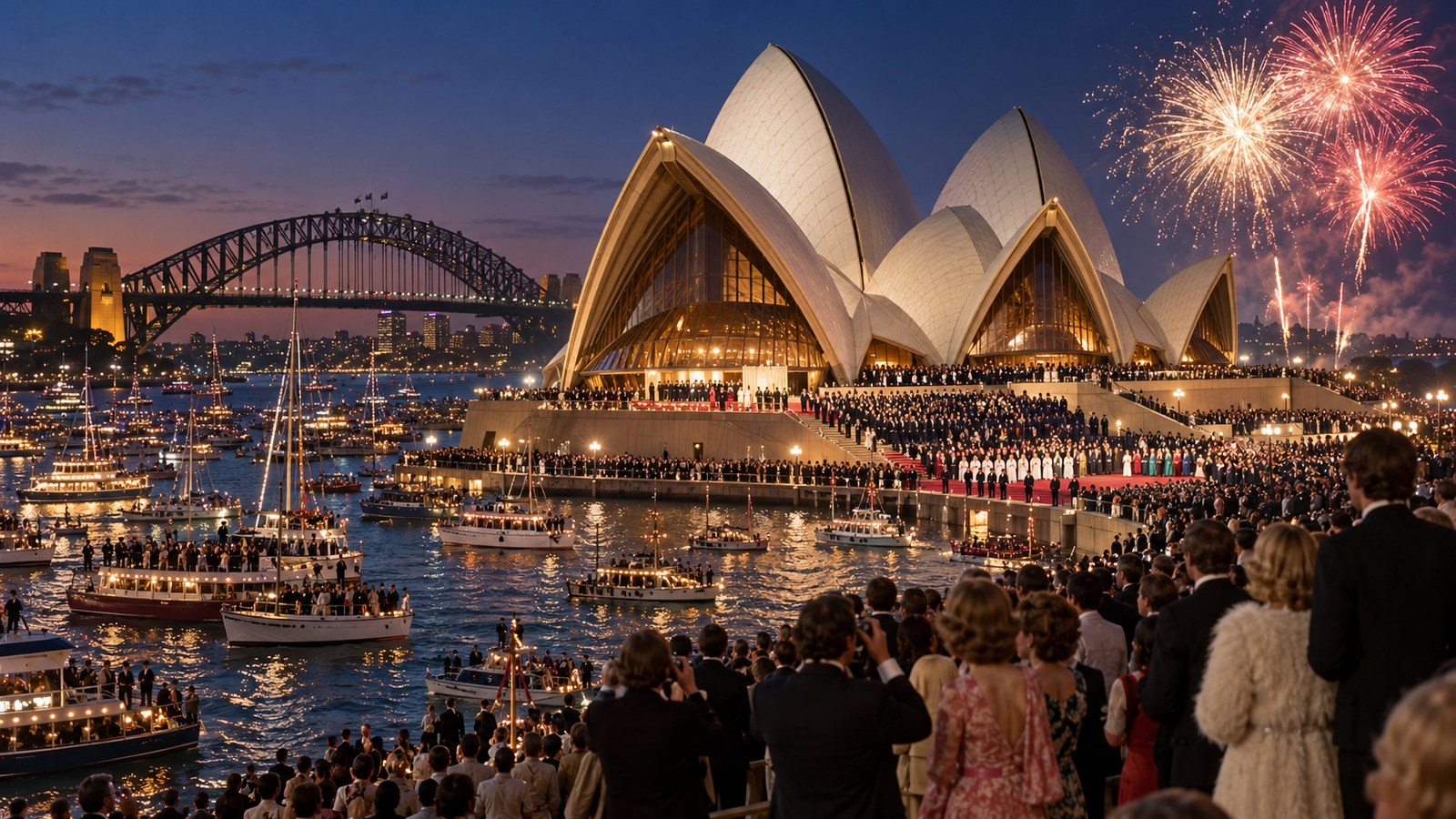
On October 20, 1973, Queen Elizabeth II formally opened the Sydney Opera House. Crowds gathered at Bennelong Point as ceremonies, music and fireworks introduced the shell-roofed complex to the public. The building joined multiple performance halls beneath forms that immediately changed the image of Sydney Harbour. Danish architect Jørn Utzon won the international design competition, but engineering difficulty, cost conflict and political change led him to leave Australia before completion. Peter Hall and a local team finished the interiors under altered plans. The date captures the event before later reputation made its consequences look inevitable, when audiences encountered a new release, performance or institution with only the expectations available at the time.
The opening celebrated a national landmark while exposing how major cultural projects distribute credit and power. Architecture itself became popular spectacle, capable of drawing people who might never attend an opera. Popular culture is never made by a famous name alone. Writers, performers, producers, technicians, broadcasters, retailers, venues and audiences shape what becomes visible and what survives. Their collaboration also determines which experiments reach the public and which disappear before they can build momentum. Looking at those conditions turns an anniversary from a list entry into a record of choices, limits and competing interests.
The complex developed a broad program of music, theater, dance and public events and later received UNESCO World Heritage status. Relations with Utzon were eventually repaired through design-principle work and later alterations. That afterlife matters because influence does not move in a straight line. Reruns, reissues, new technology, criticism and community memory can change the meaning of a work long after its first appearance. Durable pop history therefore holds creative achievement beside questions of labor, access, power and representation.
The date marks the transformation of a contested construction site into a civic stage. Its silhouette demonstrates how a performing-arts building can become both working venue and global visual symbol. Returning to this October date means separating what participants knew then from what later audiences added. Recordings, photographs, broadcasts and recollections keep the moment active, but they also select and reshape it. That distinction protects against hindsight: a chart position, premiere, publication, concert or opening may become a neat milestone later, but the people present still faced uncertainty. Reading the moment in both directions—through its original conditions and its accumulated meanings—keeps celebration from replacing history. The distance between the immediate event and its continuing interpretation is what makes this episode worth revisiting.
The Sydney Opera House formally opened on October 20, 1973.
On October 20, 1973, Queen Elizabeth II formally opened the Sydney Opera House. Crowds gathered at Bennelong Point as ceremonies, music and fireworks introduced the shell-roofed complex to the public.
Jørn Utzon created the winning design.
The opening celebrated a national landmark while exposing how major cultural projects distribute credit and power. Architecture itself became popular spectacle, capable of drawing people who might never attend an opera.
The building stands on Bennelong Point in Sydney Harbour.
The complex developed a broad program of music, theater, dance and public events and later received UNESCO World Heritage status. Relations with Utzon were eventually repaired through design-principle work and later alterations.
Explore more of "On This Day ..."
Discover more events from the same date across news, politics, technology, sports, and other fields. Each link highlights significant moments that shaped history on different fronts.