

On This Day in Science: January 6, 1912
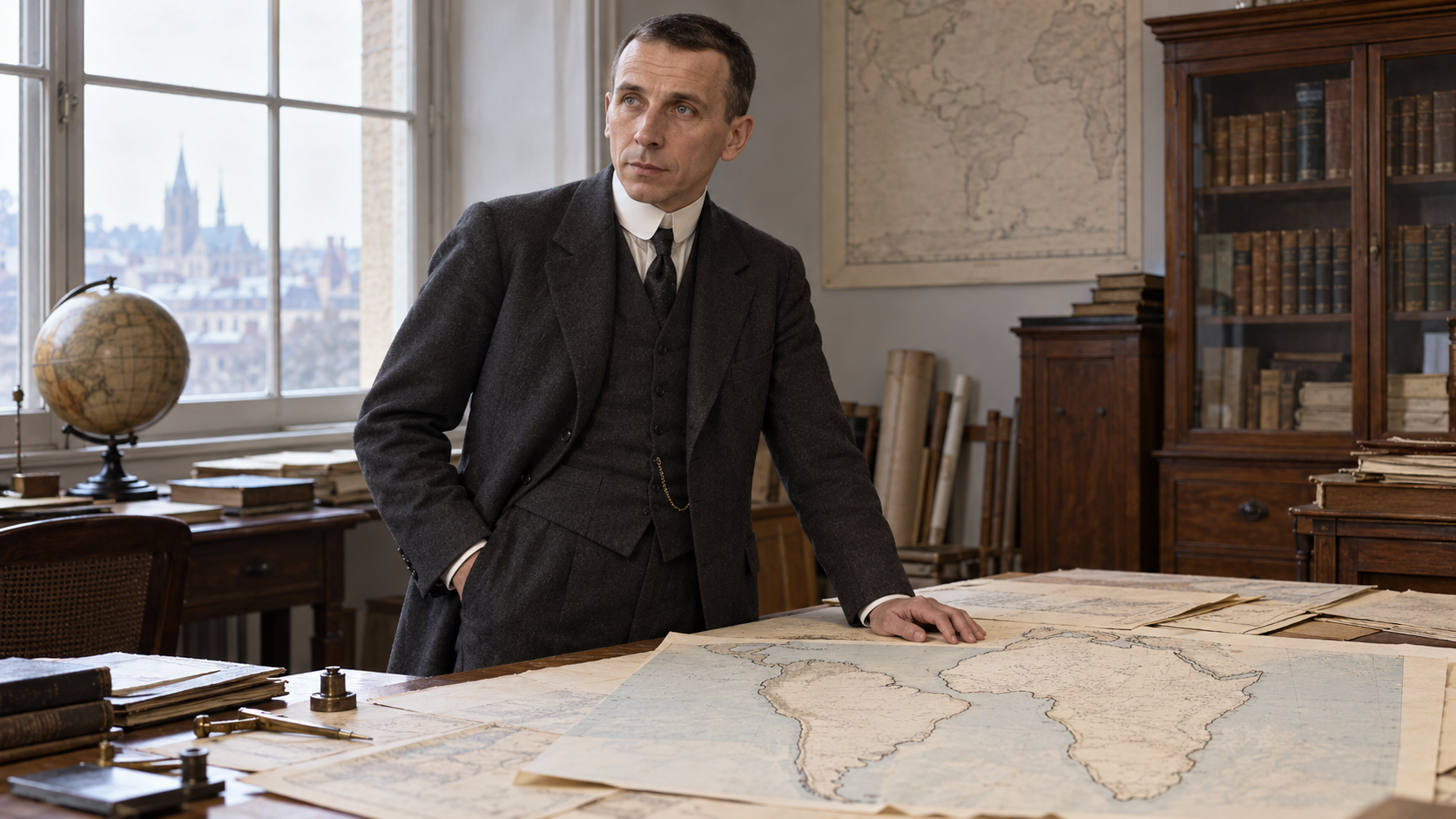
On January 6, 1912, Alfred Wegener presented his ideas about moving continents at the annual meeting of the Geological Association in Frankfurt, Germany. Wegener was a 31-year-old meteorologist and lecturer in cosmic physics at the University of Marburg, not an established geologist. In his talk on the formation of continents and oceans, he argued that the arrangement of Earth’s surface had changed over geological time. Continents now separated by wide oceans, he proposed, had once been joined and later drifted apart. The claim challenged the common view that continents and ocean basins were permanent features fixed in place as Earth cooled.
Wegener drew together evidence from several sciences. The opposing coastlines of South America and Africa appeared to fit, but shape alone was not his case. Similar fossils occurred in rocks now divided by oceans, geological formations continued from one continent to another, and traces of ancient climates appeared in places where modern conditions could not explain them. These patterns made more sense, he believed, if landmasses had once formed a larger whole. Wegener developed the argument in papers during 1912 and in his 1915 book, The Origin of Continents and Oceans, eventually using the name Pangaea for the ancient supercontinent.
The proposal faced serious weaknesses. Wegener could not provide a convincing physical mechanism powerful enough to move continents through the ocean floor, and some of the forces he suggested were far too small. Many geologists also distrusted a synthesis offered by a researcher from outside their field. His maps and reconstructions contained uncertainties, and continental drift did not immediately explain the full behavior of Earth’s crust. Rejection was therefore not based only on conservatism; the theory lacked the mechanism and global measurements required for a complete account. Wegener continued revising the idea but died during a Greenland expedition in 1930, decades before decisive evidence emerged.
Mid-20th-century discoveries transformed the debate. Mapping revealed mountain chains and trenches on the seafloor, paleomagnetic patterns recorded the movement of crust, and seafloor spreading supplied a mechanism for creating and recycling oceanic plates. By the late 1960s, plate tectonics united those findings into a theory broader and more precise than Wegener’s original drift proposal. His January 6 presentation did not contain the modern answer, but it framed the essential historical question correctly: continents are not fixed. Wegener’s achievement was to recognize a large pattern across many kinds of evidence and insist that Earth’s surface has a dynamic history.
Matching coastlines were only a starting point; fossils, rock belts, and ancient climate indicators supplied independent lines of evidence across separated continents.
His interdisciplinary approach was unusual because it combined geography, geology, paleontology, and climatology into one historical explanation.
Wegener lacked a physically adequate mechanism for moving continents, and several forces he proposed could not produce the required motion.
Without detailed seafloor maps or global geophysical data, his reconstruction remained provocative but incomplete.
Later evidence from paleomagnetism, ocean-floor mapping, and seafloor spreading showed that Earth's crust is divided into moving plates.
Modern plate tectonics surpassed Wegener's model while confirming its central insight that continents change position over geological time.
Explore more of "On This Day ..."
Discover more events from the same date across news, politics, technology, sports, and other fields. Each link highlights significant moments that shaped history on different fronts.