

On This Day in Science: January 13, 1888
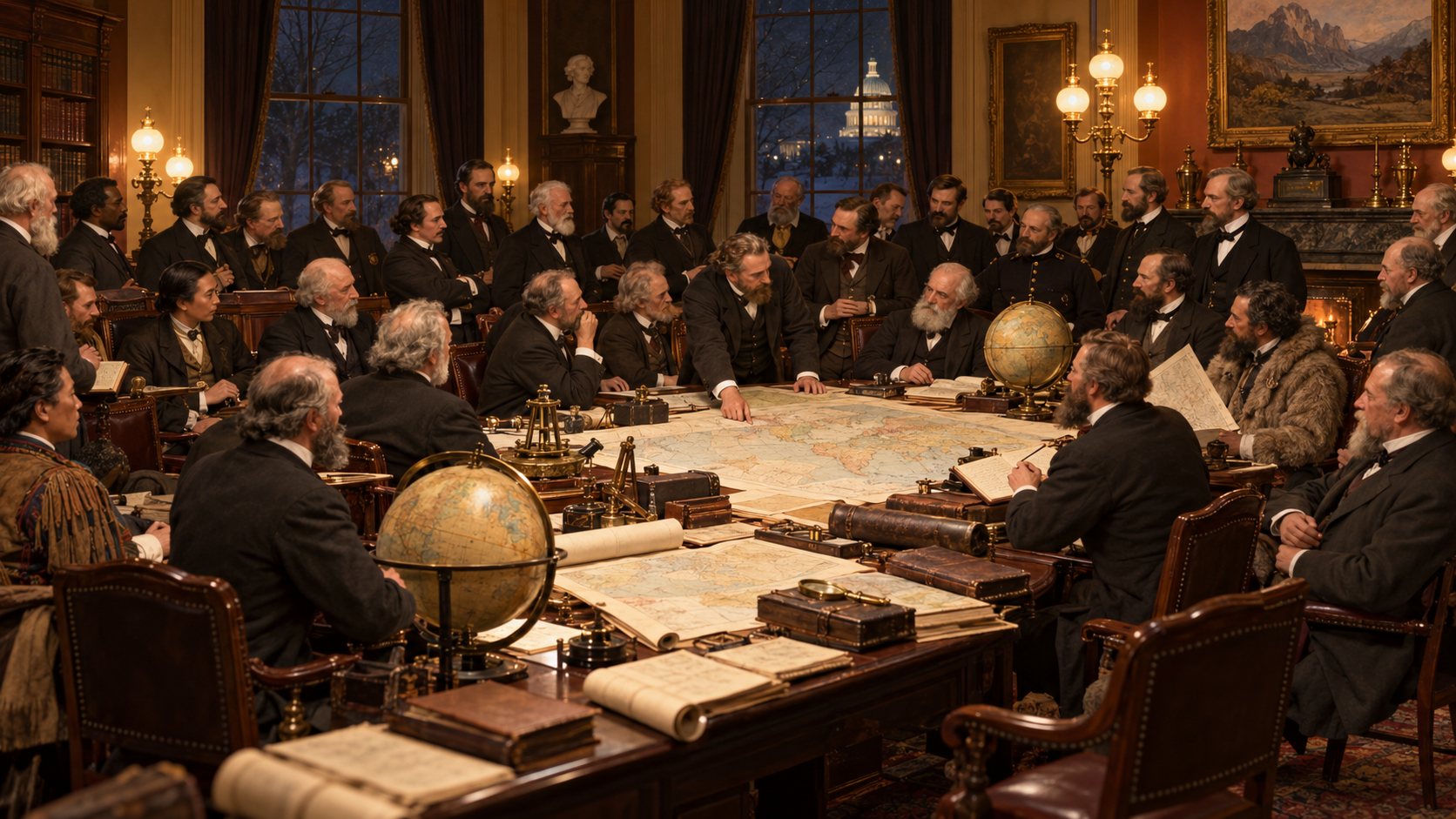
On January 13, 1888, thirty-three scientists, explorers, cartographers, teachers, and public officials met at the Cosmos Club in Washington, D.C., to organize a new institution devoted to geography. The gathering included specialists from the U.S. Geological Survey, Coast and Geodetic Survey, Army, Navy, Smithsonian Institution, and universities. They proposed a society for the increase and diffusion of geographic knowledge, a phrase that described both research and public communication. Gardiner Greene Hubbard became its first president, and the National Geographic Society was formally incorporated later that month.
Geography at the time encompassed far more than drawing maps. It brought together geology, surveying, meteorology, biology, anthropology, navigation, and the study of human settlement. The founders wanted a forum where people working across those fields could exchange results and support exploration. The first issue of National Geographic Magazine appeared in October 1888 as a sober scientific journal sent to members. Its early pages carried reports, maps, and proceedings rather than the richly illustrated storytelling that would later define the publication.
The Society’s reach expanded as printing technology, photography, and a growing membership changed how geographic information could be presented. Under later leadership, the magazine used maps and field photography to connect distant environments with a broad audience. The organization also supported expeditions and research, though its history reflects the assumptions and unequal power of the eras in which it worked. Earlier coverage sometimes treated communities through colonial or racial stereotypes. Recognizing those limits is part of understanding how scientific institutions shape public knowledge as well as collect it.
The January 13 meeting created an enduring bridge between field science and popular education. Geographic work still depends on measurement, observation, and maps, but it now includes satellite data, conservation, climate research, archaeology, and community knowledge. The Society’s best-known products changed enormously from the technical journal imagined in 1888, yet the founders’ central problem remains current: discoveries have little public value if they are not communicated clearly and responsibly. Their winter gathering in Washington helped make geography a shared account of Earth’s places, processes, and people rather than a specialty confined to survey offices. The institution’s history also demonstrates that communication is not neutral: choices about who maps, who is photographed, and who speaks can shape public understanding as strongly as the measurements themselves. Modern geographic work increasingly includes collaboration with communities whose knowledge and land appear on those maps. That practice broadens both evidence and accountability.
The 33 founders represented surveys, museums, the military, universities, and exploration, reflecting geography's broad scientific scope.
Their shared institution was designed to connect specialists who otherwise worked in separate agencies and disciplines.
The first magazine was a technical membership publication filled with reports and maps rather than modern photo essays.
Photography, color printing, and a larger audience later transformed it into a powerful form of science communication.
The Society supported research and widened interest in the world, while some historical coverage reproduced colonial and racial assumptions.
Examining both achievements and limitations helps modern science communication become more accurate, inclusive, and accountable.
Explore more of "On This Day ..."
Discover more events from the same date across news, politics, technology, sports, and other fields. Each link highlights significant moments that shaped history on different fronts.