

On This Day in Science: January 17, 1912
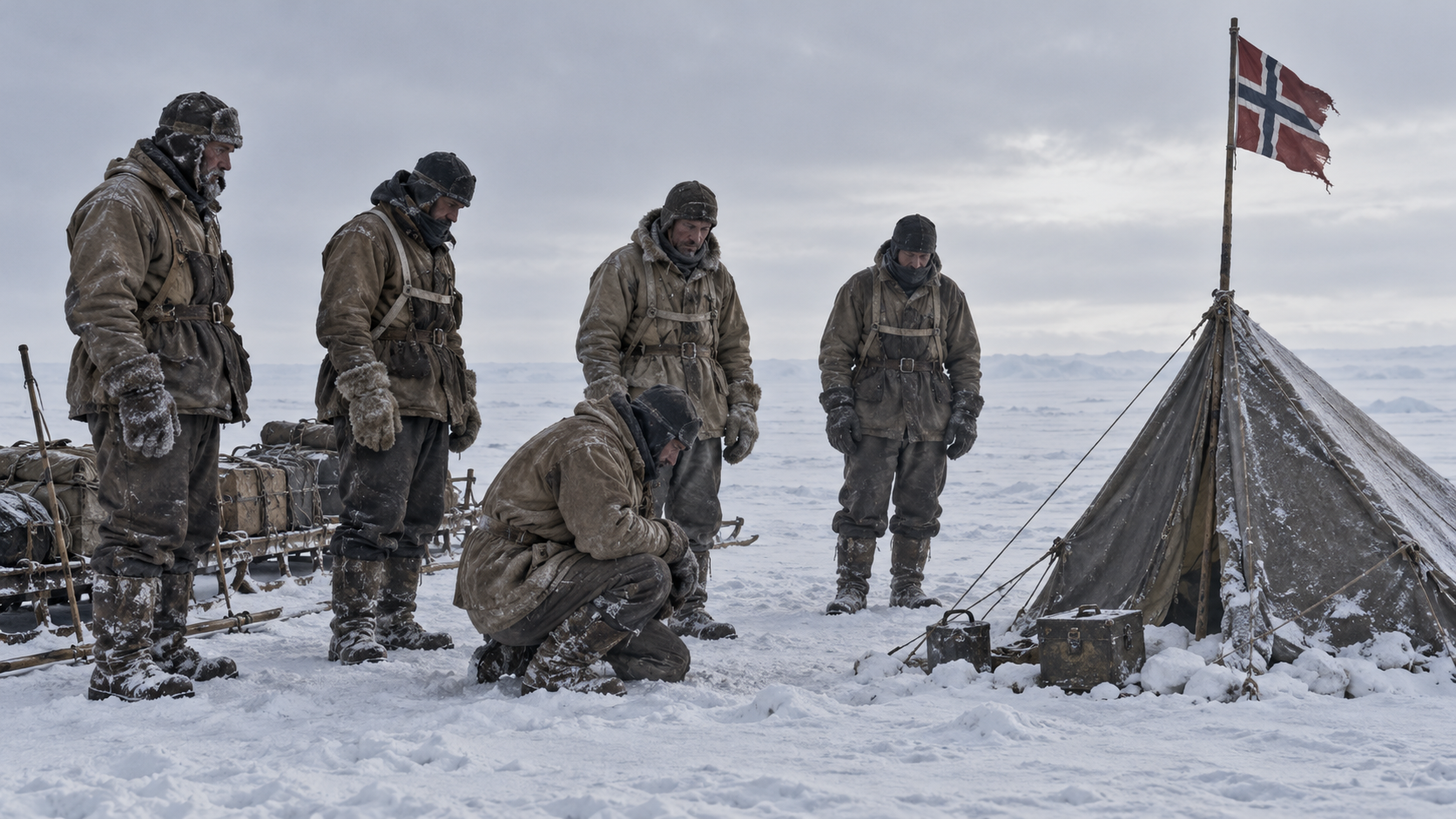
On January 17, 1912, Robert Falcon Scott, Edward Wilson, Henry Bowers, Lawrence Oates, and Edgar Evans reached the geographic South Pole after hauling sledges across the Antarctic plateau. There they found the tent and flag left by Roald Amundsen’s Norwegian party, which had arrived thirty-four days earlier. Scott recorded the disappointment in his journal, but the British team still spent two days making observations, taking photographs, and confirming its position. The moment was one stage of the larger Terra Nova Expedition, a program that combined exploration with geology, meteorology, biology, magnetism, and mapping.
The route from the expedition base at Cape Evans crossed the Ross Ice Shelf, climbed the Beardmore Glacier, and continued over high, cold terrain. Scott’s transport plan mixed motor sledges, ponies, dogs, and human hauling, but the polar party ultimately depended on its own labor. Amundsen used a different route and a tightly focused dog-sledge strategy. The contrast is often simplified into a race, yet Scott’s expedition supported multiple field teams and a broad scientific agenda. Wilson, the party’s physician and naturalist, continued observations during the polar journey, and the men collected rock specimens on the return.
None of the five reached safety. Evans died after injuries and physical decline; Oates, suffering severe frostbite, left the tent in an attempt to improve the others’ chances; Scott, Wilson, and Bowers died during a storm in late March, about 18 kilometers from a supply depot. A search party found their tent, journals, records, and geological samples in November. The loss must not be turned into a simple tale of heroic inevitability. Decisions about transport, nutrition, timing, weather, and depot placement all became subjects of historical analysis, while the party’s measured notes provide direct evidence of conditions and judgment under extreme stress.
The expedition’s scientific legacy extends beyond the polar tragedy. Its teams gathered extensive specimens and environmental records, and the rocks carried from the Beardmore Glacier included fossils that helped document Antarctica’s warmer geological past and connection to other continents. Modern Antarctic research uses aircraft, satellites, heated stations, and international logistics, but still depends on careful field records and respect for environmental limits. January 17 is therefore both an exploration milestone and a sober scientific anniversary: five people reached a precisely defined point, recorded what they found, and continued collecting knowledge even as their prospects worsened. Their records are strongest when read alongside Norwegian accounts, support-party journals, weather data, and modern analysis rather than as a single national legend.
The Terra Nova Expedition pursued a broad research program in geology, weather, biology, magnetism, and mapping.
The polar journey captured public attention, but many teams worked across Antarctica and produced lasting collections and records.
Exhaustion, injury, frostbite, weather, fuel and food limits, and logistical decisions combined during the long return route.
Historians examine those factors rather than treating the deaths as unavoidable or reducing them to a single mistake.
The final party hauled geological specimens even while weakening, including fossils important to reconstructing Antarctica's past.
Their journals and observations remain primary records of an expedition that joined ambitious research with severe human risk.
Explore more of "On This Day ..."
Discover more events from the same date across news, politics, technology, sports, and other fields. Each link highlights significant moments that shaped history on different fronts.