

On This Day in Science: February 7, 1984
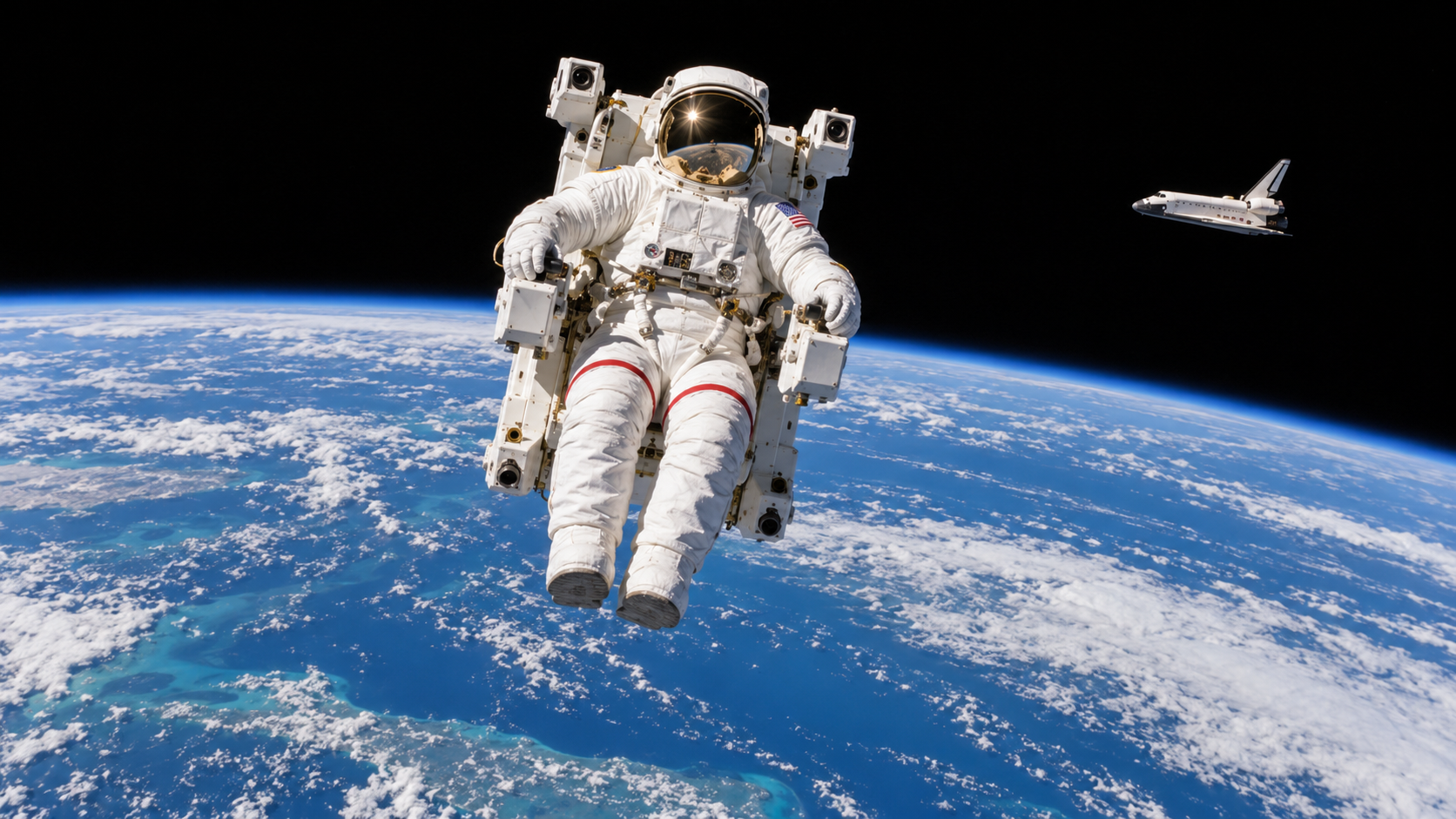
On February 7, 1984, astronaut Bruce McCandless II left the payload bay of Space Shuttle Challenger and flew free of the spacecraft without a safety tether. Wearing a nitrogen-propelled Manned Maneuvering Unit, or MMU, he moved about ninety meters from the orbiter during mission STS-41B. The backpack’s hand controllers let him translate and rotate in three dimensions while small thrusters made carefully measured corrections. A photograph of McCandless suspended against the blue curve of Earth became an enduring image of human spaceflight, but the excursion was a controlled engineering test rather than a leap into the unknown.
The MMU surrounded the life-support backpack of the spacesuit and carried twenty-four nitrogen thrusters. Its design descended from maneuvering concepts tested inside Skylab and in ground simulators. McCandless had worked on the system for years, including procedures that emphasized slow rates, visual references, and fuel awareness. Astronaut Robert Stewart also flew an MMU during the mission. Both remained in communication with the shuttle and could return by commanding gentle pulses, demonstrating that an astronaut could maneuver independently around a large spacecraft.
Untethered mobility was intended for practical work. Later in 1984, astronauts used MMUs to reach and retrieve two malfunctioning communications satellites so they could be returned to Earth. The capability suggested ways to inspect vehicles, capture objects, and support assembly beyond the reach of a robotic arm. It also carried obvious risk: a suit or propulsion failure could leave a crewmember separated from the shuttle. Operations therefore depended on redundant systems, conservative paths, rehearsed responses, and a vehicle positioned to support the spacewalker.
NASA retired the MMU after only a small number of shuttle missions as safety policy and robotic capabilities evolved. Modern astronauts normally remain tethered during spacewalks and carry a smaller emergency rescue device called SAFER. McCandless’s flight nevertheless remains a milestone in personal spacecraft design. It showed that a person enclosed in a suit could become a precisely controlled free-flying vehicle. The famous photograph conveys solitude, yet the event was profoundly collective: engineers, trainers, controllers, shuttle crewmates, and years of incremental tests made those few untethered minutes possible. The anniversary also highlights the difference between a first result and a finished understanding. A successful observation can settle one question while opening several harder ones, and even a failed objective can return measurements that reshape later designs. Preserved data, specimens, photographs, and hardware allow new generations to revisit the work with better tools. Science advances through that continuity, where a specific date marks progress without pretending that inquiry stopped there.
Bruce McCandless traveled away from the shuttle without a tether while testing the Manned Maneuvering Unit.
Robert Stewart also flew the device during STS-41B, confirming its independent control in orbit.
Twenty-four nitrogen thrusters provided translation and rotation through hand controllers.
The system was designed around slow motion, fuel discipline, redundant hardware, and carefully rehearsed return paths.
MMUs later helped astronauts retrieve satellites, but NASA eventually ended routine use of the larger units.
Today's spacewalkers stay tethered and carry compact SAFER backpacks for emergency self-rescue.
Explore more of "On This Day ..."
Discover more events from the same date across news, politics, technology, sports, and other fields. Each link highlights significant moments that shaped history on different fronts.