

On This Day in Science: February 15, 2013
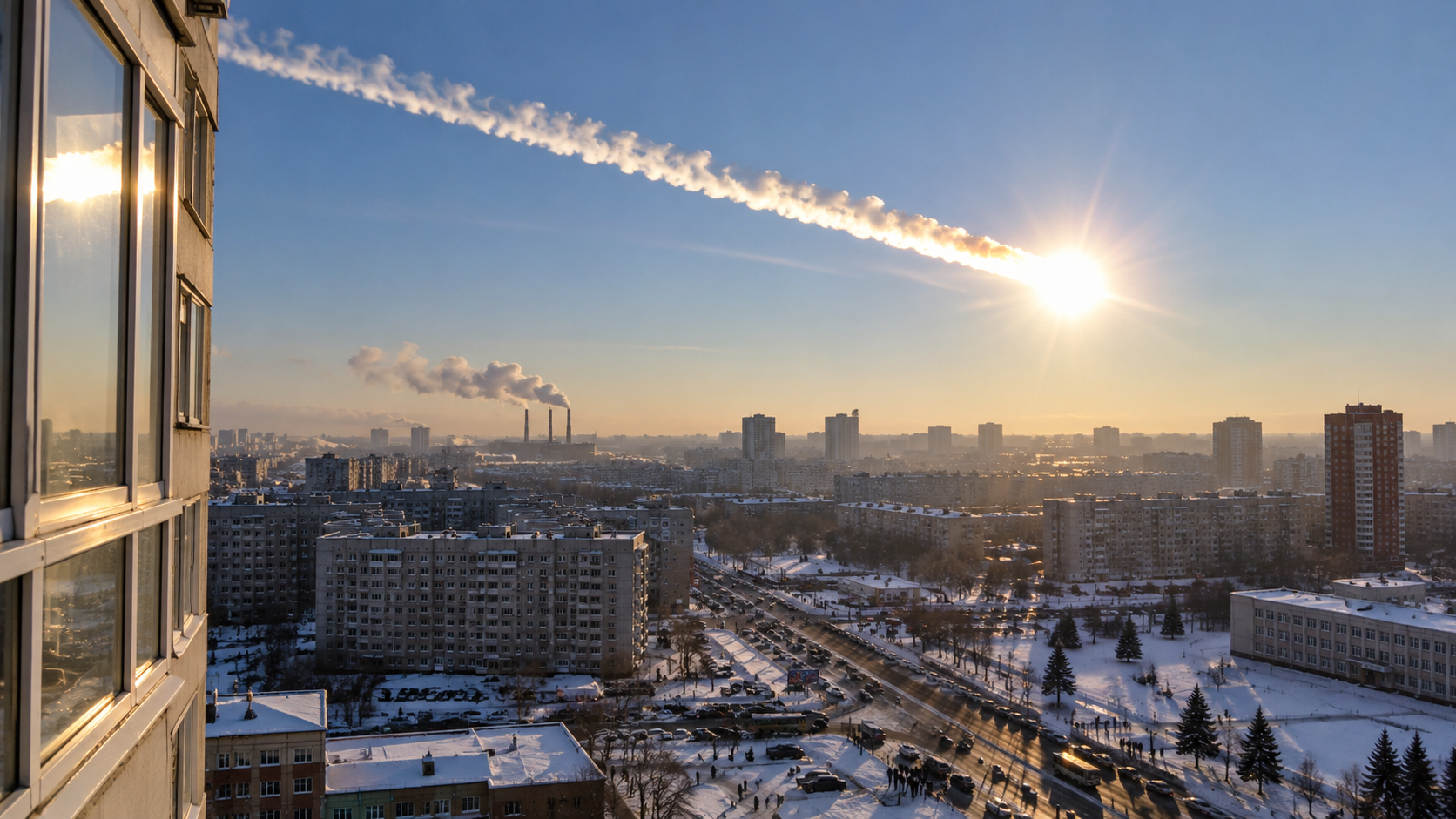
On the morning of February 15, 2013, a small asteroid entered Earth’s atmosphere over the southern Ural region of Russia and became a brilliant fireball. Traveling at roughly nineteen kilometers per second, the object crossed the sky near Chelyabinsk brighter than the Sun. Increasing aerodynamic pressure fractured it high in the atmosphere, releasing energy in an airburst rather than leaving a single large impact crater. The flash and long luminous trail were captured by security cameras, dashcams, satellites, and residents across a wide area.
The damaging shock wave arrived after the light. Windows shattered in thousands of buildings, doors and roofs were damaged, and more than a thousand people sought medical care, many for cuts caused by flying glass. The delay reflected the different speeds of light and sound, but people drawn to windows by the flash had little reason to expect a pressure wave. A fragment later recovered from Lake Chebarkul helped researchers identify the asteroid as an ordinary chondrite, while atmospheric and seismic records refined estimates of its size and energy.
Scientists concluded that the original body was about twenty meters across, large enough to cause regional damage but too small and too close to the direction of the Sun to have been detected before arrival by surveys operating at the time. Coincidentally, the much larger asteroid 2012 DA14 passed safely near Earth later that day; orbital analysis showed that the two events were unrelated. Chelyabinsk therefore revealed a gap between familiar extinction-scale scenarios and the more frequent population of smaller objects capable of destructive airbursts.
The event accelerated work on asteroid detection, impact modeling, warning, and public guidance. Telescopes have since improved their searches, while planetary-defense programs test how observations can determine an object’s orbit quickly enough for useful decisions. No system can see every small body, especially from the daylight sky, but better coverage can increase warning time and clarify likely effects. Chelyabinsk’s scientific importance rests alongside the human consequences. It showed that planetary defense includes not only distant spacecraft missions but practical communication: after a sudden flash, understanding that a shock wave may follow can itself reduce injury. The anniversary also highlights the difference between a first result and a finished understanding. A successful observation can settle one question while opening several harder ones, and even a failed objective can return measurements that reshape later designs. Preserved data, specimens, photographs, and hardware allow new generations to revisit the work with better tools. Science advances through that continuity, where a specific date marks progress without pretending that inquiry stopped there.
A roughly twenty-meter asteroid entered at extreme speed and fragmented high above the Chelyabinsk region.
The atmospheric explosion released far more energy than the pieces that ultimately reached the ground.
The bright flash arrived before the slower shock wave, drawing some observers toward windows.
Shattered glass caused many of the reported injuries across the city and surrounding communities.
The asteroid approached from near the Sun's direction and had not been detected before it entered the atmosphere.
The event sharpened efforts to find smaller near-Earth objects and communicate airburst hazards.
Explore more of "On This Day ..."
Discover more events from the same date across news, politics, technology, sports, and other fields. Each link highlights significant moments that shaped history on different fronts.